



0808
Personal Philosophy: What is Your Truth & Stance for Living?
A long time ago, in a provincial town far, far away… There was a wealthy, cynical landowner named Fyodor Pavlovitch Kara [...]
Discover a list of 20 timeless Japanese philosophies of life – plus how these ancient wisdoms can massively enrich your daily routine!
My fascination with Japan began not with giant robots or fantastical anime worlds (though those certainly have their charm). Instead, I found myself drawn to the quieter, more introspective aspects of the country’s culture – the subtle art of flower arranging, the reverence for nature, the emphasis on harmony. While friends discussed the latest manga releases, I was more captivated by Japanese philosophies, from the serene beauty of Wabi-sabi to the resilient spirit of Gaman. These concepts have resonated with me on a deeply personal level, offering alternative perspectives that feel particularly relevant in today’s fast-paced world.
Highlights
This section delves into the unique Japanese perspective on beauty, exploring concepts that find elegance in imperfection, transience, and the natural world. From the rustic simplicity of wabi-sabi to the artful mending of kintsugi, these principles offer a profound appreciation for the subtle beauty that surrounds us, inviting us to see the world with fresh eyes.
A concept rooted in Zen Buddhism and the Japanese tea ceremony (chanoyu – 茶の湯), Wabi-sabi (侘寂) encourages one to find beauty in the imperfect and transient aspects of the world. The term is derived from two separate words:
What it emphasizes:
In today’s fast-paced, technology-driven world, where we are constantly bombarded with images of perfection and novelty, the concept of wabi-sabi offers a refreshing and much-needed counterpoint. It reminds us to slow down, be grateful for what we have, declutter our surroundings, connect with nature, and live more sustainably.
Examples of how to apply in real life:
The flow of river is ceaseless and its water is never the same.
(Yuku kawa no nagare wa taezushite, shikamo moto no mizu ni arazu – ゆく河の流れは絶えずして、しかももとの水にあらず)
Kamo no Chomei
Japanese philosophy beauty in imperfection
Kintsugi (金継ぎ), also known as Kintsukuroi (金繕い), is the Japanese art of mending broken pottery with lacquer dusted or mixed with powdered gold, silver, or platinum. The term is made up of two parts:
Thus, it literally translates to “gold joining” or “gold repair.” The technique is believed to have originated in the late 15th century during the Muromachi period. Legend has it that when the shōgun Ashikaga Yoshimasa broke his favorite tea bowl and sent it back to China for repairs, it was returned with unsightly metal staples. This prompted Japanese craftsmen to seek a more aesthetically pleasing method of repair.
What it emphasizes:
Given that today’s society is so obsessed with newness, perfection, and disposability, the concept of Kintsugi serves as a reminder that it is our “breaks” (personal struggles, setbacks, and traumas) that shape who we are and add to our character. Repairing and restoring is more sustainable and meaningful than simply discarding and replacing.
Examples of how to apply in real life:
Rain makes the ground firm.
(Ame futte ji katamaru – 雨降って地固まる)
Japanese aesthetics
The term “Mono no aware” (物の哀れ) is comprised of two words:
As such, it can be translated as “an empathy toward things,” or “a sensitivity to ephemera.” It speaks to a deep awareness of the impermanence of all things, coupled with a gentle wistfulness at their passing. More than just simple sadness, it involves a poignant appreciation of the fleeting nature of beauty and life.
While the concept has roots in ancient Japanese literature, it gained prominence during the Edo period, particularly through the works of the prominent literary figure Motoori Norinaga. The philosophy is closely tied to several key aspects of Japanese culture and thought, including:
Change has always been a constant in the world. Even in the midst of transition and loss, one may still find significance in their daily existence and demonstrate compassion to others. Rather than constantly chasing after the next thing, we need to take a step back from time to time to reflect and be mindful of the moment.
Examples of how to apply in real life:
The best flower is the cherry blossom; the best man is the warrior.
(Hana wa sakuragi, hito wa bushi – 花は桜木、人は武士)
Japanese philosophies
Ichi-go ichi-e (一期一会) is a Japanese idiom that translates to “one time, one meeting.” It encapsulates the idea that every moment, every encounter, is unique and will never be replicated exactly in the same way again. As such, one should cherish each moment as if it were a once-in-a-lifetime opportunity.
The term is often attributed to the tea master Sen no Rikyū, who promoted the importance of mindfulness and presence in the tea ceremony. Each tea gathering, with its specific combination of people, setting, and circumstances, was considered a unique and unrepeatable event.
What it emphasizes:
Examples of how to apply in real life:
Today’s enemy is tomorrow’s friend.
(Kyō no teki wa, ashita no tomo – 今日の敵は、明日の友)
Miyamoto Musashi
Japanese concepts of life
In Japanese culture, maintaining harmonious relationships and showing consideration for others are paramount. Below is a list of philosophies that promote empathy, respect, and selfless service, fostering a deep understanding of interconnectedness and the importance of contributing to a peaceful and cooperative society.
The Kanji character for Nagomi (和) is the same one used for “wa,” which represents harmony and peace in a broader sense – a state of concord and balance. While the concept has existed for centuries, the specific term “nagomi” has gained more widespread recognition in recent times as a way to describe this desired state of being.
What it emphasizes:
Examples of how to apply in real life:
Harmony is to be valued.
(Wa wo motte tattoshi to nasu – 和を以て貴しと為す)
Prince Shōtoku, Seventeen-article Constitution
Japanese philosophies
Omoiyari (思いやり) is a very interesting term in that it is made up of two components:
So basically, its literal meaning is “to extend one’s thoughts” or “to give one’s feelings” to others. Increasingly recognized as a key aspect of Japanese culture and social interaction, Omoiyari goes beyond simply being polite; it involves deeply considering the feelings, needs, and circumstances of others and acting accordingly.
What it emphasizes:
The philosophy is deeply ingrained in Japanese culture and is reflected in various aspects of life:
In today’s increasingly individualistic world, qualities such as empathy and compassion have become crucial more than ever. The concept of Omoiyari serves as a stark reminder of why we need to foster a sense of community and contribute to a more inclusive society.
Examples of how to apply in real life:
Kindness is not for the sake of others.
(Nasake wa hito no tame narazu – 情けは人の為ならず)
Japanese philosophies
Read more: Platinum Rule vs Golden Rule – How the Principles of Empathy Have Shifted
A unique concept of hospitality that goes far beyond simply providing good service, Omotenashi encompasses a spirit of selflessness – when one anticipates the needs of guests before they are even expressed and provides a truly personalized and memorable experience. Often described as “serving from the heart” or “wholehearted hospitality”, it is something that permeates various aspects of Japanese culture, from customer service to personal interactions.
The prevalence of the capitalist mindset these days – which typically places a stronger emphasis on profit over value – is a reason why everything we do often feels transactional and impersonal. Concepts such as Omotenashi serve to remind us of the importance of human connection, genuine care, and sincere communication. More than just a way for businesses to gain a competitive edge, serving people from the heart is crucial for enriching one’s personal life and ensuring a harmonious society.
Examples of how to apply in real life:
If a fish cares for water, the water will care for the fish.
(Uogokoroareba mizugokoro – 魚心あれば水心)
Japanese philosophies
Oubaitori (桜梅桃李) is a Japanese proverb made up of 4 Kanji characters, each referring to a type of tree that blossoms in spring:
Just as these trees have different blossoms and fruits, each individual comes with their own talents, strengths, and characteristics. Instead of comparing oneself to others, one should embrace their uniqueness and celebrate the diverse beauty of the world.
While admitting the importance of individuality, Oubaitori doesn’t promote individualism in a Western sense. Rather, its core message is to recognize and respect individual differences within a harmonious social context.
What it emphasizes:
It is a sad truth that comparison and competition have become the norm nowadays due to the impact of news and social media. No wonder why countless people are subjected to unnecessary stress and anxiety. As such, we need to remind ourselves to shift our perspectives and celebrate differences.
Examples of how to apply in real life:
When three people meet, wisdom is exchanged.
(Sannin yoreba monju no chie – 三人寄れば文殊の知恵)
Japanese philosophies of life
From finding one’s purpose (ikigai) to dedicating oneself to a craft (kodawari), these principles offer a roadmap for personal development, encouraging us to strive for mastery in all aspects of life and to embrace the journey of lifelong learning.
The concept of Ikigai is often translated as “a reason for being”. Literally, it means “the worth of living” or “the value of being alive” (Iki/ 生き – Life, to live; Gai/ 甲斐 – Worth, value, or use). Despite its roots in traditional Japanese culture, the term gained wider recognition in the mid-20th century – it is typically associated with the longevity and happiness of people in Okinawa, known as a “blue zone” where people live exceptionally long and healthy lives.
Most Western studies visualize Ikigai as four overlapping circles:
The intersection of these four elements is considered your ikigai – your reason for getting up in the morning. As authors such as Ken Mogi have suggested, one may achieve it by working on the following pillars:
How to find your Ikigai:
Ask yourself this: What are the small things in the swamp of your mind that will carry you through a difficult patch? These are perhaps the elements you want to focus on and keep very present in your mind.
Ken Mogi
Ikigai Japanese philosophy
Read more: 82 Ikigai Quotes – Find Your Reason for Being
There isn’t a perfect single-word translation in English for the term Kodawari (こだわり), which is derived from the verb “kodawaru” (拘る – “to be particular about,” “to be fussy about,” or “to stick to something”). Generally speaking, one may think of it as referring to a strong adherence to one’s principles and a refusal to compromise on quality.
Kodawari encompasses a constant pursuit of perfection in something – often in a seemingly small or specific area. It can be described as an unwavering commitment to one’s craft, a meticulous attention to detail, and a personal standard of excellence that goes beyond mere functionality or efficiency. It’s about taking pride in one’s work and striving for the highest possible quality, even if it’s only noticed by oneself.
While kodawari is often associated with professional craftsmanship, its principles can be applied to various aspects of daily life:
Examples:
It’s worth reminding that Kodawari is not about being obsessive or perfectionistic in a negative way. Rather, it involves a deep commitment to excellence in whatever one does. It’s about finding joy and fulfillment in the process of creation and refinement.
Efforts will not betray you.
(Doryoku wa uragiranai – 努力は裏切らない)
Japanese philosophies
Hansei (反省) is a Japanese word that translates to self-reflection, introspection, or critical examination of oneself. The term is made up of two Kanji characters:
Therefore, hansei literally means “to turn back and examine” or “to reflect and inspect”. Originating from Confucianism and Buddhism, it has been integrated into multiple aspects of Japanese society, from education and personal development to business management and methodologies like Kaizen.
At its core, the focus is on continuous improvement through honest evaluation of one’s actions, performance, and contributions. It’s not simply about admitting mistakes, but also about deeply analyzing the reasons behind them.
What it emphasizes:
How to practice hansei:
Know yourself.
(Onore wo shire – 己を知れ)
Yamamoto Tsunetomo
Japanese philosophies
Read more: Understanding Yourself – Roadmap to a Deeper, More Authentic YOU
Shu-Ha-Ri (守破離) is a Japanese concept that describes the stages of learning to mastery, particularly in traditional arts like martial arts, tea ceremony, and calligraphy:
Shu (守) – Obeying the Rules:
Analogy: A student meticulously copying a master painter’s work to understand brushstrokes and composition.
Ha (破) – Breaking the Rules:
Analogy: The student painter begins to experiment with different color palettes and slightly alters the composition based on their own artistic vision.
Ri (離) – Transcending the Rules:
Analogy: The painter has developed their own distinct style, recognizable and unique, and can create original works of art without directly copying any previous masters.
Shu-Ha-Ri provides a valuable framework for learning and skill development in any field, even outside traditional Japanese arts. It emphasizes the importance of a strong foundation before attempting innovation – as well as of both learning from established knowledge and developing one’s own unique approach.
Examples of how to apply in real life:
When the student is ready, the teacher will appear. When the student is truly ready, the teacher will disappear.
Tao Te Ching
Japanese philosophies
While mainly used in martial arts, the term Shin-Gi-Tai (心技体) is actually applicable to many areas of life. It speaks to the importance of balance and harmony between three key elements:
These aspects are interconnected and interdependent. Neglecting any one of them will hinder overall performance and mastery.
True mastery, therefore, comes from developing all three aspects in harmony, creating a synergistic effect where the whole is greater than the sum of its parts.
While originating in martial arts, Shin-Gi-Tai has broader applications in various fields:
With hardships comes pleasure and pleasure comes hardships.
(Ku areba raku ari – 苦あれば楽あり)
Japanese philosophies
Literally meaning “change for the better”, Kaizen is a philosophy that promotes making small, incremental changes over time to achieve significant improvements in processes, efficiency, quality, safety, and other aspects of an organization or individual’s life. Its core message is simple: consistent small steps are more sustainable and effective than large, disruptive changes.
While the concept of continuous improvement has existed for a long time, the term “Kaizen” became widely recognized in the post-World War II era, particularly within Japanese manufacturing industries like Toyota. It played a crucial role in the country’s remarkable economic recovery and its rise to global manufacturing prominence.
Key principles:
Examples of how to apply in real life:
Overall, Kaizen is not a quick fix or a one-time solution. It’s a long-term practice that emphasizes continuous learning, adaptation, and improvement.
One step each day.
(Ichinichi ippo – 一日一歩)
Japanese business philosophies
Life inevitably presents challenges, and Japanese philosophy offers valuable tools for navigating adversity with grace and fortitude. This section delves into concepts like gaman (endurance) and shikata ga nai (acceptance), exploring how to cultivate resilience, find strength in difficult times, and accept what is beyond our control, allowing us to move forward with greater peace of mind.
Widely regarded as a catchphrase of Japanese, Ganbaru (頑張る) (“stand firm”) implies a sense of inner strength and determination to overcome obstacles. The concept has been present in the country’s culture for centuries, but its usage became more widespread and prominent in the post-World War II era, as Japan focused on rebuilding and economic growth. It then became a national ethos, encouraging hard work and dedication to contribute to the country’s recovery.
Ganbaru has several nuances that contribute to its rich meaning:
Even monkeys fall from trees.
(Saru mo ki kara ochiru – 猿も木から落ちる)
A key cultural value in Japan, Gaman emphasizes the importance of self-discipline and emotional restraint, particularly in challenging situations. It encourages individuals to endure hardship, pain, and frustration with Stoicism and dignity, without complaining or giving up.
Literal meaning:
While the individual characters might suggest negative connotations, in combination, “gaman” takes on a positive meaning: the ability to control one’s ego and impulses in the face of difficulties.
The concept has roots in Buddhist teachings about impermanence and the acceptance of suffering. Additionally, it has also been influenced by Confucian values – and is particularly prevalent during periods of hardship in Japanese history, such as wartime and natural disasters.
While Gaman is indeed an admirable virtue, it’s important to be aware of its nuances and potential drawbacks. In other words, one needs to distinguish between healthy endurance and suppressing necessary emotional expression – and to seek support when needed.
Fall down seven times, stand up eight.
(Nana korobi ya oki – 七転び八起き)
Japanese philosophies
Another concept that closely aligns with that of Gaman, Shikata ga nai (仕方がない) translates to “it cannot be helped,” “there’s nothing that can be done about it,” “it is what it is”. It expresses a sense of resignation to events or situations beyond one’s control – the willingness to admit reality and adapt to it.
The phrase is made up of three separate words:
In other words, its literal meaning is “there is no way [of doing something about it].” A lack of options or alternatives to change the situation.
On the surface, it may seem to represent a pessimistic, defeatist outlook; and yet, the phrase actually encompasses several nuances:
Examples of how to apply in real life:
Spilt water won’t go back into its tray.
(Fukusui bon ni kaerazu – 覆水盆に返らず)
Japanese philosophies on life
From practicing dietary restraints to avoiding wastefulness, the principles below encourage us to live with intention, appreciate the present, and tread lightly on the earth, promoting a sustainable and harmonious existence.
The verb “kiyomeru” (清める) comes from the adjective “kiyoi” (清い), meaning “pure,” “clean,” “clear,” or “undefiled.” The act of kiyomeru, therefore, is about restoring something to a state of purity – which can be both physical and spiritual.
The concept of purification has ancient origins in Japan, predating the arrival of Buddhism. Shinto, the indigenous religion of Japan, places great emphasis on purity and the need for ritual cleansing to maintain harmony with the natural world and the kami (spirits or deities). Buddhism further reinforced these ideas with its emphasis on purifying the mind and overcoming negative karmic influences.
While rooted in traditional beliefs, the concept of kiyomeru is still very relevant in modern life:
Don’t forget our original intention.
(Shoshin wasuru bekarazu – 初心忘るべからず)
Japanese philosophies
Hara hachi bu (腹八分) is a Japanese Confucian-inspired teaching that translates to “eat until you are eight parts (out of ten) full.” It’s a dietary practice that encourages one to stop eating when they are about 80% full, rather than completely stuffed.
What it emphasizes:
The practice is often cited as one of the reasons for the longevity of the Japanese population, particularly in Okinawa, a “blue zone” known for its high concentration of centenarians. More than just a dietary recommendation, it’s a cultural tradition that promotes mindful living and respect for one’s body.
How to practice:
One easy way to start applying the concept of hara hachi bu is to skip dessert. Or to reduce portion size. The idea is to still be a little bit hungry when you finish.
Hector Garcia Puigcerver
The word “mottainai” is derived from the Buddhist term “mottai” (勿体), which originally referred to the essence or inherent value of things, especially in a religious or spiritual context. The addition of “nai” (無い), meaning “not” or “there is not,” creates the expression “mottainai,” implying a loss or lack of that inherent value due to waste.
A deeply ingrained Japanese concept, Mottainai goes beyond simply acknowledging that something has been misspent; it conveys a feeling of deep remorse and a recognition of the inherent value of resources, objects, time, and even opportunities. It’s a call to appreciate and utilize things fully, avoiding unnecessary waste in all its forms.
The term is particularly relevant in today’s consumer-driven society, where waste is often rampant. It serves as a reminder of why one needs to adopt sustainable consumption habits, reduce environmental impact, and express appreciation for the resources they have.
Japanese environmental philosophy
How to practice:
I only feel angry when I see waste. When I see people throwing away things we could use.
Mother Teresa
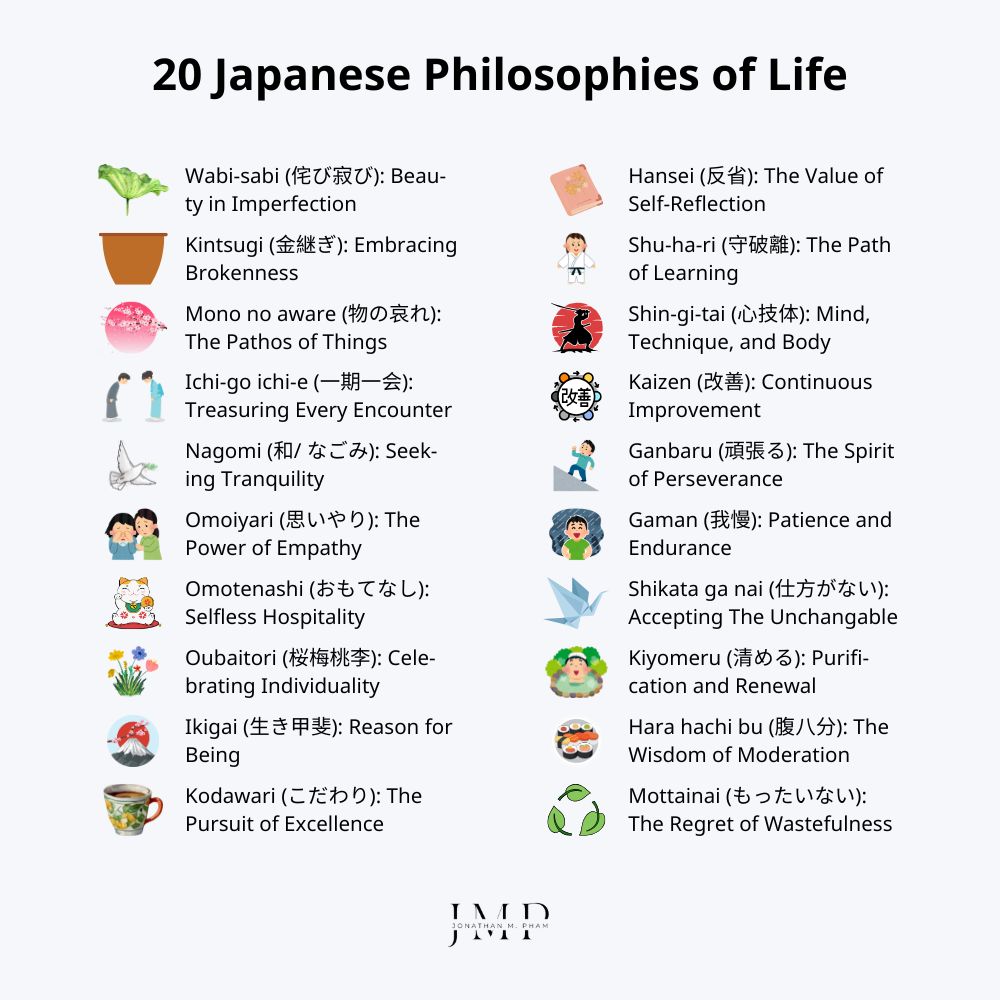
List of Japanese philosophies
From the quiet contemplation of Wabi-sabi to the unwavering strength of Gaman, exploring these Japanese philosophies has been more than just an intellectual exercise for me; it’s been a journey of personal reflection. These principles, with their ancient roots and enduring wisdom, offer practical frameworks for navigating the complexities of modern life. By embracing them, we can – as I have found myself doing – enrich our lives, foster deeper connections, and discover a greater sense of peace and fulfillment!
Further readings:
Other resources you might be interested in:

A long time ago, in a provincial town far, far away… There was a wealthy, cynical landowner named Fyodor Pavlovitch Kara [...]

Let us visit a fictional place: The Village of the Valley. Once upon a time, those who lived there were divided into two [...]

Has this ever happened to you? Let’s say you are suffering from a frustrating health issue, or stuck in a chaotic life d [...]