



0808
Personal Philosophy: What is Your Truth & Stance for Living?
A long time ago, in a provincial town far, far away… There was a wealthy, cynical landowner named Fyodor Pavlovitch Kara [...]
Learn how the practice of self-coaching may help you get unstuck, dissolve limiting beliefs, and find clarity on your personal journey.
Have you ever felt stuck, circling the same problem, wishing you had a wise friend or a coach/ mentor to help you?
For most of us, our tendency in times of confusion and uncertainty is to look outside of ourselves for that “aha!” moment of clarity.
While external wisdom is indeed invaluable, one of the most powerful and accessible guides for your growth is, and always has been, YOU yourself. In other words, you have the potential to become your own coach!
Does that sound a little… awkward? Not at all, I dare to say.
Self-coaching is a widely recognized and effective approach. It’s not about “hacking” your brain or forcing change involuntarily. Rather, the idea is to listen to yourself with the intent to understand, and from that understanding, find a way forward.
Highlights
Self-coaching is the practice of applying curiosity and compassion to yourself. It’s about creating the space to understand why you feel the way you do – and how your beliefs shape your reality.
Unlike passive journaling, where one simply records their own day, self-coaching is an active process of listening. It’s designed to help you bridge the gap between where you are and where your inner wisdom knows you can be.
The practice requires you to hold two roles at once:
As of this point, some may wonder: “Can I truly be objective enough to coach myself?”
The answer is a definitive yes, but we must first start by reframing the goal. Specifically, what we are aiming for is NOT perfect, sterile “objectivity” – but compassionate awareness.
You don’t need to be a cold, detached analyst. You simply need to be a kind observer.
Self-coaching is a learnable skill, not an innate talent. Its effectiveness relies on your ability to create a tiny pause between a feeling and your reaction to it.
By taking a small step back and asking gentle questions (which we’ll cover below), you create the mental space to see your own stories. You can’t see all your own blind spots – that’s the gift of community and external coaches – but you will surely be able to, over time, cultivate self-reliance and find your own center.

While self-coaching does have its use in professional life, its true power is personal. It is a foundational skill for one to live a more intentional, authentic life.
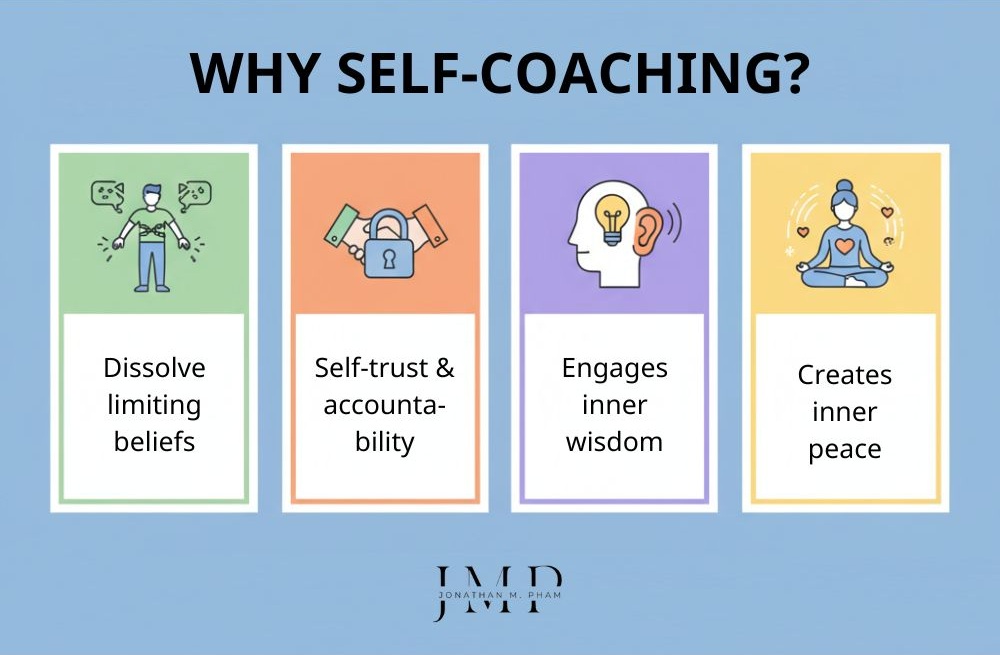
We all have old stories we frequently tell ourselves (“I’m not good enough,” “I’m not a creative person,” “I’m unlovable”). Self-coaching is the practice of bringing these stories into the light, examining them with kindness, and realizing they are just stories – not facts at all.
Example: You might hold the belief, “I always procrastinate on important things.” However, with self-coaching, you learn to become curious and ask yourself, “What thought leads to my procrastination? Is it ‘I have to do this perfectly’?”
Reframing your thoughts is key to cultivating adaptability and a growth mindset. As found out by research published in Frontiers in Psychology, self-coaching significantly reduces procrastination and improves goal attainment – precisely because it helps challenge rigid internal narratives. By dissolving these old stories, you become more flexible and open to new ways of being.
Every time you pause, observe your own feelings, and respond with understanding instead of judgment, you are teaching your inner self that it is safe to be honest with you.
Example: You feel a wave of social anxiety before a party. Instead of criticizing yourself (“I’m so awkward”) or forcing yourself to go (an act of self-abandonment), you pause to think: “I’m feeling anxious. That’s okay. What’s one thing I can do to feel 1% safer?” Maybe it’s deciding to stay for just one hour.
In doing so, you are essentially training yourself to become accountable to your own needs. As coaching expert Dr. Bethany Peters notes, this process fosters the confidence and clarity that are foundational to trusting oneself.
The practice allows you to untangle your own voice from the noise of the world. You stop waiting for someone else to give you the answer and start learning to listen to the wisdom you already hold.
This is the core of Emotional Intelligence (EQ). It’s the ability to reflect on one’s own thinking (metacognition) and identify one’s authentic feelings. Over time, the practice strengthens the ability to rise above all the external static.
Example: You’re facing a career choice. The “noise” is what you should do (e.g., “take the job with the better title”). With self-coaching, however, you quiet that noise and ask, “What do I truly value? What path aligns with my desire for peace, not just prestige?”
So much of our suffering comes from arguing with reality. The practice of self-coaching makes it easier to separate the neutral facts of your life from the painful stories you’ve layered on top of them – so that you may finally find peace.
Example: You get stuck in a long traffic jam. The fact is, “I am in a car, and it is not moving quickly.” The story is, “This is a nightmare! My whole day is ruined! I’m always so unlucky!” That story is exactly what creates the suffering; all you need to stop the misery is to take a breath, and let it go.
You’re still in traffic, but you’re no longer at war with reality.
Read more: Life Management – How to Design a Life You Love
The power of self-coaching
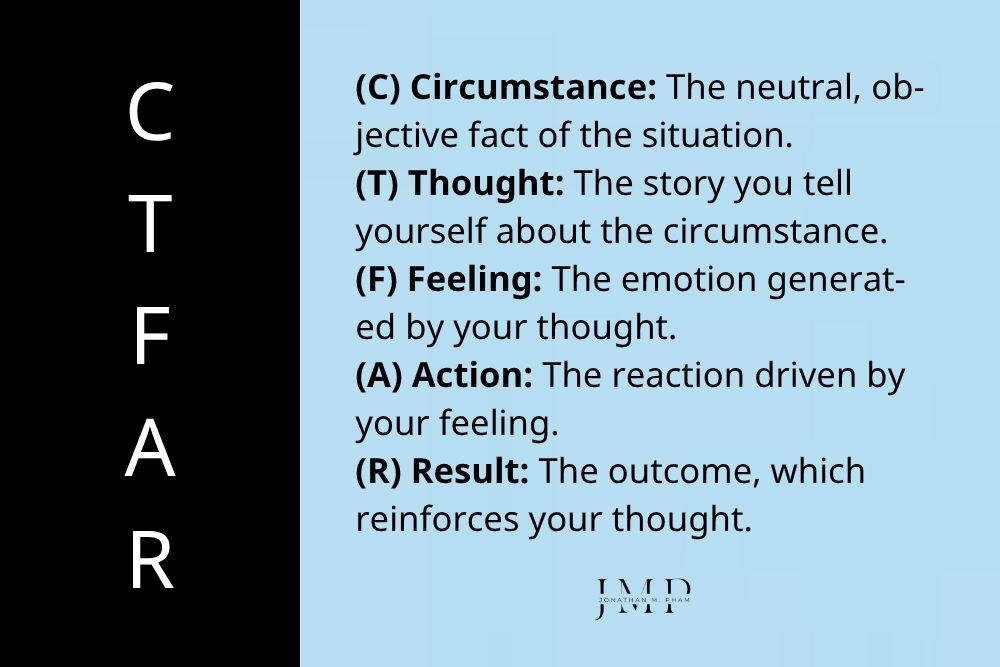
To deconstruct our experiences, we can leverage a simple framework – the CTFAR model, popularized by master coach Brooke Castillo. It proposes that every moment in our life follows this five-step chain:
What is needed for self-coaching
Let’s look at how the model applies to a real-life example.
(C) Circumstance: A colleague received a promotion you applied for. (This is a neutral fact).
(T) Thought (The Story): “This proves I’m not valued and I’ll never get ahead here.”
(F) Feeling (The Emotion): Demotivated, resentful, and small.
(A) Action (The Reaction): You emotionally disengage from your work, stop speaking up in meetings, and avoid your manager.
(R) Result (The Outcome): You feel unseen and unvalued, which proves your original thought, “I’m not valued,” true to yourself.
Do you see it? The circumstance (losing the promotion) didn’t directly create the result (feeling unseen). The story about the circumstance was the real engine of the entire cycle!
Read more: Law of Attraction – What You Think, You Become!
Let’s revisit that same scenario: (C) = My colleague received the promotion.
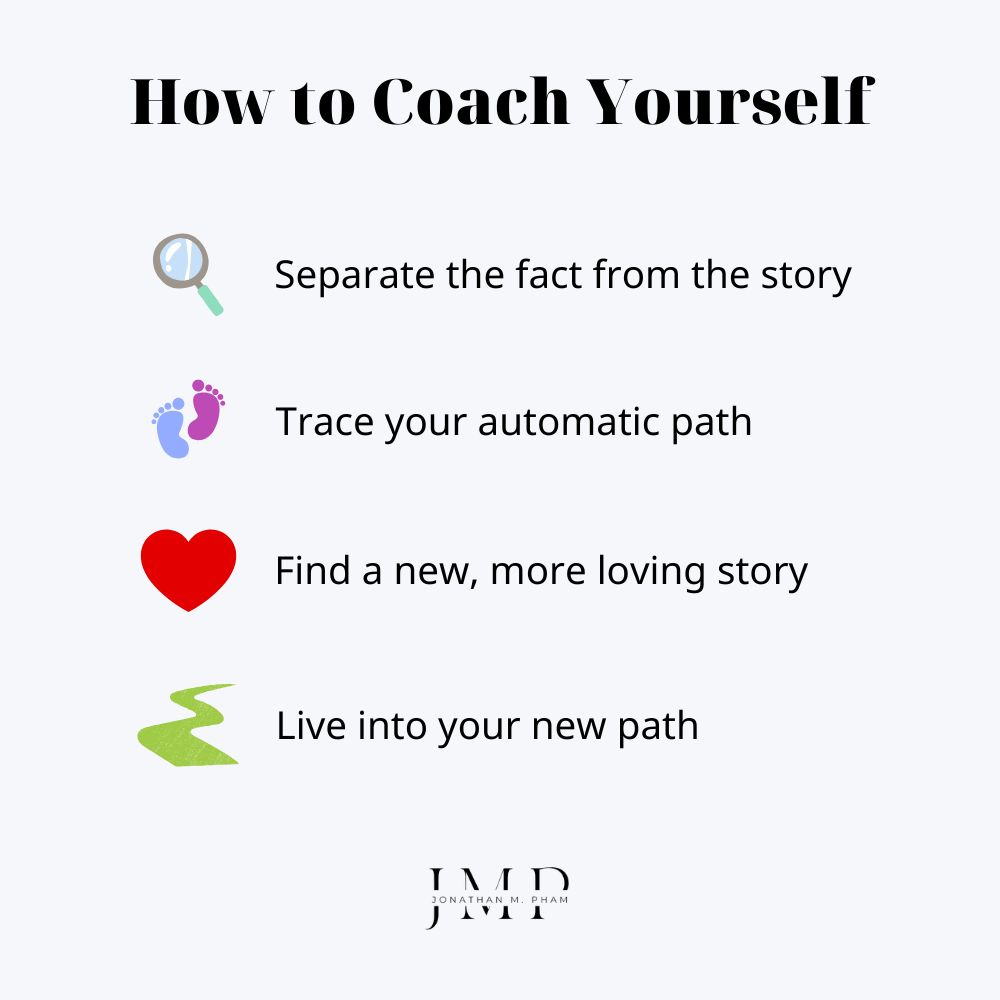
Most of our pain comes from treating our stories as facts. As such, the first step is to make a clear distinction between the two of them.
How-to: Take a piece of paper. On one side, write the Fact in a single, objective sentence. (e.g., “X was given the new role.”). On the other, write down all the Stories you are telling yourself. (e.g., “This is unfair,” “They never see my work,” “I’ll be stuck here forever,” “This is proof I’m not good enough.”). This separation alone is enough to create immediate relief.
Before you can change, you must understand. Look at the story you’re telling and trace its path with honesty and zero judgment.
How-to:

How to be your own life coach: Starting with self-leadership
This is the heart of self-coaching. You cannot change the (C), but you have 100% power to change your (T).
The goal is not to jump to toxic positivity (e.g., “This is great! I love failing!”). What’s important is to find a new thought that feels true, believable, and serves you better. For example:
Old story: “This proves I’m not good enough.” (Disempowering)
A better one: “This outcome is data. It shows me what I value, and gives me a chance to get curious.” (Empowering)
Or even a neutral story: “This person was chosen. I am disappointed, and that is okay. I am in control of how I move forward.” (Grounding)
A new story naturally inspires a new path.
New Thought (T): “This is an opportunity for me to get precise feedback and align my actions with my real objectives.”
New Feeling (F): Curious, centered, proactive (or at least, less resentful).
New Action (A): I give myself space to feel the disappointment. I journal on what this job really means to me. I congratulate my colleague. I schedule a calm, curious conversation with my manager to ask for feedback and share my own goals.
New Result (R): I gain clarity on my path. I feel a sense of peace and integrity because I acted from my values (curiosity) rather than my fears (resentment).
Read more: Coachability – The Secret to Rapid Growth
How to coach yourself
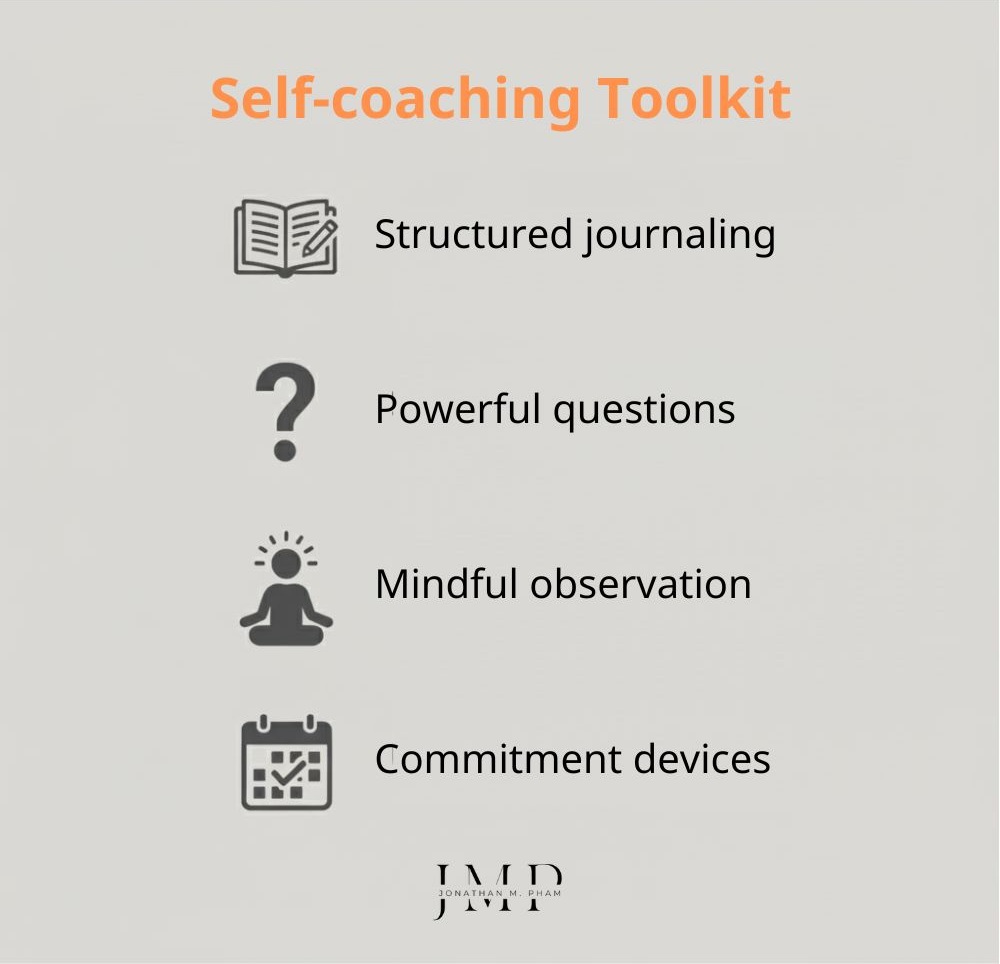
These are the daily practices that allow you to gradually build the muscle of self-awareness.
This is the primary tool for getting your thoughts out of your head and onto paper, where you can see them clearly.
How to practice: When you feel a strong negative emotion, don’t just write aimlessly. Instead, grab a journal and create five sections: C, T, F, A, R. Fill in the columns for your current, automatic cycle. This forces you to pinpoint the exact story driving your feeling. Then, use a new page to consciously write out a new T-F-A-R chain.
Questions are the engine of self-coaching. They are open-ended (not “yes/no”) and designed to open up new perspectives.
Sample self-coaching questions:
Read more: 200 Self-reflection Questions – Toolkit for Life Pilgrims
This is the skill of noticing your thoughts and feelings in real-time without jumping to any conclusion. It creates the sacred pause between the (C)ircumstance and your (T)hought, giving you the power to choose.
How to practice: You don’t need to meditate for an hour. Start by setting a reminder on your phone for three times a day. When it goes off, just pause for 60 seconds. Take one deep breath and ask: “What am I currently thinking? What am I currently feeling?” That’s it.
Self-coaching is only effective if it leads to new action. A commitment device helps bridge the gap between your intention and execution.
How to practice: If your new (A)ction is “I’m going to journal for 10 minutes,” treat that as “sacred time.” Put it in your calendar. By scheduling your intention, you are sending a message to yourself that your growth and peace are a priority.
Read more: 32 Self Discovery Activities for Everyone
Self-coaching exercises
Check out more life coaching quotes here!
You are your own best teacher. My advice is to question all things. Seek for answers, and when you find what seems to be an answer, question that, too.
Louis L’ Amour
In a very real sense we have two minds, one that thinks and one that feels.
Daniel Goleman
To ask the right question is already half the solution of a problem.
Carl Jung
Who looks outside, dreams. Who looks inside, awakens.
Carl Jung
Until you make the unconscious conscious, it will direct your life and you will call it fate.
Carl Jung
Self-coaching, as we have discussed, is not a one-time event. It is not a tool to “fix” yourself, because you are not broken.
It is, at its core, a lifelong practice of returning to yourself, from time to time. Back to your values – to your own inner wisdom. And most importantly, back to a place of compassion for yourself, no matter what circumstance you are currently in.
Provided that you are truly patient and disciplined enough, I can guarantee that one day, you will finally be able to connect to that inner voice. And from that point, you will be able to live a much more fulfilling and rewarding life.
Other resources you might be interested in:

A long time ago, in a provincial town far, far away… There was a wealthy, cynical landowner named Fyodor Pavlovitch Kara [...]

Let us visit a fictional place: The Village of the Valley. Once upon a time, those who lived there were divided into two [...]

Has this ever happened to you? Let’s say you are suffering from a frustrating health issue, or stuck in a chaotic life d [...]