




0808
Personal Philosophy: What is Your Truth & Stance for Living?
A long time ago, in a provincial town far, far away… There was a wealthy, cynical landowner named Fyodor Pavlovitch Kara [...]
Life coaching is a powerful tool that has the ability to transform and facilitate positive changes in one’s life.
Do you ever feel a pervasive sense of imbalance, despite external successes? Perhaps you’re navigating a significant life transition, battling self-doubt, or simply seeking a clearer direction amidst the noise of daily life. For many, the pursuit of happiness often feels fragmented – and that’s where practices such as life coaching come in to save the day.
Highlights
Life coaching is an empowering process aimed at enabling individuals to take control of their lives and realize their full potential. Through the guidance of a trained professional coach, one learns to explore new possibilities and create positive changes in all areas of life – including physical health, mental well-being, emotional state, spiritual beliefs, and social relationships.
In a life coaching relationship, the two parties (the coach and the coachee) start by setting clear objectives – while also taking into account any existing fears or concerns that may be standing in the way of progressing toward their desired outcomes. With the guidance of their coach, the coachee comes up with a detailed plan – including specific, achievable steps for reaching those goals. This plan could include regular meetings with the coach to provide accountability and reinforcement for staying on track with their objectives.
During the journey, the life coach’s role is to offer feedback and utilize tools such as goal-setting exercises to further facilitate progress.

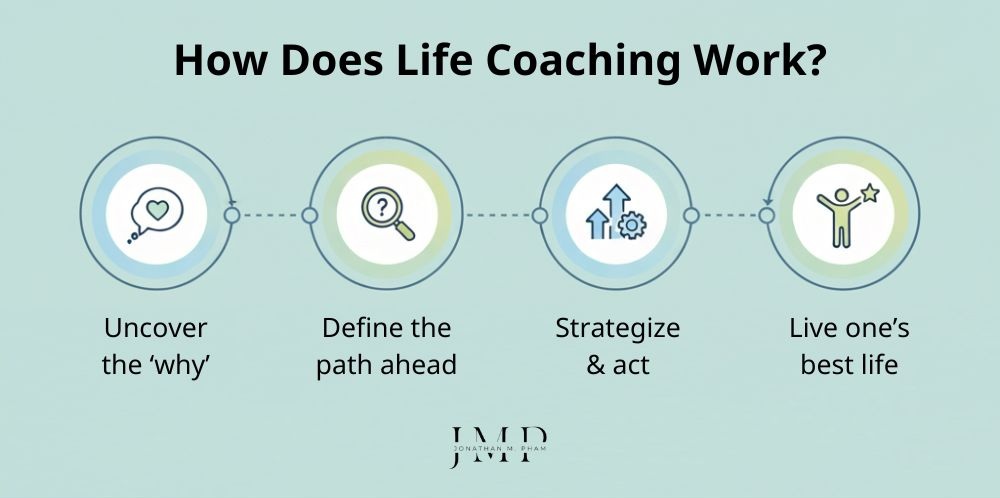
The process begins with the coach engaging their client in discussions about what it is that they value and what kind of life they would like to create. The coach then collaborates with the coachee to define the latter’s life purpose – one that is both exciting and resonating deeply to them – which serves as the foundation for everything else.
Once this first step is finished, the coach may utilize techniques such as reflective questioning, active listening, paraphrasing, etc. so that the client may better understand how their purpose may turn out when realized. This could include anything from career aspirations or relationship goals – to physical health objectives and financial ambitions.
Next, the two work on defining what it takes to visualize this vision – specific action steps to take. Support systems such as apps, calendar reminders, etc. may be considered to ensure progress and success along the way.
All in all, life coaching offers an opportunity for holistic personal growth by cultivating awareness around one’s true gifts, strengths, and values – so that these may be leveraged for positive change in all areas of life. With clarity on how they wish to become – plus what it takes to “get there” and consistent support from the coach, the coachee is better equipped to live a happier and more fulfilling life.
Life coaching has evolved from ancient philosophies to a structured profession in modern times. Its roots can be traced back to Ancient Greece, where philosophers like Socrates, Plato, and Aristotle frequently emphasized the importance of self-examination and improvement. Socrates, for example, is known for promoting a type of questioning technique that encouraged introspection, a principle central to coaching today. Similarly, Eastern philosophies, including Confucianism and Buddhism, played a major role in spreading ideas of mindfulness and self-cultivation.
The modern concept of coaching began to take shape in the 1960s and 1970s, influenced by sports coaching and psychology. The term “coach” originally referred to a tutor who helped students pass exams; it later extended to sports and personal development.
In 1974, Timothy Gallwey published his work – The Inner Game of Tennis – in which he introduced psychological techniques that became foundational in coaching. Gallwey’s ideas gave rise to the emergence of the GROW model, one of the most influential coaching frameworks as of now.
In the 1990s, coaching became a formalized profession with the establishment of organizations like the International Coach Federation (ICF). Since then, the industry has continued to grow, integrating technology, evidence-based practices, and diversity initiatives.
Life coaching is an incredibly powerful tool for anyone looking to make meaningful changes in their lives – regardless of their age and background. Whether one is struggling with depression or anxiety, trying to build better relationships, or just want to improve their overall quality of life, working with a certified life coach provides a supportive atmosphere that provides the comfort, clarity, and guidance needed to facilitate transformation.
Various studies have demonstrated the positive effects life coaching – including but not limited to:
All in all, life coaching is a worthy consideration for those who are:

When it comes to life coaching, there are a few popular types:
Life coaching and therapy are two distinct fields, but many people often mistake one for the other. Both involve working with an individual to improve their life – but the types of issues they tackle are vastly different.
While therapists focus on treating mental health issues such as depression or anxiety, life coaches’ role is to support their clients in achieving more general goals in various areas of life.
Life coaching takes a practical approach to goal achievement that involves setting meaningful objectives, creating a plan for reaching them, and implementing the plan with guidance from a certified coach. This type of work usually involves one-on-one sessions where the coach helps the client gain clarity about their needs and desires, identify any challenges in the way of achieving these goals, define strategies for overcoming those challenges, and ultimately strive towards becoming their best self.
Therapy, on the other hand, is more focused on recognizing and exploring past experiences and difficult emotions that may be preventing a person from living their best life. The aim here is to gain insight into these issues through talk therapy sessions where individuals may discuss their thoughts and feelings openly with a therapist. Additionally, they learn new coping skills necessary to manage symptoms related to mental health problems like depression or anxiety better.
In some cases, however, therapists may offer additional services such as life coaching alongside traditional talk therapy sessions – so as to better maintain the progress achieved during treatment over time.
| Feature | Life Coaching | Therapy |
| Primary Focus | Achieving future goals, practical application | Treating mental health issues, exploring past |
| Issues Addressed | General life goals (career, relationships, etc.) | Mental health conditions (depression, anxiety) |
| Approach | Goal setting, plan creation, implementation | Talk therapy, exploring emotions, coping skills |
| Scope | Future-oriented, growth | Past-oriented, healing |
When looking for a good life coach, it is recommended that you follow this checklist:
Aim to find one with experience working with similar clients. A coach who has successfully guided individuals through challenges similar to yours (e.g., career transitions, relationship issues, personal growth, health and wellness, etc.) will, naturally, have a deeper understanding of the nuances involved.
Ask: “Have you worked with clients facing [your specific challenge/goal]?” “What were the typical outcomes for them?” “Can you describe a challenging case similar to mine and how you approached it?”
Why it matters: Shared experiences help build trust and rapport, providing a foundation for deeper empathy and tailored guidance. They can offer practical advice based on firsthand knowledge and serve as a role model.
While the life coaching industry isn’t as heavily regulated as some other professions (like therapy), certification from a reputable organization (e.g., International Coaching Federation – ICF) demonstrates a commitment to ethical standards and a foundational understanding of coaching methodologies.
Ask: “What certifications do you hold, and from which organizations?” “What kind of training did you undergo for your certification?”
Why it matters: Certifications indicate that the coach has received structured training, learned proven techniques, and adheres to a code of ethics. This boosts their credibility and gives you a good reason to be confident in their skills.
Consistency key to progress in coaching. Hence, you should make sure that their typical session frequency and duration align with what you’re looking for.
Ask: “What are your typical coaching hours?” “Do you offer flexible scheduling, such as evenings or weekends?” “How often do you recommend we meet, and for how long?” “What is your policy for rescheduling or missed sessions?”
Why it matters: Good availability ensures consistent guidance and accountability, which are vital for achieving goals. Not to mention, coaches who adapt to your schedule demonstrate commitment to your progress.
Consider their approach and style – is it directive or collaborative? Action or introspection? Different coaches employ different methods. For instance:
Ask: “Can you describe your coaching philosophy and approach?” “Do you lean more towards guiding or instructing?” “How do you balance helping clients gain self-awareness with driving them to take action?”
Why it matters: The best coaching style for you will depend on your personality, learning style, and the nature of your goals. A good fit ensures you’ll feel comfortable and engaged in the process.
Beyond their skills and experience, a coach’s demeanor significantly impacts the coaching relationship. Look for:
Ask: Pay close attention during initial consultations. How do they respond to your questions? Do you feel heard and understood?
Why it matters: A positive, supportive, and authentic coach fosters trust, open communication, and a strong client-coach connection, which are essential for effective outcomes.
Coaching fees can vary widely based on the coach’s experience, specialization, location, and the package offered.
Ask: “What are your coaching fees?” “Do you offer different packages (e.g., hourly, monthly, multi-session)? What’s included in each?” “What are your payment terms and methods?” “Are there any hidden costs?”
Why it matters: Clear financial expectations are crucial to avoid misunderstandings and ensure the relationship is sustainable for both parties.
Word-of-mouth is a powerful indicator of a coach’s effectiveness.
Ask: “Do you have testimonials from past clients I can review?” “Can you provide references I could speak with (if applicable and appropriate for the coach’s privacy policy)?” You can also ask your network if they have experience with life coaches and who they would recommend – or look for reviews on their website, social media, or professional coaching directories.
Why it matters: Recommendations and testimonials offer real-world insights into a coach’s impact and style, helping you gauge their suitability for your needs.

When working with a life coach, your willingness to be coachable and open to new things is paramount. The very essence of coaching is about challenging your current thinking, exploring different approaches, and stepping outside your comfort zone. If you’re unwilling to try new strategies, consider alternative viewpoints, or engage in introspection, the coaching process will be limited.
Coaching isn’t merely about engaging in philosophical discussions or conceptualizing ideas; it’s fundamentally about taking measurable steps toward realizing one’s goals. Your coach will help you identify what actions are necessary, but the responsibility for execution lies squarely with you.
Read more: Life Management – How to Design a Life You Love
At the end of the day, it is imperative to remember that this is fundamentally your journey, and no one else’s. While your coach is an invaluable guide, facilitator, and accountability partner, they are not there to fix you or provide all the answers. Rather, their role is to empower you to find your own solutions and take ownership of your life.
Read more: Self-coaching – The Art of Being Your Own Coach

Check out more quotes about life coaching here!
Working with a life coach can be an incredibly rewarding experience. With the guidance of a qualified and experienced professional, you will be equipped to learn how to overcome challenges, set effective goals, and realize your highest potential!
Other resources you may be interested in:

A long time ago, in a provincial town far, far away… There was a wealthy, cynical landowner named Fyodor Pavlovitch Kara [...]

Let us visit a fictional place: The Village of the Valley. Once upon a time, those who lived there were divided into two [...]

Has this ever happened to you? Let’s say you are suffering from a frustrating health issue, or stuck in a chaotic life d [...]