




0808
Personal Philosophy: What is Your Truth & Stance for Living?
A long time ago, in a provincial town far, far away… There was a wealthy, cynical landowner named Fyodor Pavlovitch Kara [...]
Understanding others is key to building stronger relationships, navigating conflict with ease, and becoming a more influential communicator.
In today’s interconnected world, understanding others has become a crucial skill when it comes to cultivating long-term relationships, both personally and professionally. Empathy, active listening, and perspective-taking are essential qualities for bridging interpersonal gaps, fostering trust, and bringing about harmonious interactions. By developing these abilities, one may navigate the complexities of human connection with greater ease and compassion.
Highlights
Understanding others is a multi-layered concept, but at its core, it’s about recognizing, appreciating, and empathizing with the diverse thoughts, feelings, and experiences of people different from yourself. More than simply knowing facts about someone, it’s about actively trying to see the world from their perspective.
Key aspects of understanding others:
Personal relationships:
Professional settings:
Social interactions:
Understanding how you interact with others
Understanding others is fundamental to bringing about a happy and fulfilling life – both for you and those around you:
The ability to resonate with people’s motives, feelings, and perspectives lays the foundation for deeper connections characterized by better communication, trust, intimacy, and less likelihood of misunderstandings. When disagreements arise, you are better equipped to find common ground and approach them constructively.
For instance, let’s say you’re working on a group project with a colleague, Alex, who has been consistently late to meetings and seems uninterested in the project. It may be tempting for you to accuse him of being lazy or uncommitted, which will just lead to a defensive reaction and escalate the situation. However, what if he is juggling a demanding job and family responsibilities, which have been causing him to feel overwhelmed trying to balance his commitments? Envisioning a possibility like that will help you approach Alex in a much more constructive manner.
Learning to empathize with differing points of view means a lot more than just a way of conflict resolution. When we understand each other, we can work together more effectively to solve problems and achieve common goals.
An example is a manager leading a team tasked with developing a new product. Simply dictating one’s vision for the project will just breed resistance and a lack of engagement. On the other hand, by taking the time to learn each member’s strengths, weaknesses, and aspirations, the manager may build up a more inclusive and collaborative environment, in which tasks are delegated based on skills and growth opportunities. This translates to better teamwork, increased productivity, and more successful business outcomes.
Stepping outside one’s own perspective is crucial to learning new things, challenging personal assumptions, and growing as a person. By observing how others perceive you, you gain insights into your own behavior and communication style – how it impacts everyone. This breeds compassion and sensitivity to others’ experiences.
At the same time, you also learn how to manage your own emotions and cope with stress more effectively.
As a leader, understanding your team members’ strengths, weaknesses, and motivations lays the foundation for effective delegation, support, and a more positive work environment that promotes diversity and inclusion. On the other hand, being able to find common ground with potential clients/ business partners through grasping their interests contributes to increased success rates.
Imagine you’re studying for a big exam with your friend Sarah. You’ve been hitting the books hard, pulling all-nighters, and feeling confident. Sarah asks you, “How’s your studying going?”
Scenario 1: Unaware of Sarah’s struggles
Without knowing Sarah’s situation, you might respond with:
A. “Great! I’m feeling really prepared.” In this case, you assume Sarah shares your experience and enthusiasm.
B. “I’m pulling all-nighters, barely surviving on coffee! How about you?” This answer focuses on your own experience, potentially making Sarah feel inadequate if she’s struggling.
C. “This test is gonna be brutal! Feeling stressed?” While acknowledging the difficulty, your response might come across as negative or pessimistic.
Scenario 2: Aware of Sarah’s challenges
Knowing Sarah has been swamped with extracurricular activities and hasn’t had much time to study, you might respond with:
D. “How are you feeling about the exam? Is there anything I can do to help?” In replying like that, you demonstrate empathy and offer support, acknowledging your friend’s problems (if any).
E. “I’ve been studying a lot, but I know you’ve been busy. Maybe we could form a study group?” This offers a collaborative solution that takes into account her situation.
F. “Don’t worry, I’m sure you’ll do great! You’re always so smart.” While encouraging, such a response might downplay her concerns and avoid addressing the underlying issue.
As shown in the example above, understanding people’s perspectives allows you to tailor your response to their specific needs and feelings, thereby fostering a more supportive and productive study session.
Read more: Asking for Help – The Power That Comes From Vulnerability

The topic of understanding yourself and others has long been drawing the interest of researchers and psychologists – who have been striving to learn how and why people are able to comprehend and empathize with the feelings, thoughts, and perspectives of others. Over time, various theories and models have emerged, each of which presents unique insights.
One popular concept when it comes to understanding others is the Theory of Mind (ToM), which refers to the ability to attribute mental states (e.g. beliefs, desires, emotions, and intentions) to oneself and others, and to realize that they may differ from one’s own. This capability is crucial for navigating social interactions, understanding different perspectives, predicting/ explaining behavior, and communicating/ cooperating more effectively. Typically, TOM develops gradually around age 4 – and is influenced by factors such as cognitive abilities, social interactions, and cultural background.
Another important concept is empathy, which involves both cognitive and emotional components (e.g. perspective-taking, emotional contagion, empathic concern). It is about cognitively understanding another’s perspectives, emotionally resonating with their feelings, and adopting prosocial behavior such as helping, comforting, and supporting people. While some believe the ability to empathize is innate, others emphasize that it is cultivated through social learning, interaction, and practices such as mindfulness, meditation, and role-playing.
Additionally, there are a lot more theories that explain the psychology behind understanding others, some of which include:
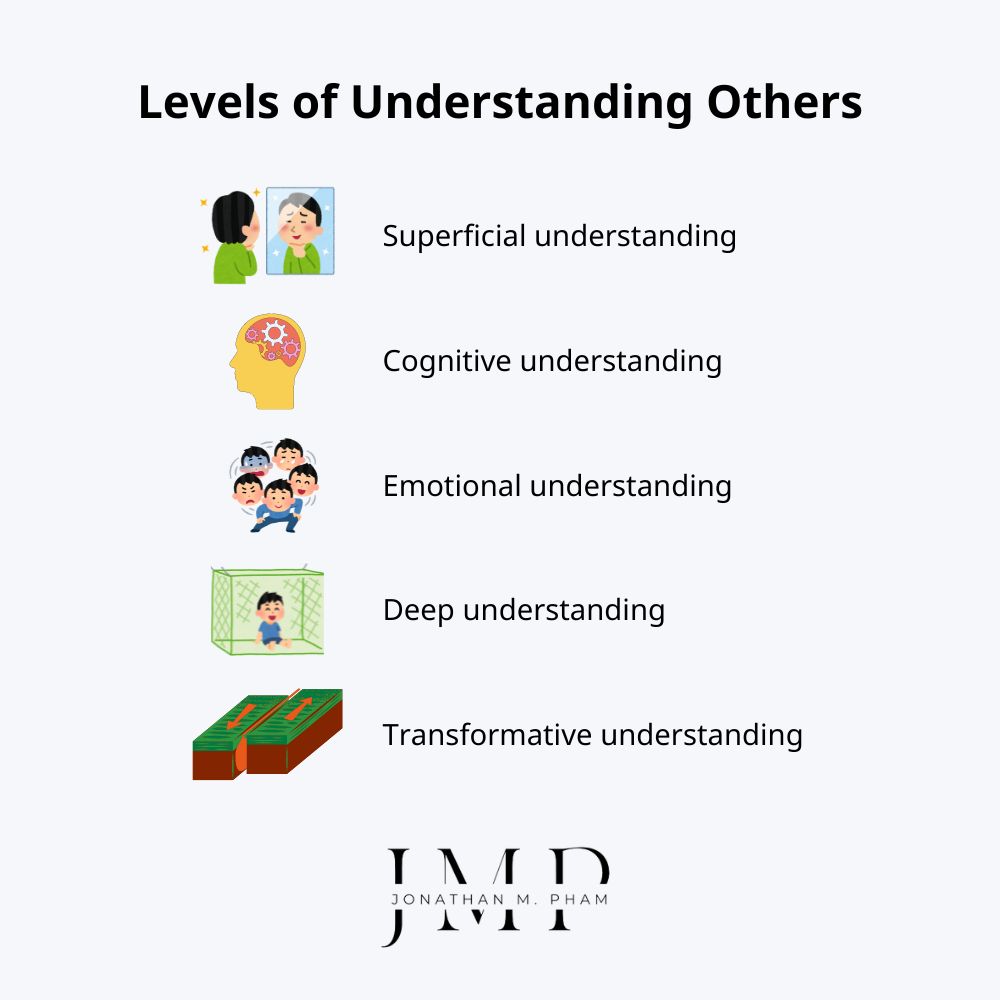
This is the most basic level, where we have minimal information about someone. We might know their name, job, or a few basic facts, but we lack insight into their deeper thoughts, feelings, and motives. As such, we often rely on stereotypes and assumptions, which may lead to misinterpretations.
The next phase involves actively trying to empathize with someone’s perspective and reasoning. We pay attention to their words, actions, and nonverbal cues (e.g. facial expressions, tone of voice, actions), and attempt to piece together their thoughts and feelings. This involves cognitive processes like perspective-taking and mental state attribution.
While it’s better than superficial understanding, it might not capture the emotional nuances of the experience – yet.
Here, we go beyond mere observation and start recognizing emotional states like happiness, sadness, or anger based on verbal and nonverbal cues. In other words, we slowly grasp the general “what” of people’s feelings.
This level goes beyond just knowing someone’s thoughts; it is about resonating with their emotions on a deeper level. We demonstrate empathy and compassion, and even share others’ joy or sorrow to some extent. This emotional connection lays the foundation for a more nuanced and authentic appreciation of their experience.
This phase is characterized by a profound connection with someone else’s inner world, including their values, beliefs, and unique life experiences. We can almost “step into their shoes” and see the world through their eyes; in other words, the “why” behind their emotions.
Such an awareness requires long-term connection, trust, and open communication.
The highest level involves co-creating meaning with the other person. We engage in open dialogue, actively listen, and explore their perspective together. This shared journey leads to a deeper understanding that transcends what either of you could have reached alone.
Understanding people’s needs
Human beings have a strong tendency to distort other people’s feedback to fit their own views. We know this intellectually, and yet we rarely seem to recognize it as it’s happening.
Heidi Grant Halvorson
Understanding others, while crucial for cultivating meaningful connections and attaining fulfillment in life, often turns out to be a quite challenging feat due to a wide array of social and psychological obstacles.
Our natural tendency to see the world through our own lens is what blinds us to other perspectives. When interpreting situations based on our experiences and values, we become likely to miss the nuances of another’s reality.
Unconscious prejudices based on race, gender, culture, or other factors often distort interpretations of others’ actions and intentions – which causes us to judge them unfairly or overlook important aspects of their experiences. Many times, we tend to seek and favor information that confirms our existing beliefs, while ignoring or rejecting information that contradicts them.
For instance, an American businessperson, accustomed to direct communication, is negotiating a deal with a Japanese client. He may hold stereotypes about Japanese culture being more indirect and formal. When the Japanese client pauses for a long time after the American makes a proposal, the American might interpret this as a sign of disagreement or disinterest – which causes him to become impatient or push for a quick decision, overlooking the possibility that his client is taking time to consider the proposal carefully and maintain harmony within the relationship. At the same time, he might seek out information that confirms his stereotype (e.g., articles about Japanese business culture being indirect) while dismissing or ignoring what contradicts it (e.g., examples of Japanese people being direct in certain contexts).
In this example, the American’s unconscious prejudice has led to misinterpretations, potential misunderstandings, and a failure to effectively communicate with his client.
Read more: Subconscious Mind Power – Exploring The Hidden Force Within
Strong emotions such as anger, fear, and anxiety often cloud our judgment and make it difficult to empathize with someone whose perspective differs from our own. We might become defensive, dismissive, or react impulsively rather than seeking genuine appreciation.
A lack of self-awareness, active listening, or emotional regulation typically hinders one’s ability to share the emotions of those around them.
Read more: Self-leadership – The Art of Leading from Within
Sometimes, we simply lack enough information to truly understand someone due to limited communication, cultural differences, or personal boundaries – which causes us to make assumptions or misinterpretations.
For example, a new coworker, Maria, from a different cultural background, starts at your company. She seems quiet and reserved during team meetings. Due to having limited interactions with Maria (primarily in formal work settings), you may not be aware of her cultural norms, such as valuing indirect communication or expressing emotions differently. As a result, you might assume that Maria is uninterested or disengaged.
To overcome this barrier, you could try initiating casual conversations with Maria outside of work settings to learn more about her personality and background. Encourage her to share her thoughts and experiences, be mindful of cultural differences, and respect her boundaries if Maria seems hesitant to proceed further.
Language barriers, nonverbal cues that differ across cultures, and communication styles are all potential causes of misunderstandings.
People sometimes present themselves in ways that are not entirely accurate or omit important details (e.g. a person recounts a traumatic event, but downplays their own role or emotions to avoid feeling vulnerable). This can make it tough to genuinely understand their thoughts and experiences.
Power imbalances, group dynamics, and social pressures may give rise to situations where open and honest communication is challenging. Workplace hierarchies, competitive environments, and time constraints are all potential barriers to forming genuine connections and understanding colleagues.
Human beings are complex creatures with ever-evolving thoughts, emotions, and motivations. It’s not always easy to unravel these complexities and fully grasp another person’s inner world.
For instance, let’s say a friend of yours is acting unusually quiet and withdrawn during a social gathering. This reaction may be attributed to a variety of causes, including unseen emotions (e.g. the friend might be dealing with a personal issue, such as a breakup, job loss, or family conflict, that they’re not comfortable sharing), cultural differences (e.g. they might be hiding their feelings to avoid appearing weak or disrespectful, especially if they come from a culture that values emotional restraint), or past experiences (e.g. they might have experienced trauma or rejection that makes them hesitant to open up to others).
Such complexity makes it challenging to accurately interpret people’s actions and feelings across situations.
Read more: Healing Your Inner Child – 15 Steps to Unearthing the Happy, Healthy You Within
To truly understand others, one needs to invest a great deal of time, energy, and authentic efforts. Active listening, open-mindedness, and a willingness to challenge one’s own assumptions are essential for cultivating meaningful connections.
Sharing our true selves with others is in itself a vulnerable act. Most of us find it difficult to open up and create the conditions necessary for deep mutual understanding.
Read more: Not Listening – The Silent Killer of Relationships and Success in Life
Understanding others is a valuable skill that can massively enrich your life and relationships. Here are some practical steps you may take to improve your ability to connect with and truly “get inside” the world of those around you:
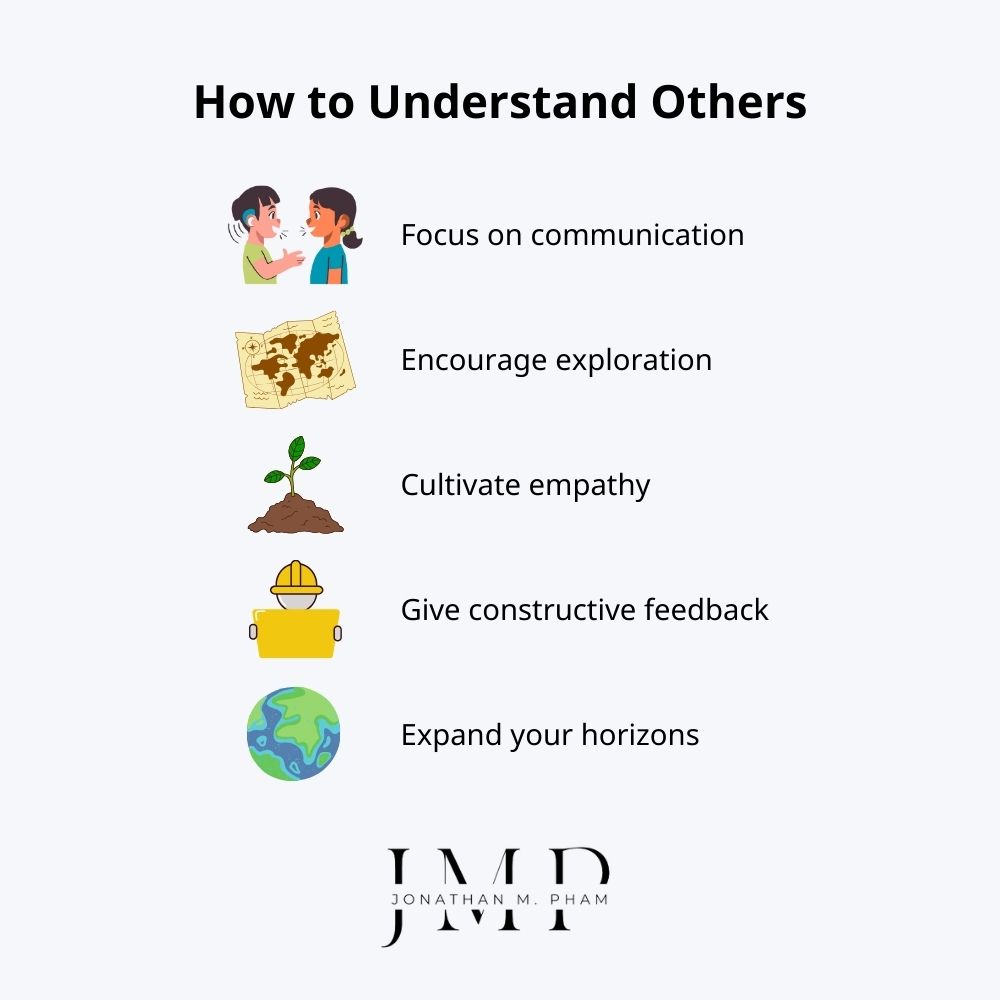
The core idea of high-quality communication is to be fully present in the conversation and actively engaged with the other person. This involves more than just hearing the words; it’s about getting to the underlying meaning and perspective.
Key components:
Example:
Imagine you’re having a conversation with a friend who recently lost their job. In this case, you can ask questions like, “How are you feeling about this?” or “What are your plans for the future?”. When it comes to summarizing, you might say, “So, it sounds like you’re feeling a bit overwhelmed but also hopeful about finding a new job.”
High-quality communication is a skill that takes practice; hence, be patient with yourself and keep working on it.
The essence of this tip is to create a space where the other person feels comfortable sharing their thoughts and experiences in depth by asking open-ended questions (e.g. “how,” “what,” and “why”). The reason is that such questions invite elaboration; they prompt the speaker to provide more details, context, and personal perspectives. Additionally, unlike “yes” or “no” questions, they don’t suggest a particular answer – but stimulate the speaker to think critically and reflect on their thoughts and feelings.
Example:
Let’s say you’re talking to a friend about a recent trip. Rather than “Did you have a good time?”, a question like “What was the most memorable part of your trip?” encourages your friend to share their experiences in a much more detailed manner.
Additional tips:
Empathy, the ability to understand and share people’s feelings, is a crucial skill for cultivating strong relationships and resolving conflicts. Imagine yourself in the other person’s situation – including what’s going on within them, then acknowledge their feelings without minimization. In fact, simple phrases like “That sounds frustrating” or “I can understand why you’d feel that way” often go a long way. After that, let the person know that you’re there for them and offer to help if needed.
Sample responses:
Read more: Platinum Rule vs Golden Rule – How the Principles of Empathy Have Shifted
When offering feedback, it’s important to focus on specific behaviors rather than generalized statements. For example, instead of saying, “You’re always late,” you could say,
“I’ve noticed that you’ve been late to our meetings the past few weeks. Is there something going on that’s affecting your punctuality?”
Under all circumstances, you should offer suggestions for improvement rather than criticism. For instance, instead of saying, “You’re so disorganized,” you could say,
“I’ve found that using a to-do list has helped me stay organized. Would you like to try that?”
The last tip is about stepping out of one’s comfort zone and actively seeking out new experiences and perspectives – so as to facilitate personal growth and self-discovery. By doing so, you broaden your understanding of the world and develop a greater empathy for others. During this process, consider making use of resources like books, documentaries, workshops, or courses to improve your understanding of human behavior and communication.
Example:
Imagine you’re at a cultural festival and meet someone from a different country. You might ask, “What’s your favorite thing about your culture?” or “Can you tell me about a traditional custom?” While listening to their responses, you notice that they use gestures or facial expressions differently than you do, and you adjust your own communication style to better connect. After the event, you watch a documentary about their culture or read a book by an author from that country.
Self-awareness, often overlooked in interpersonal relationships, is crucial for fostering empathy, understanding, and effective communication with others. It’s about recognizing your own thoughts, emotions, and behaviors, and how they influence daily interactions.
When you’re aware of your own feelings and reactions, it becomes easier to recognize and understand those of others (e.g. if you’re aware of your tendency to feel defensive when criticized, you’re more likely to understand why someone might react defensively to feedback). At the same time, you are less likely to project assumptions onto others, knowing that everyone has their own biases.
Understanding yourself also facilitates high-quality communication. For instance, if you know you tend to interrupt when others are speaking, you can consciously work on practicing active listening to improve your interpersonal skills.

Understand yourself before understanding others
Individual:
Group activities:
Read more: 32 Self Discovery Activities for Everyone
Ways of understanding
The most basic of all human needs is the need to understand and be understood. The best way to understand people is to listen to them.
Ralph G. Nichols
Don’t judge a man until you have walked a mile in his shoes.
Native American proverb
Seek first to understand, then to be understood.
Stephen R. Covey
Be curious, not judgmental.
Walt Whitman
You never really understand a person until you consider things from his point of view.
Harper Lee
The smartest thing you can know is that you don’t know.
Kiyokazu Washida
Don’t look out only for your own interests, but take an interest in others, too.
Philippians 2:4
Whoever is patient has great understanding, but one who is quick-tempered displays folly.
Proverbs 14:29
This book explores the challenges and pitfalls of communicating and interacting with strangers, plus how we may improve our ability to understand and trust them. Stories and research from psychology, sociology, and history are featured to illustrate humanity’s common mistakes and biases when we encounter unfamiliar people.
Cain’s work explains the differences and similarities between introverts and extroverts, as well as how they can work together and learn from each other. Additionally, she also presents advice and strategies for introverts to thrive in various aspects of life, such as work, school, and relationships.
A classic and timeless guide for improving your interpersonal skills and relationships. It teaches you how to communicate effectively, persuade others, handle conflicts, and win people over.
Read more: Skill Development – A Guide to Future-Proofing Yourself
Understanding others is not merely a social nicety; it is a crucial competency that benefits us in a variety of ways. Through practicing self-awareness, active listening, and demonstrating a genuine desire to connect with others, we may foster deeper connections, build stronger relationships, and navigate life’s challenges with greater resilience. These are all essential components for a more fulfilling life and harmonious community.
Other resources you might be interested in:

A long time ago, in a provincial town far, far away… There was a wealthy, cynical landowner named Fyodor Pavlovitch Kara [...]

Let us visit a fictional place: The Village of the Valley. Once upon a time, those who lived there were divided into two [...]

Has this ever happened to you? Let’s say you are suffering from a frustrating health issue, or stuck in a chaotic life d [...]