




0808
Personal Philosophy: What is Your Truth & Stance for Living?
A long time ago, in a provincial town far, far away… There was a wealthy, cynical landowner named Fyodor Pavlovitch Kara [...]
Discover the impact of refusing to apologize, why we resist saying sorry, and learn how to break free from this damaging habit.
Apologies play a crucial role in maintaining harmony and meaningful connections. Yet, we often find ourselves hesitating to utter the two simple words, “I’m sorry.” Refusing to apologize is a common bad habit that leaves significant repercussions on our relationships and personal growth; hence, it is crucial that those who aspire to reach greater heights in their professional journey learn how to get rid of it.
Highlights
We all know of those who constantly fail to acknowledge their wrongdoings or hurtful actions toward others. This reluctance to admit fault/ take responsibility is what strains their relationships and impedes personal growth.
Refusing to apologize manifests itself in various ways, some of which include:

Sample responses of people who refuse to apologize:
The reasons behind our reluctance to apologize are really complex and multifaceted – influenced by various factors such as our personality, the specific situation at hand, and the dynamics of our relationships:
Read more: The Excessive Need to Be Me – When the Ego Takes Over

Why do people resist apologizing
The consequences of refusing to apologize extend far beyond a mere exchange of words, reaching into the core of our relationships, self-esteem, and overall well-being. By disregarding the opportunity to offer a genuine apology, we open ourselves up to several serious repercussions:
(This section – alongside the next two parts – is compiled with inspiration drawn from #Habit 15 in Dr. Marshall Goldsmith‘s bestseller ‘What got you here won’t get you there‘, which was written based on his years of experience coaching executives from various organizations)
Apologizing is akin to a cleansing ritual, to a confession in a place of worship. We are all aware of how the words “I’m sorry” help bring about solace and resolution – and yet, despite its apparent simplicity, many of us find it challenging to do so. There are various factors that contribute to this dilemma surrounding apologies.
Some may view apologizing as a sign of weakness – this is particularly evident among those who have a relentless drive to succeed in every endeavor. Admitting wrongdoing can be difficult, especially when we are accustomed to being right most of the time. Seeking forgiveness may even be seen as an act of humiliation, possibly suggesting a sense of subservience.
Another consideration is the perceived loss of power or control that comes with an apology, prompting many to resist taking responsibility for their actions.
However, the irony lies in the fact that the very fears that deter us from apologizing are actually – and can be swiftly dissolved with a genuine “I’m sorry”. In saying such words, we foster connection and transform those around us into allies and partners, shattering the barriers that hinder harmonious relationships.
Reflecting on past experiences, you may realize that the refusal to express regret has been a common cause of fraying relationships, both in personal and professional spheres. The bitterness stemming from an unapologetic act can persist for extended periods, damaging bonds that once thrived.
We must learn to appreciate that refusing to apologize is as detrimental as any other interpersonal flaw. By mustering the courage to say sorry for our wrongdoings, we extend an olive branch, paving the way for reconciliation and strengthening the very bonds that might otherwise fray.
People who can’t apologize at work may as well be wearing a T-shirt that says, “I don’t care about you.”
Marshall Goldsmith

Refusing to apologize is a weakness, not a strength
If you smile at people, they will smile back. If you ignore them, they will resent you. If you put your fate in their hands – i.e., cede power to them – they will reward you.
Marshall Goldsmith
Dr. Goldsmith once shared a story about him dining at the elegant Le Perigord, a renowned French restaurant in New York City as follows:
I had never been to a restaurant like this, where the flower arrangements required separate tables, the cutlery had the heft of an ax, and the waiters were dressed in black tie and sported impenetrable French accents. I confessed to the waiter that I was intimidated by the surroundings, that I only had one hundred dollars, tip included, to spend on the meal, and that I couldn’t read the menu, which was hand-written in French.
“Would you please bring me the best one-hundred-dollar meal you have,” I asked.
I am convinced that the meal I was served that night – not only the extra courses, the cheese tray, and the constant refills of my wine glass, but also the ridiculously solicitous service – was worth at least 50% more than my hundred-dollar budget. I admitted I was a rube, and the staff responded by treating me like the Sun King.
This experience instilled in me the conviction that if you put all your cards in someone else’s hands, that person will treat you better than if you kept the cards to yourself.
As you may see from the story above, when we place faith in others, they will respond with kindness and generosity.
This principle reflects the interconnectedness of our actions and the responses they elicit from those around us.
Whether in personal relationships or professional endeavors, acknowledging the interplay between our deeds and the reactions they evoke will guide us toward more harmonious and rewarding interactions. By sowing seeds of trust, respect, and goodwill, we are more likely to reap a bountiful harvest of positive outcomes and enriched connections with others.
To gain a friend, let him do you a favor.
Benjamin Franklin
Apologies possess an extraordinary and profound impact, resonating deeply in the human psyche, much like a heartfelt declaration of love. They are akin to an inversion of “I love you”. While love expresses care and joy, an apology conveys remorse and acknowledgment of having caused hurt. Both gestures are equally seductive and compelling, transforming relationships between individuals in irrevocable ways and propelling them towards new, potentially wonderful, horizons together.
One of the most compelling aspects of saying sorry is that it prompts people to let go and stop living in the past. By expressing regret, one acknowledges their inability to alter history. Instead, they admit their wrongdoing, demonstrate remorse for the pain inflicted, and pledge to improve moving forward.
This combination of an admission of guilt, a sincere apology, and a plea for guidance resonate profoundly – even with those who may seem cold-hearted. The power of this approach can be alchemical when applied in the workplace, significantly impacting how coworkers perceive and regard one another.
Dr. Goldsmith once shared the example of one of his coaching clients as follows:
My client Beth was the highest-ranking woman at a Fortune 100 company. Her bosses loved her. So did her direct reports. By contrast she was loathed by some of her peers. When I surveyed her coworkers I learned that she had a particularly toxic relationship with a hard-boiled division chief named Harvey. Beth was a smart, know-it-all young hotshot brought in by the CEO to stir things up. Harvey, however, saw her as arrogant and felt she didn’t respect the company’s history and traditions. The two of them were in a perpetual turf war, and it brought out the worst side of her personality: Her mean, vindictive streak. We agreed that this is the behavior she would change.
The first thing I had Beth do was apologize—to Harvey. I could see her bristle at the suggestion. I told her, “If you can’t do this, you can’t get better. And by the way, I’m outta here. I can’t help you.” The thought of yielding to Harvey was so distasteful to her that I actually scripted out the apology. I didn’t want any misgivings or hesitations to creep in and pollute the apology (which would destroy the effect). To Beth’s credit she followed the script.
She said, “You know, Harvey, I’ve got a lot of feedback here and the first thing I want to say is that I’m positive about a lot of it. The next thing I want to say is that there are some things at which I want to be better. I’ve been disrespectful to you, the company, and the traditions in the company. Please accept my apologies. There is no excuse for this behavior and . . .”
Harvey cut her off before she could finish her apology. She looked at him with alarm, poised for another fight, until she noticed that he had tears in his eyes. The first thing he said was, “You know, Beth, it’s not just you. It’s me. I have not been a gentleman in the way I’ve treated you. I know that this was hard for you to tell me these things and they are not all your problems. This is my problem, too. We can get better together.”
When one seeks growth and improvement, it inspires reciprocity, with others endeavoring to better themselves too. This process of personal and collective transformation permeates various levels of human interaction, from individuals and teams to divisions and entire companies. As individuals strive for improvement, the cumulative effect elevates teams, fosters growth, and propels organizations toward success.
In this way, the genuine act of apologizing acts as a catalyst for positive change – elevating relationships, and fostering a culture of mutual support and development within organizations. By recognizing the transformative potential of apologies, individuals and teams can forge a path toward collective growth and become a formidable force in their respective domains.
Read more: Law of Attraction – Tips for Manifesting Abundance and Success in Life
Now that we are aware of the consequences of refusing to apologize, it’s time to start taking action to resolve things.
Apologizing to someone we have hurt is a powerful act of humility and accountability – demonstrating respect, empathy, and genuine remorse for our actions. A heartfelt apology has the potential to mend wounds, rebuild trust, and foster renewed harmony in one’s relationships.
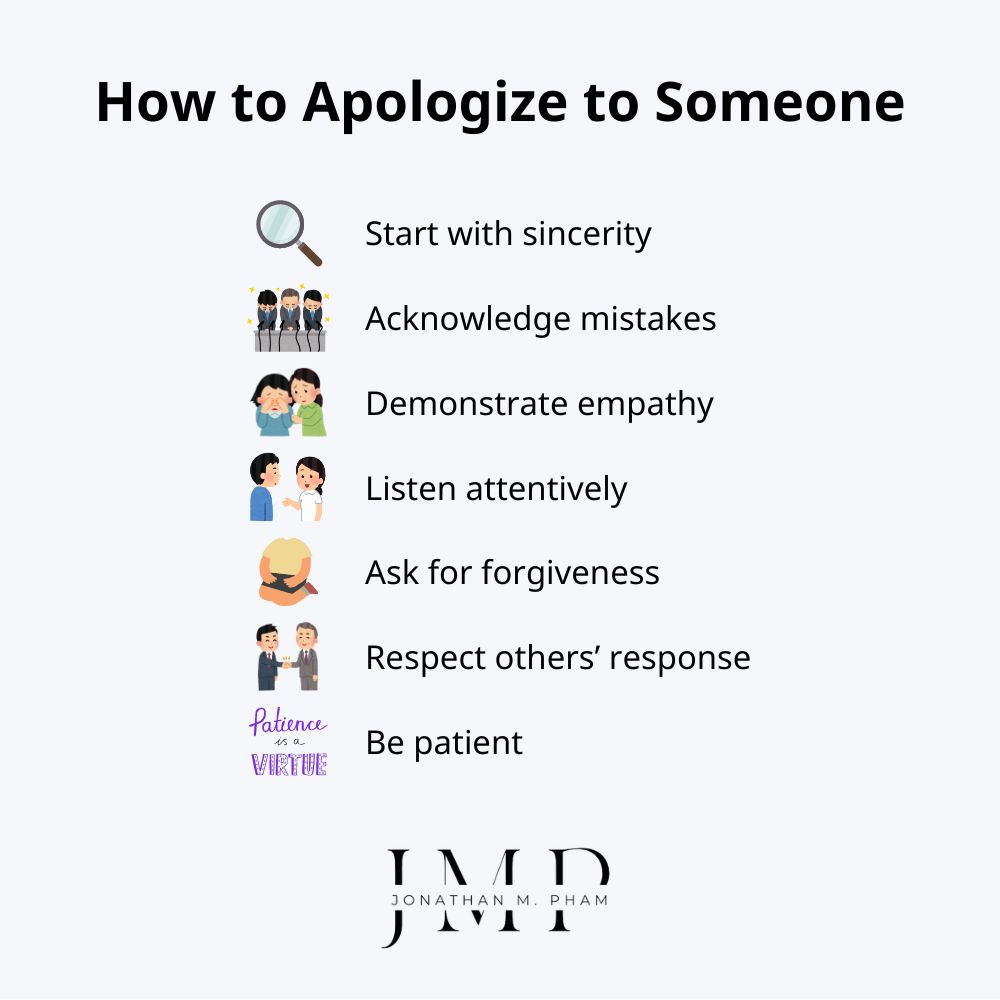
To offer an effective apology to someone you hurt deeply, consider following these essential steps:
Begin with a straightforward and heartfelt “I’m sorry.” These simple words carry significant weight and convey your willingness to take responsibility for your actions. Under all circumstances, refrain from phrases like “I’m sorry, but …” or “I’m sorry if …,” as they signal an unauthentic or feeble attempt to deflect blame.
Be specific and honest about the actions that caused harm and why they were wrong. Do not justify, minimize, or deny your mistake – instead, openly acknowledge the consequences of your actions, and how they hurt or affected the other person.
Express genuine regret and remorse for the pain you caused. It is recommended that you make use of empathic language to illustrate your willingness to understand others’ feelings, such as “I can imagine how you felt” or “I know this must have been hard for you.”
Read more: Platinum Rule vs Golden Rule – How the Principles of Empathy Have Shifted
Give the other person the space to express their feelings and needs without interruption, argument, or justification. Actively listen and strive to acknowledge their perspectives – plus the impact of your actions. For instance, you can say, “I hear you. I can see how much I hurt you by doing that.”
Do not be afraid of requesting forgiveness and expressing commitment to improving in the future. Offer to make amends in a concrete way, showing that you are willing to take corrective action. For instance, you can say, “Please forgive me for what I did. I will never do it again. Is there anything I can do to make it up to you?”
People may respond differently to your apology – they may accept/ reject/ need time to think about it. Regardless of their reaction, respect their decision and avoid pressuring them to forgive or forget.
Forgiveness takes time. For the healing process to truly take effect, be patient and understanding, consistently demonstrating that you genuinely regret your actions.
Below is an example of an apology following the guidelines above:
“I’m so sorry for what I said to you yesterday. I realize now that I was completely out of line, and my words were hurtful. I was feeling stressed and frustrated, but that’s no excuse for how I treated you. I want to express my deepest regret and apologize from the bottom of my heart.
I understand that my words may have caused significant pain, and I can’t take back what I said. However, I want you to know that I’m here for you if you need to talk or if there’s anything I can do to make things right.
I genuinely hope you can find it in your heart to forgive me. I promise that I will learn from this mistake and never utter anything hurtful like that again.”
While apologizing may be challenging, it is a rewarding and transformative endeavor. Embracing the responsibility of making amends can facilitate personal growth, encourage learning from mistakes, and foster reconciliation within our relationships.
Read more: Healing Your Inner Child – 15 Steps to Unearthing the Happy, Healthy You Within
Navigating the aftermath of an unaccepted apology requires emotional maturity, empathy, and humility. While the experience may be challenging, such moments also present opportunities for self-reflection, understanding, and growth.
Here are some valuable tips to navigate such a circumstance:

Refusing to apologize
While apologizing is an essential first step towards reconciliation, it alone does not suffice when we have hurt someone or acted inappropriately. To truly make amends, we must take concrete actions to repair the damage and restore the trust that may have been compromised.
A meaningful apology should be accompanied by tangible behavioral and attitudinal adjustments. Avoid reverting to old patterns and show your dedication to making lasting changes. For example, if you did something dishonest before, do your best to demonstrate increased honesty and transparency in your interactions moving forward.
Remember, the process of making amends is not a one-time effort – it is an ongoing commitment to positive change and understanding. Patience, humility, and a sincere desire for personal growth are required for one to sustainably tread the path to restoring relationships – and fostering more compassionate connections with others.
When someone refuses to apologize for hurting you, the emotional impact can be significant, leaving you feeling hurt, angry, and even betrayed. Coping with this situation and finding a way to move forward is certainly challenging – that said, there are constructive steps you can take to navigate this emotionally taxing experience:
Life becomes easier when you learn to accept an apology you never got.
Robert Brault
In this life, when you deny someone an apology, you will remember it at time you beg forgiveness.
Toba Beta
Never ruin an apology with an excuse.
Benjamin Franklin
Sincere apologies are for those that make them, not for those to whom they are made.
Kelsey Frizzell

Refusing to apologize
Refusing to apologize is a bad habit that has far-reaching consequences in our interpersonal relationships and personal growth. It impedes the resolution of conflicts, distances us from those we care about, and inhibits our capacity for self-improvement. However, by acknowledging the impact of our actions and seeking reconciliation, we not only repair our relationships – but also embark on a journey of personal growth, compassion, and ultimately, a more harmonious and fulfilling life.
Other resources you might be interested in:

A long time ago, in a provincial town far, far away… There was a wealthy, cynical landowner named Fyodor Pavlovitch Kara [...]

Let us visit a fictional place: The Village of the Valley. Once upon a time, those who lived there were divided into two [...]

Has this ever happened to you? Let’s say you are suffering from a frustrating health issue, or stuck in a chaotic life d [...]