



0808
Personal Philosophy: What is Your Truth & Stance for Living?
A long time ago, in a provincial town far, far away… There was a wealthy, cynical landowner named Fyodor Pavlovitch Kara [...]
Explore practical insights to better understand yourself – including emotions, values, and motivations – for a more fulfilling and authentic YOU.
The journey of understanding yourself is a winding path, often shrouded in confusion and self-doubt. But take heart! In this article, we will delve into practical tools and insightful practices to illuminate your emotions, decipher your values, and finally, meet the authentic YOU waiting to be discovered.
Highlights
Understanding yourself means having a vivid, detailed perception of who you are as a person. It involves being aware of your thoughts, feelings, actions, and motivations, plus how they impact your life and relationships.
Self-understanding is a continuous process that goes beyond knowing your favorite color or remembering your birthday. Specifically, it’s about delving deeper into:
The process requires ongoing introspection, self-questioning, and a willingness to be honest with yourself, even about the less flattering aspects (e.g. fear of failure, the need for constant validation, arrogance, tendency to find fault in others, etc.). As challenging as it may seem, it is the key to unlocking your potential and living a more harmonious, authentic life.

Understanding yourself psychology
Self-understanding means a lot more than academic qualifications. Being aware of your biases and thought patterns enables you to analyze situations more objectively, make sounder decisions, and extract valuable lessons from previous experiences. For example, a manager who recognizes their bias towards those with similar backgrounds and their preference for quantitative data may actively seek feedback from team members with different perspectives and make decisions based on a broader range of information.
Additionally, you become more capable of regulating your feelings and remaining resilient – even in the face of uncertainties and societal expectations. This facilitates inner peace and the pursuit of things that align with your authentic self.
When you know your strengths, weaknesses, values, and passions, you are better equipped to set goals that are truly aligned with your authentic self – rather than resorting to impulsive choices. For instance, knowing that you are passionate about empowering others may prompt you to pursue a career path that revolves around coaching, mentoring, and training (rather than a purely high-income job). This focus and direction means a higher chance of achieving success in areas that matter most to you.
Understanding both your own needs and those of others contributes to fostering deeper, more authentic connections with friends, family members, and colleagues. Knowing your limits and respecting those of others enables you to set and enforce healthy boundaries (e.g. not taking additional work that may compromise one’s emotional well-being and other commitments), thereby reducing unnecessary resentment and conflict.
Not to mention, when you’re true to yourself, you attract people who appreciate your authentic self, resulting in more genuine and supportive interactions.
Research by the Harvard Business Review has revealed a strong correlation between the level of understanding oneself and overall well-being. Being able to regulate your inner state brings tranquility and satisfaction, as well as helps cope with stress/ other negative emotions in work and life.
Self-understanding is a cornerstone of effective leadership, especially during times of crisis. According to a study by McKinsey, leaders who demonstrate high awareness of themselves (referred to as “centered leadership”) are 4 times more capable of navigating change than those who do not. This may be attributed to the increase in adaptability, decision-making effectiveness, resilience, etc. that stems from self-knowledge.
As you gain awareness of your thoughts, emotions, values, and motivations, you naturally embark on a lifelong quest to uncover more about yourself. This constant process of reflection and exploration leads to new insights and a deeper understanding of who you are at your core.
For instance, let’s say you’re someone who has always been a people-pleaser. You’ve noticed that you often prioritize others’ needs over your own, which has been causing feelings of overwhelm lately. You then recognize that this pattern of behavior stems from a deep-rooted fear of rejection and a desire to be liked by everyone. Although your core values are connection and belonging, the current methods of achieving this have been misguided. This newfound understanding motivates you to explore healthier ways to connect with others – while also setting boundaries for yourself.
Understand yourself before understanding others
Understanding yourself paves the way for success
The best leaders are not afraid to look inward and chart their own course
Read more: Self-leadership – The Art of Leading from Within
Awareness of your thoughts involves examining the internal dialogues, recognizing biases/ patterns, and naming the mental frameworks that trigger feelings. Think of it as shining a light on the inner workings of your mind.
What gives your life meaning? What principles guide your actions? Identifying your core values is like finding the compass that steers you in the right direction.
Recognizing your talents and limitations is crucial for making informed choices and setting realistic goals. It’s about embracing your unique blend of light and shadow.
How have previous experiences shaped who you are today? Reflecting on the past reveals patterns and lessons that may be leveraged to make better choices in the future and grow as a person.
For example, let’s say there’s a person named John, who has spent 10 years in marketing. He realized he often felt stressed during campaign launches and preferred the analytical aspects of his role.
Through reflection, John identified a pattern of seeking roles with high-pressure, deadline-driven responsibilities. He learned that while he enjoyed the adrenaline rush initially, long-term job satisfaction stemmed from data analysis and strategic planning. Armed with this knowledge, John decided to pursue a career shift by enrolling in a data science course and networking with professionals in the field.
Read more: Living in the Past – The Problem of Dwelling on What Was
What do you want out of life? What are you working toward? Connecting your individual aspirations to a larger sense of purpose brings direction and fulfillment into your life.
How do you connect with others? What roles do you play in different relationships? Recognizing your patterns in social interactions is essential for cultivating stronger, healthier bonds – as well as for developing empathy and navigating social situations with greater ease.
Seeking feedback from trusted friends and coaches/ mentors sheds light on how you come across to others – which is an invaluable tool for self-improvement.
Read more: Self-coaching – The Art of Being Your Own Coach
Being aware of how you interact with others lays the foundation for tailoring your messages for maximum impact. For example, you’re a naturally analytical person (Analytical communication style) – who prefers data, logic, and structured information. As a result, when presenting a new project, you might lean towards a detailed, data-driven approach. However, if your audience is primarily creative or emotionally driven, they might struggle to connect with your message.
In this case, rather than diving straight into numbers, you might start by painting a picture of the problem the project solves, and then support your points with data.
What is your contribution to society? How can you make a positive impact on the world?
Example:
“I can contribute to society by being a dedicated teacher. I help shape young minds and prepare them to be responsible citizens.”
This includes being aware of your physical health, energy levels, and the body’s needs – so as to better take care of your physical well-being and refrain from unhealthy habits (e.g. overconsumption of snacks/ caffeine, etc.), thereby resulting in improved health and happiness.
How do you experience the world through your senses? Do you appreciate the beauty of the world around you?

Despite the various benefits mentioned above, many of us struggle with understanding who we really are – which can be attributed to a variety of reasons:
Our inner world is a vast and unexplored territory. Diving into it often proves to be scary, as we might uncover truths about ourselves that are uncomfortable or challenging.
For instance, imagine someone who always presents themselves as confident and outgoing; however, deep down, they might fear vulnerability and rejection. To protect this image, they avoid situations that could expose their insecurities. This fear of uncovering their “true self” prevents them from authentic connections and personal growth.
Overcoming the problem requires courage and self-compassion. Specifically, one needs to create a safe space for exploration, challenge negative self-talk, and gradually build self-awareness.
Our ego often protects us from negative self-perception, creating blind spots and distorting our self-image. As such, we tend to resist examining aspects of ourselves that threaten our sense of self-worth.
Read more: The Excessive Need to Be Me – When the Ego Takes Over
Our brains are wired for efficiency and often take shortcuts in processing information. These biases lead us to misinterpret our experiences and draw inaccurate conclusions about ourselves.
Consider someone who prides themselves on being always in control. Their ego might prevent them from acknowledging feelings of insecurity or fear of failure. To maintain their image of competence, they might avoid taking risks or seeking help, hindering their personal and professional growth.
It’s essential to recognize that acknowledging our flaws and vulnerabilities is not a sign of weakness but an essential step toward true knowledge.
When we turn our attention inward, we risk encountering aspects of ourselves that we’ve tried to bury or avoid. These emotional wounds can be difficult to face, and the discomfort they bring often breeds a strong resistance to further exploration.
On the other hand, self-awareness often leads to insights and realizations that require changes in our behavior or beliefs. This prospect can be quite frightening, as it involves stepping outside of our comfort zone.
Read more: Healing Your Inner Child – A 15-step Guide

In today’s world – given the rise of social media and a materialistic mindset, we are constantly bombarded with messages about who we should be, what we should achieve, and how we should behave. These external pressures – despite the intentions behind them – make it challenging for many of us to connect with our authentic selves.
Most of us are not taught how to effectively reflect on our thoughts, feelings, and motivations. No wonder why we often lack the skills necessary for self-understanding.
Different cultures have different values and priorities, which partially shape how we see ourselves and interact with the world. In individualistic cultures like the United States, self-reliance and personal achievement are often emphasized. Individuals may define themselves based on their accomplishments and unique qualities.
In contrast, collectivist cultures like Japan prioritize group harmony and interdependence. People’s identity is often intertwined with their social roles and relationships, making it difficult to separate personal desires from group expectations.
To overcome this challenge, one needs to develop cultural awareness, practice empathy, learn to appreciate differences, and engage in continuous self-reflection.
As individuals, we undergo physical, emotional, and cognitive transformations throughout our lives. Our experiences, relationships, and even our environment all contribute to this ongoing process of change. What felt true about us yesterday may no longer apply today, making it difficult to hold onto a fixed sense of self (and potentially giving rise to issues such as identity crisis).
Flexibility and self-compassion serve as anchors as one navigates the constant state of flux in life. Additionally, it also helps to identify your core values that remain consistent despite external changes.
Despite the challenges mentioned above, the journey of self-understanding is still within our reach – and ultimately rewarding. After all, the key is to never stop exploring and learning.
Read more: 45 Daily Mindfulness Questions for Adults
The art of understanding yourself in life
The combination of your innate traits (e.g. introversion vs extroversion), emotional responses (temperament), and personal preferences plays a major role in shaping your thoughts, feelings, and actions. Recognizing it may shed light on your behavioral patterns (e.g. why you prefer quiet environments, why you need alone time to process information, why you’re drawn to intellectually stimulating activities, etc.) – based on which you become better equipped to make informed choices about your career, relationships, and lifestyle.
These form the foundation of your moral compass and guide every decision. Understanding them is crucial to making choices that align with your authentic self (e.g. choosing actions that align with truthfulness if honesty is a core value of yours).
Our internal narratives and mental frameworks play a major part in shaping our perception of the world and ourselves. Do you often engage in positive or negative self-talk? Do you tend to seek out information that confirms your existing beliefs while ignoring contradictory evidence? Do you overemphasize personal factors and underestimate situational factors when explaining others’ behavior?
Read more: Passing Judgment – Why We Must Stop This Destructive Habit
The people you surround yourself with often leave a significant impact on your self-perception and self-development. Healthy, supportive relationships encourage self-reflection and personal growth, while toxic ones produce opposite results.
Cultural norms, societal expectations, and social roles can significantly shape your identity and influence behavior.
Childhood experiences and family dynamics all contribute to one’s emotional patterns, self-beliefs, and communication styles. For instance, someone raised in a highly critical and controlling family environment might develop low self-esteem and a tendency to people-please. They might also struggle with assertiveness and have difficulty setting boundaries.
Examining these influences is crucial to knowing one’s emotional triggers and making conscious choices in the present life.
Continuous learning, challenging yourself with new experiences, and engaging in introspective activities like journaling or therapy all contribute to accelerating the self-discovery process.

I am who I am.
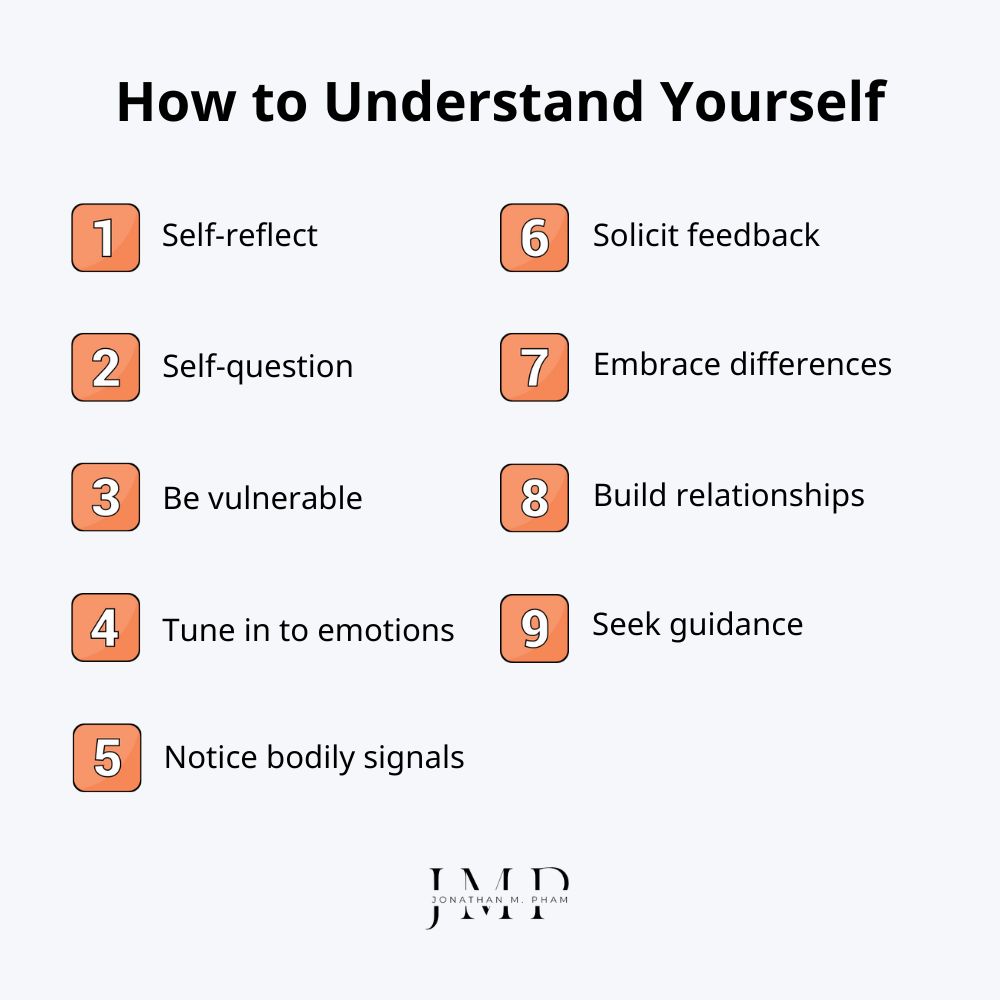
There’s no single recipe for truly understanding yourself, as it’s a lifelong journey with unique paths for each individual. However, here are some practical tips and resources to guide you on your self-discovery adventure:
Practice journaling, meditating, or spending time in introspection to ponder your thoughts, feelings, and motivations. Ask yourself questions like: “What are my values?”, “What brings me joy?”, “What fears are holding me back?”.
We often develop a self-image based on past experiences, societal expectations, and personal beliefs. Despite providing a comfortable, familiar identity, it might not accurately reflect who you truly are or what you are capable of. Hence, don’t take it at face value.
For example, let’s say you’ve always believed you’re shy and introverted. This belief might have shaped your behavior over the years, leading you to avoid social situations. Instead of accepting “I’m shy” as a fact, ask yourself:
“Is this truly accurate in all situations? Are there instances where I’ve been outgoing or comfortable socializing?”
Additionally, reflect on past experiences where you might have stepped outside your comfort zone. Were you successful? How did you feel? Consider talking to friends or family about their perception of you as well. Do they see you as shy? Could there be other aspects of your personality that are more prominent?
Explore both your strengths and weaknesses, and acknowledge your shadows. Accepting your whole self, flaws and all, is crucial for authentic self-knowledge.
Being attentive to your feelings, recognizing their triggers, and learning healthy coping mechanisms will enable you to regulate emotions effectively and nurture stronger relationships.
Our bodies are incredibly intelligent and responsive to our emotional and mental states. Physical sensations like tension, pain, or energy levels often reflect what’s happening inside. By tuning into these signals, we may gain valuable insights into our emotions, needs, and overall well-being.
Imagine you’re feeling stressed about an upcoming deadline. You might notice tension in your shoulders, a racing heart, or difficulty concentrating. These physical sensations are your body’s way of telling that you’re feeling overwhelmed.
Instead of ignoring these signals, try a body scan meditation. Focus on each part of your body, from your head to your toes, noticing any sensations. This should help pinpoint the source of the tension and find ways to relax, such as deep breathing or stretching.
Read more: Subconscious Mind Power – Exploring The Hidden Force Within

Ask trusted friends, family, or mentors for honest feedback on your strengths, weaknesses, and how you come across to others. Their input may yield unique perspectives you might not have considered before.
Step outside your comfort zone and try new things. Explore different cultures, hobbies, and social settings. The more new experiences you are exposed to, the easier it is to realize hidden talents, challenge your existing perspectives, and lead to greater self-understanding.
Surround yourself with people who encourage your self-exploration and celebrate your individuality. Healthy relationships provide a safe space for vulnerability and honest feedback.
Consider therapy or coaching if you’re facing specific challenges or want deeper insights into your inner world. A trained professional should be able to provide expert guidance and support in your self-discovery journey.
Read more: Asking for Help – The Power That Comes From Vulnerability
Tools like Myers-Briggs, Enneagram, DISC, Jordan Peterson, or the Leonard Personality Inventory (LPI) offer amazing insights into your traits and preferences. Though they are not definitive, all provide a great starting point for self-exploration.
Find prompts that encourage deeper reflection on specific aspects of yourself, such as your values, relationships, or past experiences.
Explore self-help books, articles, and online resources on self-discovery and personal growth. With these, you should be able to find inspiration and practical advice from others who have walked similar paths.
Express your inner world through artistic endeavors like writing, painting, music, singing, or dancing. Exploring the creativity side often uncovers hidden aspects of yourself and reveals unique insights into your emotions/ life experiences.
How to get a deeper understanding of thyself
A mini self-awareness quiz
Answer these questions honestly to gain some insights into your current level of self-awareness:
By considering your answers, you may realize areas where you feel confident in your self-awareness and areas where you might want to focus your self-understanding efforts.
Deepening self-discovery questions
Go beyond the surface with these prompts to dig deeper into your internal world:
These questions may not have immediate answers, but pondering them over time should result in profound realizations about who you are.
Read more: 200 Self-reflection Questions – Toolkit for Life Pilgrims

Knowing yourself is the beginning of all wisdom.
Aristotle
Understanding yourself is power. Loving yourself is freedom. Forgiving yourself is peace. Being yourself is bliss.
Unknown
To find yourself, think for yourself.
Socrates
The most difficult thing in life is to know yourself.
Thales
Your visions will become clear only when you can look into your own heart.
Carl Jung
The journey into self-love and self-acceptance must begin with self-examination… until you take the journey of self-reflection, it is almost impossible to grow or learn in life.
Iyanla Vanzant
The one who cherishes understanding will soon prosper.
Proverbs 19:8

Understanding yourself involves a lifelong adventure filled with plenty of opportunities and challenges at the same time. Though there will be ups and downs along the way, it is a journey that will ultimately open the door to a more fulfilling life. The only question is: are you ready to take the first step today?
Other resources you might be interested in:

A long time ago, in a provincial town far, far away… There was a wealthy, cynical landowner named Fyodor Pavlovitch Kara [...]

Let us visit a fictional place: The Village of the Valley. Once upon a time, those who lived there were divided into two [...]

Has this ever happened to you? Let’s say you are suffering from a frustrating health issue, or stuck in a chaotic life d [...]