




0808
Personal Philosophy: What is Your Truth & Stance for Living?
A long time ago, in a provincial town far, far away… There was a wealthy, cynical landowner named Fyodor Pavlovitch Kara [...]
Discover the negative impact of living in the past – plus how to stop clinging to what was, move forward, and create a fulfilling life.
Living in the past is a major obstacle to change – it does no good to dwell on/ cling to your previous life and refuse to let it go if your desire is to change the future and become a better version of yourself today. For those who would like to advance further on their journey towards self-mastery, learning to abandon this bad habit is crucial to making progress and moving forward.
Highlights
The act of living in the past (also referred to as rumination, dwelling on/ clinging to the past) occurs when one becomes excessively preoccupied with past events – or maintains a belief that things would/ should remain the same as they were previously. This behavior can manifest in various ways, including:
Indulging in a past-oriented mindset often evokes feelings of nostalgia, fostering an illusion that life was simpler and more joyous in earlier times. This fixation is what impedes one’s ability to fully immerse themselves in the present and build a better future.

If you are depressed, you are living in the past. If you are anxious, you are living in the future. If you are at peace, you are living in the present.
Lao Tzu
Below are some indicators commonly observed among those who demonstrate the habit of dwelling on the past:
Have you ever wondered: “Why am I living in the past?”. Numerous factors may contribute to one dwelling on past things/ mistakes/ negativities – some of the most notable reasons include:
When it comes to human behavior, there is a common notion among psychologists that states: “When it’s hysterical, it’s historical”. Specifically, many of our emotional reactions – including the tendency to live in the past – are actually rooted in previous experiences.
For instance, if you possess perfectionistic tendencies or constantly seek approval, it may stem from your parents never acknowledging your worthiness.
If you exhibit a sense of superiority and believe you will never do anything wrong, it could be a result of your parents showering you with excessive praise, fostering an inflated sense of self-importance.
Those who have undergone traumatic events often struggle to let go of the past. They may continuously relive the traumatic experience in their minds or live in a perpetual state of fear, dreading its recurrence. Reflecting on – and addressing – such unresolved matters is necessary to facilitate the release of the past’s hold.
An example is when one experiences the loss of a loved one – in this case, moving on from their grief should prove challenging. Or, one constantly bullied in school might become cautious of other people and likely to withhold information – both to protect themselves from potential personal attacks and to gain an edge over others.
A deep-seated fear of the uncertain is a reason why people seek solace in the past. They may perceive the future as uncontrollable, prompting them to resist change and cling to how things were/ have been.
For instance, managers who are used to the command-and-control style may be reluctant to relinquish their authority – even when they are fully aware of the benefits of empowering other team members. They may worry that others will not be able to make decisions on their own – or that they will make mistakes. They hold on tightly to the delusion that “I have succeeded by telling people what to do – there is no reason for me to embrace a new approach to leading the organization”.
The allure of nostalgia may contribute to the habit of living in the past, as people immerse themselves in fond memories, often idealizing bygone times. When faced with difficulties, one may cling to previous positive experiences or successes as a means to avoid the present harsh realities or responsibilities.
A good example is when a person struggling with their current job may reminisce about their time in college – when they were carefree and successful. They may idealize that period and compare it unfavorably to their current situation, which makes them discouraged and unmotivated.
A pervasive negative mindset can anchor us in the past, impeding our ability to embrace positivity and growth. When one persistently fills themselves with destructive emotions – such as regret, grudge, and bitterness, it becomes extremely challenging for them to embrace the present, make progress, and move forward.
An overwhelming desire to preserve one’s self-identity – to be “me” – is a common factor that hinders personal growth and perpetuates clinging to the past. For instance, a manager who has always been regarded as a “tough” guy may be reluctant to hand out praises for fearing that it will make him appear unauthentic (even when he is aware of the beneficial effects of giving compliments).

“Is dwelling on the past bad?” – some may ask. It is true that occasional and purposeful reminiscing may bring about positive effects – such as fostering gratitude for the present, drawing lessons from experiences, cherishing memories, and reconnecting with one’s core values. However, when reminiscing becomes a habitual tendency or a means of escape from the present, it becomes a problem we need to worry about.
Below are some major dangers of living in the past:
Constantly fixating on the past inhibits personal growth and prevents one from moving forward. The inability to fully let go of previous events hinders progress in life – while at the same time evoking feelings of sadness, regret, and anger. Over time, continually reflecting on negative experiences will exact a toll on one’s mental well-being.
Another problem with dwelling on the past is how it distorts one’s perception, veiling present circumstances with idealized or romanticized notions. This twisted view may lead to unrealistic expectations, dissatisfaction, and resentment.
Endlessly comparing oneself to a past version engenders a sense of inadequacy, resulting in diminished self-esteem and a lack of confidence. When fixating on what has happened or what could have been, one neglects the opportunities and possibilities available in the present.
Moreover, this detrimental habit also hinders the cultivation of meaningful relationships, pursuit of goals, and fulfillment of responsibilities – ultimately leading to dissatisfaction, regret, and strained connections.
Focusing on past mistakes, failures, losses, and traumas breeds feelings of sadness, anger, guilt, shame, and resentment. These emotions permeate one’s mood, motivation, and self-confidence, while also impairing coping mechanisms when faced with stress and challenges.
A preoccupation with the past stifles openness to new experiences, ideas, and perspectives. It fosters resistance to change, averse to risk-taking, and settling for less than what one deserves. Additionally, repeating patterns of behavior that led to past circumstances or avoiding situations reminiscent of them stifles learning, growth, and the discovery of new possibilities.
By recognizing the disadvantages of living in the past, you are better equipped to develop a healthy balance between cherishing memories and embracing the present, enabling personal growth and a brighter future.

There is no point in dwelling on the past
Even when fully aware of the detrimental effects of dwelling on the past, one may find it more “alluring” to ponder over their previous life – instead of letting it go and embracing change. In fact, releasing certain aspects and events from our past often proves arduous, since it entails accepting that our desired outcomes did not come to fruition. Moreover, it can feel like a concession that someone other than ourselves was correct.
However, despite its challenges, we possess the power to make a conscious decision to let go. It begins with recognizing that clinging to the past serves no fruitful purpose. Instead of fixating on what could have been, we can redirect our focus towards the present moment and the limitless possibilities that lie ahead. Instead of fixating on what cannot be changed, remind yourself that you have the capability to choose your own life and move on to a brighter future.
There comes a time in your life when you have to choose to turn the page, write another book, or simply close it.
Shannon L. Alder
(This section below is compiled with inspiration from the bestseller ‘What got you here won’t get you there‘ by world-class executive coach – Dr. Marshall Goldsmith)
As shared by Dr. Goldsmith, he once worked with a client who would spend countless hours lamenting about his problems.
“Marshall, you don’t understand. Let me explain why I have these issues. Let me explain my mother and father.”
It was one long unendurable whine. Finally, I reached into my pocket for a coin and said,
“Here’s a quarter. Call someone who cares.”
Reflecting on what has happened is not inherently problematic – in fact, it is a valuable process if the objective is to come to terms with it. To understand why we got HERE.
However, if the goal is to shape the future – to get THERE, dwelling on the past will do nothing good.
During his coaching career, working with clients who cling tightly to their past, desiring to unravel the mysteries of why they are the way they are, has always been one of Dr. Goldsmith’s greatest challenges. Convincing them that the past cannot be altered, rewritten, or used as an excuse is a lengthy process. The only option available to them is to accept and move forward.
What’s really interesting is that many people derive satisfaction from living in the past, particularly when it allows them to blame others for the misfortunes they have experienced. In this case, the inclination to dwell on the past manifests as an even more worrying interpersonal problem, in which previous events are adopted as a “weapon” against others.
On the other hand, we also hold on to the past in order to juxtapose it with the present, often with the intention of highlighting our own virtues at the expense of others. A classic example is when people start a conversation with something like: “When I was your age…”
What really is the trigger behind such a behavior?
When making excuses, we attribute our failures to someone or something beyond our control. We refuse to hold ourselves accountable – instead, we point the finger at anyone but ourselves.
Sometimes, we blame others not to justify our failures, but as a subtle way of boasting about our successes.
Dr. Goldsmith confessed that he too once fell prey to this detrimental habit. Years ago, he suffered from a profound setback – which caused him to later that day return home and unleash his frustrations upon his daughter, Kelly:
One day, annoyed over a professional setback, I came home and took out my annoyance on Kelly. I trotted out the sorriest, most pathetic speech any parent can give a child, the one that begins, “When I was your age . . .” Inevitably, it’s a self-pitying lecture that points out how difficult and miserable the parent’s childhood was in comparison with the childhood the parent is now providing for his or her children.
I started yammering about growing up in Kentucky in a gas station and how we didn’t have money and how hard I had to work to become the first person from my family to graduate from college. Contrasting this, of course, with all the wonderful things Kelly had.
She patiently listened to my diatribe, instinctively letting me vent. When I was finished, she said,
“Daddy, it’s not my fault you make money.”
It was at that moment that Dr. Goldsmith realized the profound truth in her statement. How could he expect her to comprehend the struggles of poverty – when he had deliberately worked to shield her from that harsh reality? He then recognized the fallacy in his actions – and the unfair burden he had placed upon his daughter.
I don’t have much patience with “therapy” that clings to the past – because going backward is not about creating change. It’s about understanding.
Marshall Goldsmith

Keep in mind that people change, but the past doesn’t.
Becca Fitzpatrick
As mentioned, reflecting on the past can be beneficial – provided it is done in moderation and with intention. However, when the practice transforms into a habitual pattern, it becomes counterproductive and potentially detrimental.
“It’s no use crying over spilled milk”. Regardless of how extensively you groan over it, the past remains unchangeable. Its events and circumstances are etched in history. What you can control, however, is how you learn from it and forge a new path forward.
Instead of dwelling on what was, it is much better to look forward – so that you may:
Looking forward to the future endows you with the role of the author in your own life. Each chapter presents an opportunity for growth, achievement, and self-discovery. You possess the authority to introduce new characters and experiences, enhancing the richness of your personal journey.
By directing the gaze toward the future, you set your intentions and chart your course. You clarify what truly matters to you and what you aim to accomplish. Such focus propels you to take action, confront obstacles, and make progress.
During this process, vision boards, affirmations, and journaling serve as valuable tools to visualize and manifest your desired outcomes.
Fixing your sights on the future fosters receptiveness to fresh experiences, novel ideas, and alternative perspectives. Rather than fearing change, you embrace it as a catalyst for growth and enlightenment. You remain keenly aware of the possibilities that unfold in the present and await you in the future, eagerly seizing them with curiosity and enthusiasm.
By directing the attention toward things that lie ahead, you stoke the fires of optimism within – which acts as a potent motivator, infusing your endeavors with determination and positivity. The anticipation of your envisioned goals fuels your drive, guiding your efforts with purpose and efficiency. This constitutes improved productivity, happiness, and contentment in life.
Constantly dwelling on the past inhibits true engagement with the present – as it draws your focus away from the here and now, fixating on what has already transpired or what could have been. By embracing a forward-looking mindset, you become more attuned to the present, relishing each moment as it unfolds.
Just because the past didn’t turn out like you wanted it to, doesn’t mean the future can’t be better than you ever imagined.
Ziad K. Abdelnour

I have a future to look forward to – instead of dwelling on the past
Read more: 12 Stoic Principles to Live by in Modern Life
To live fully in the present, while also planning appropriately for the future, we must learn as much as possible from the painful memories of the past, then let these memories go.
Dalai Lama
To stop living in the past, one must first learn to let go – this encompasses a multifaceted psychological process that entails accepting the past, relinquishing attachments, and forging ahead in life. It does not equate to dismissing or erasing the past – rather, the aim is to acknowledge and learn from previous experiences without allowing them to control us.
The act of letting go has been proven to yield profound psychological benefits, including:
Read more: Healing Your Inner Child – A 15-step Guide

Movement is life; and it is well to be able to forget the past, and kill the present by continual change.
Jules Verne
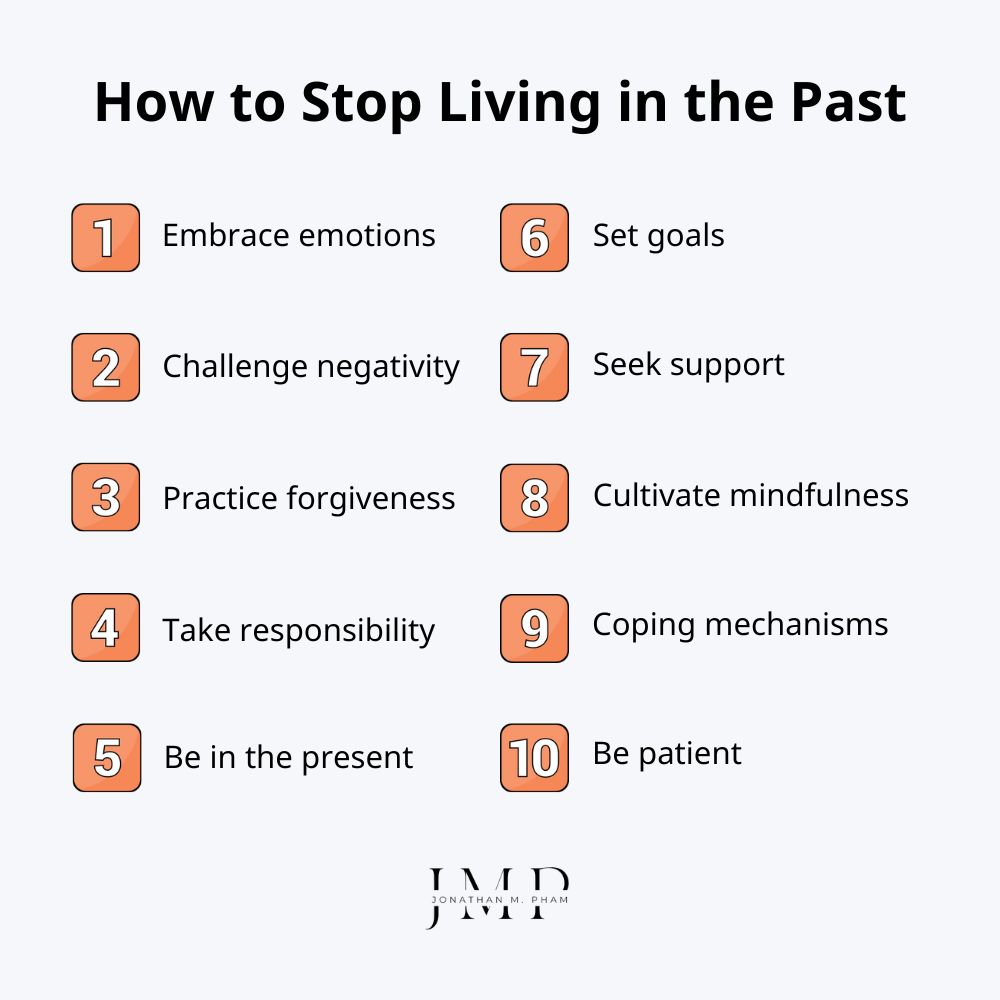
Here, I have compiled a few essential steps to help you break free from the shackles of the past and move forward:
Confronting the past often involves facing up to the negative emotions associated with it – anger, sadness, guilt, shame, regret, etc. Do not try to resist – instead, acknowledge that such feelings are normal and valid, given the circumstances. Acceptance is the first step towards healing.
Read more: Understanding Emotions – Key to Balance & Success in Life
To live our lives to the fullest in the present, we must be willing to ask ourselves the right questions about our past.
Iyanla Vanzant
A good way to stop dwelling on negative thoughts is to question their validity – whether they hold true or serve any purpose in your present life. Dissect these beliefs and reframe them with more constructive and empowering perspectives. For example:
“I’m not good enough.”
Read more: 200 Self-reflection Questions – Toolkit for Life Pilgrims
Holding onto grudges, resentments, and blame perpetuates living in the past. To let go of such burdens, it is crucial that you learn to forgive both yourself and others.
Forgiveness should not be misunderstood as condoning or forgetting what transpired; rather, it entails releasing the hold the past has on you – so that healing unfolds, and you can embark on a path of personal growth.
Part of dwelling on the past involves evading responsibility for your role or contribution to the situation. Recognize that taking responsibility does not equate to self-blame or guilt. It entails acknowledging your part in what unfolded and using it as an opportunity for growth and improvement. Learn from your mistakes, allowing them to shape a wiser, more resilient version of yourself.
Clinging to the past often results in missing out on the richness of the present and resisting change. For this reason, one must learn to challenge the notion that the past was superior or safer than the present.
Engage fully in the present moment by heightening your awareness of your senses, thoughts, feelings, and actions. Embrace change as an opportunity for growth, allowing new experiences, ideas, and perspectives to enrich your life.
Read more: Meaning of Life – Finding a ‘Why’ to Your Existence
To cease living in the past, you need to have a sense of purpose and direction for the future. Reject the notion that the past defines or limits you – instead, set meaningful goals aligned with your values and passions. Break these goals down into manageable steps and take consistent action – and make sure to celebrate each milestone and success along the way, so as to foster a sense of progress and accomplishment.
Engaging in open and honest conversations with a trusted confidant, such as a coach, mentor, or accountability partner should help a lot with processing your feelings and developing effective strategies for letting go.
Read more: Asking for Help – The Stepping Stone to Changing Your Life
Practice the art of mindfulness – paying deliberate attention to the present moment without judgment. Mindfulness enables you to shift your focus away from the past, allowing you to let go of lingering thoughts and emotions tied to it.
In moments of stress or overwhelm, it is crucial to employ healthy coping mechanisms. For this purpose, you may consider engaging in regular exercise, relaxation techniques, or spending quality time with loved ones to cultivate emotional intelligence and well-being.
Letting go and moving forward is an ongoing process that requires self-awareness, effort, and support. You need to be aware that setbacks and challenges may arise along the way. Do not let these obstacles discourage you or cause you to lose sight of your goals. Remain steadfast in the knowledge that you possess the power and potential to shape your future and craft a story aligned with your aspirations.
Read more: 50 Push Yourself Quotes to Move Forward & Inspire Success
On the other side, when faced with someone trapped in the cycle of living in the past, here are some practical tips to aid them in breaking free from such destructive patterns:
The most reliable predictor of what you will be doing 5 minutes from now is what you are doing NOW.
Marshall Goldsmith
Do not cling to the past – video series by Sally Helgeson and Marshall Goldsmith
Creating a new identity – by Marshall Goldsmith
Don’t let yesterday use up too much of today.
Will Rogers
Yesterday is history, tomorrow is a mystery, but today is a gift. That is why it is called the PRESENT.
Master Oogway
The past is a place of reference, not a place of residence; the past is a place of learning, not a place of living.
Roy T. Bennett
The past is a stepping stone, not a millstone.
Robert Plant
No amount of regretting can change the past, and no amount of worrying can change the future.
Roy T. Bennett
The past is a candle at great distance: too close to let you quit, too far to comfort you.
Amy Bloom
It is always important to know when something has reached its end. Closing circles, shutting doors, finishing chapters, it doesn’t matter what we call it; what matters is to leave in the past those moments in life that are over.
Paulo Coelho
You can’t reach for anything new if your hands are still full of yesterday’s junk.
Louise Smith
The person who clings to nothing of the past, present and future, who has no attachment and holds on to nothing – that person, I call a Holy Person.
Buddha
Life is not a burden; it should be lived with passion.
Jorge Bergoglio (Francis)
Remember ye not the former things, neither consider the things of old.
Isaiah 43:18

Living in the past is a major hindrance to our present well-being and future growth. By constantly dwelling on what was, we limit ourselves from fully experiencing and embracing the opportunities that lie before us.
It is crucial to recognize that the past is a part of us, but it does not define us. We have the power to release the grip of nostalgia – while redirecting our focus towards the present moment and the possibilities that await us. Letting go of the past enables us to embark on a transformative journey of self-discovery, personal growth, and fulfillment.
Other resources you might be interested in:

A long time ago, in a provincial town far, far away… There was a wealthy, cynical landowner named Fyodor Pavlovitch Kara [...]

Let us visit a fictional place: The Village of the Valley. Once upon a time, those who lived there were divided into two [...]

Has this ever happened to you? Let’s say you are suffering from a frustrating health issue, or stuck in a chaotic life d [...]