



0808
Personal Philosophy: What is Your Truth & Stance for Living?
A long time ago, in a provincial town far, far away… There was a wealthy, cynical landowner named Fyodor Pavlovitch Kara [...]
Learn how to identify in-demand competencies, overcome learning challenges, and build a personalized skill development plan for the future.
The world is shifting rapidly, driven by technological advancements, globalization, and changing business needs. As such, the competencies one needs to succeed have also been evolving. Below, we will explore essential skill development strategies to future-proof one’s professional development journey and stay relevant in today’s ever-changing landscape.
Highlights
Skill development (also referred to by other names such as further training, professional development, vocational training, etc.) is the deliberate and continuous process of acquiring, refining, and enhancing your knowledge, competencies, and capabilities in specific areas. Its main purposes include:
Example: A marketing professional might undertake a course in analytics to better understand campaign performance and optimize strategies, directly meeting the growing demand for data-driven marketing.
Example: For someone aiming for a leadership role, skill development in areas like strategic thinking, team management, and conflict resolution would be invaluable.

Skill development is achievable through a variety of means, including:
These are the foundational mental abilities that enable us to learn, understand, and process information. Competencies such as critical thinking, problem-solving, analytical reasoning, and memory retention form the bedrock of our intellectual capacity. Working on them is like sharpening your mental toolkit, allowing you to approach challenges with clarity, make informed decisions, and adapt to new information effectively.
Example: In today’s information-rich world, critical thinking is crucial for discerning fact from fiction, evaluating different perspectives, and making sound judgments based on evidence. When facing a complex work project, strong reasoning skills enable you to break down the problem into manageable parts, analyze different solutions, and choose the most effective approach.
These refer to the specific, teachable, and measurable competencies required to perform particular tasks or jobs. These are the “know-how” skills directly related to specific industries and occupations. Examples include computer programming languages, data analysis techniques, financial accounting principles, engineering design skills, proficiency in specific software applications, or even culinary arts techniques.
The interpersonal attributes, personality traits, communication abilities, social graces, and personal habits that are needed for getting along with others and successfully navigating social and professional environments. While less tangible than hard skills, they are equally vital, if not more so, for thriving in any workplace and in personal life.
Key soft skills include effective communication (both written and verbal), teamwork and collaboration, public speaking, adaptability, conflict resolution, negotiation skills, and emotional intelligence. Time management, while sometimes considered a personal skill, also heavily influences your ability to collaborate effectively with others, making it relevant here as well.
These underpin one’s ability to navigate life’s complexities with finesse. Learning a new language not only opens doors to new cultures but also sharpens cognitive abilities. Or, incorporating mindfulness practices into daily routines aids in stress management and cultivates self-awareness, fostering emotional resilience.
Read more: Design Thinking – Reframe Thought Patterns to Unlock Innovation
Skill development topics
The future belongs to those who learn more skills and combine them in creative ways.
Robert Greene
In a world characterized by rapid change and increasing complexity, skill development is not merely beneficial – it’s indispensable for personal and professional success, as well as overall well-being. This is particularly evident during times of crisis (e.g. losing a job), where the ability to adapt and cultivate new competencies can be a lifeline.
One of our readers shared this story: when he lost his job during the worst time of mass layoffs of 2023-2024, he quickly launched a blog and a marketing business called RetainTrust. Although it didn’t generate income at first, it helped him reconnect with former colleagues, meet new people, learn new skills like WordPress development and web design, and ultimately led to new clients and a full-time job opportunity.
By actively mastering new competencies and refining existing ones, you significantly expand your career options and make yourself a far more attractive candidate to potential employers. In essence, it is about future-proofing your career from the outset.
Example: Consider two recent graduates applying for a digital marketing position. One has a general marketing degree. The other, in addition to a similar degree, has proactively acquired certifications in Google Analytics, SEO optimization, and social media marketing tools through online courses. The second graduate, demonstrably equipped with specific and current digital marketing skills, will undoubtedly be the more sought-after candidate.
Continuous learning and skill enhancement equip you with the advanced knowledge, specialized expertise, and broader capabilities needed to perform at a higher level and confidently undertake more challenging responsibilities. This directly translates into improved performance in your current role, making you eligible for promotions, leadership positions, and more complex and rewarding projects.
The journey of learning new things is intrinsically rewarding. It keeps you intellectually stimulated, engaged, and curious. Skill development opens doors to new opportunities, experiences, and perspectives, broadening your horizons both professionally and personally. As you overcome learning curves and master new abilities, it contributes to a profound sense of accomplishment, significantly boosting your confidence and self-esteem.
Read more: Fulfillment in Life – How to Find Meaning & Passion Every Day
The modern world of work is characterized by constant evolution, driven by technological advancements, globalization, and shifting industry paradigms. By staying abreast of emerging trends, understanding new technologies, and continuously upskilling, you are far better equipped to adapt to change, remain relevant in the long run, and future-proof your career against obsolescence.
Example: The rapid rise of Artificial Intelligence (AI) and automation is transforming numerous industries. Professionals who proactively cultivate skills in areas like AI, machine learning, data science, or even in managing human-AI collaboration are future-proofing their careers. They are positioned to not only survive but thrive in a job market increasingly influenced by these technologies, while those who fail to adapt risk being left behind.
Survival in business requires a synergy of skills.
Richard Branson
The pursuit of knowledge and new abilities stimulates intellectual curiosity, keeps your mind sharp, and can prevent cognitive decline. Additionally, it also gives rise to new hobbies and interests, providing avenues for relaxation, creativity, and personal enjoyment, thus reducing stress and improving mental health.
Many forms of skill development, particularly soft skills, enhance social connections and communication abilities, fostering stronger relationships and a greater sense of belonging, all contributing to a more balanced and flourishing life.
Example: Learning a new language can open doors to new cultures, travel experiences, and connections with people from different backgrounds, enriching social well-being.

Skill development benefits
By purpose:
By approach:
Success is 20% skills and 80% strategy. You might know how to read, but more importantly, what’s your plan to read?
Jim Rohn
With the relentless pace of technological advancements and constantly shifting market dynamics, the ability to learn new things quickly, embrace change, and adapt to evolving circumstances has become paramount. This goes beyond simply learning a new skill once – it’s about cultivating a growth mindset and a commitment to lifelong learning.
To facilitate this continuous skill enhancement, microlearning – breaking down information into small, digestible chunks – has emerged as a highly effective and popular strategy, allowing for learning in short bursts and easily integrating into busy schedules.
Read more: 30 Growth Mindset Questions for Everyone – Empowerment through Inquiry
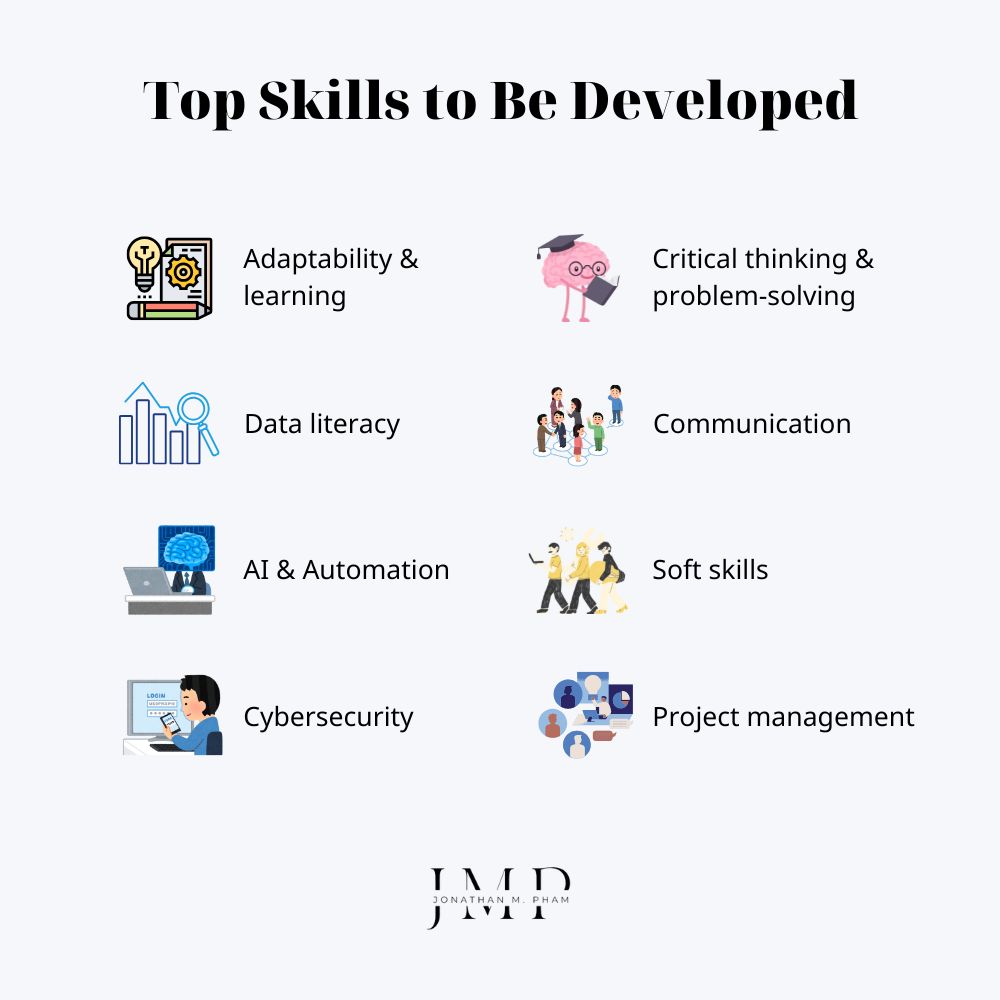
In an era profoundly shaped by AI, automation, and data, digital and data literacy are no longer optional – they are foundational competencies. Understanding digital tools, platforms, and online environments is indispensable for effective communication, collaboration, and accessing information.
Furthermore, the ability to not just collect but to comprehend, interpret, and critically evaluate data is increasingly vital across diverse industries and roles. This includes understanding data privacy, security, and ethical considerations in the digital realm.
Example: Think about a teacher who needs to transition to online teaching. Digital literacy is crucial for using learning management systems, creating engaging online content, and facilitating virtual classrooms. Data literacy becomes important when they analyze student performance data to tailor their teaching methods effectively.
While becoming an AI expert isn’t necessary for everyone, a foundational familiarity with machine learning technologies and automation is increasingly essential for professionals across virtually all sectors. Understanding how AI and automation are transforming industries, and what opportunities and challenges they present, is crucial for strategic career planning.
While technical skills like coding, programming, data science, and engineering remain highly valuable for those directly building and implementing AI systems, even non-technical roles will benefit from understanding AI’s capabilities and limitations, and how to work alongside AI-powered tools.
Example: A journalist doesn’t need to be a programmer, but knowing how AI algorithms curate news feeds and analyze data can help them critically evaluate information sources and potentially improve the ability to do research.
Read more: Will AI Kill Us All? Reflecting on the “Bogeyman” of the 21st Century
Every individual, regardless of their role, likely handles sensitive data, whether it’s customer information, financial records, or intellectual property. Knowing how to create strong passwords, recognize phishing attempts, use secure networks, and understand basic data protection principles are fundamental competencies for everyone.
Skills such as identifying bias, evaluating evidence from diverse sources, and finding creative resolutions to intricate challenges are indispensable for navigating today’s dynamic, ambiguous, and often overwhelming environment. Automation can handle routine tasks, but critical thinking and problem-solving are essential for tackling novel, ill-defined, and complex issues.
In a world overloaded with information, the ability to reason also becomes crucial for discerning credible sources, identifying misinformation, and making sound judgments based on evidence rather than assumptions or biases.
Mastery of active listening, clear and concise communication (both verbal and written), and proficiency in virtual collaboration tools is increasingly essential, particularly in today’s increasingly distributed and remote work environments. These skills bridge geographical divides, foster understanding, and enable teams to work synergistically towards shared goals.
As technology increasingly automates routine and transactional tasks, distinctly human competencies like empathy, leadership, interpersonal skills, and teamwork are gaining even greater prominence and are increasingly what distinguish high-performing individuals and teams. Emotional intelligence (EQ), which involves understanding and effectively managing your own emotions, recognizing and influencing those of others, is crucial for fostering strong relationships, building trust, navigating interpersonal dynamics, and leading with compassion.
Read more: 35 Emotional Intelligence Questions to Attain Self-mastery
Imagine a marketing team launching a new product campaign. Project management skills are essential for planning the various stages of the campaign, delegating tasks to team members (content creation, social media promotion, advertising, etc.), managing the budget, tracking deadlines, and ensuring all components come together smoothly for a successful launch.
Even in personal life, such skills can be applied to organize a complex event like planning a wedding or managing a home renovation, bringing structure and efficiency to large, multi-faceted endeavors.
Even in such technical lines as engineering, about 15% of one’s financial success is due one’s technical knowledge and about 85% is due to skill in human engineering, to personality and the ability to lead people.
Dale Carnegie
Build your skills, not your resume.
Sheryl Sandberg
Identifying skills for development is a crucial first step in your journey toward improvement.
Without Knowledge, Skill cannot be focused. Without Skill, Strength cannot be brought to bear and without Strength, Knowledge may not be applied.
Alexander the Great

How to build a skill development plan: Start by understanding yourself
Read more: 200 Self-reflection Questions – Toolkit for Life Pilgrims
The abundance of resources and opinions these days makes it confusing for a lot of us when it comes to selecting the most relevant competencies to work on. Moreover, keeping abreast of rapidly evolving technologies and industries also poses a significant challenge – especially for the previous generations.
Not to mention, our innate tendency to overestimate strengths and underestimate weaknesses further complicates the process, making it difficult to objectively identify areas for improvement.
Balancing competing priorities such as work, personal life, and skill development often leads to procrastination and disrupted learning plans. Sustaining motivation, especially in the face of initial setbacks, proves challenging for many of us – who often find themselves struggling to find dedicated time for learning amidst busy schedules.
High-quality training programs and resources may not be readily accessible to everyone – and even for those who have access to them, the plethora of learning methods available just makes things complicated.
Furthermore, the absence of encouragement and guidance from peers, mentors, or colleagues is also another factor that hampers progress and accountability.
Translating acquired skills into real-world applications necessitates practice and adaptation. However, our fear of failure – as well as limited opportunities within current roles – often inhibits the efforts to utilize newly developed competencies.
The perpetual evolution of skills demands ongoing learning and adaptation, which can be draining for many people. Integrating skill development into daily life without neglecting other obligations requires diligent effort to sustain motivation and seek challenges for growth.
Overcoming these hurdles requires a proactive and tailored approach. By acknowledging individual challenges, seeking support from peers and mentors, and implementing effective learning strategies, one may navigate the complexities of skill development with greater efficacy.
Don’t wish it were easier. Wish you were better.
Jim Rohn
Read more: 10x Thinking – Elevate Your Success to New Heights
Nobody ever mastered any skill except through intensive persistent and intelligent practice.
Norman Vincent Peale
Below are some tips for individuals to consider applying to their professional development journey.
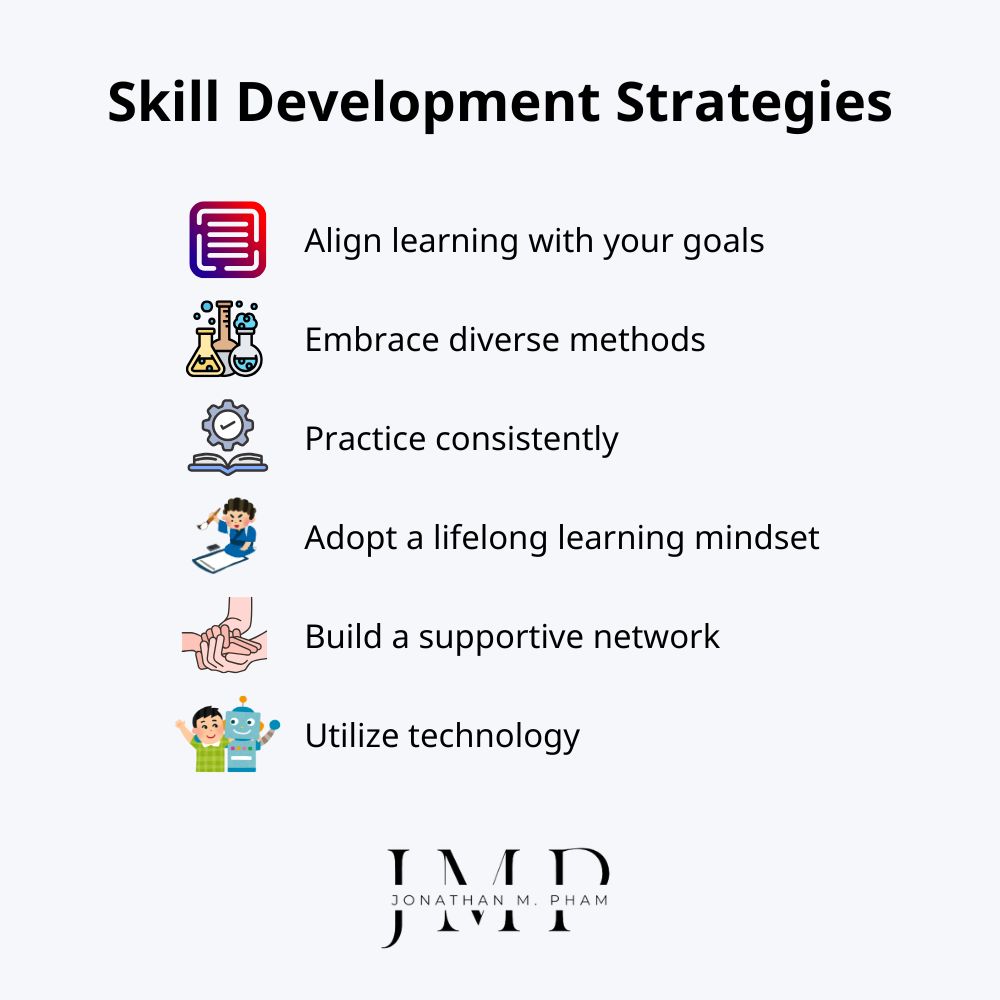
You should prioritize developing skills based on their direct relevance to your career aspirations, your current role’s evolving needs, and even your personal growth objectives. This means taking a deliberate approach to skill selection rather than randomly chasing trends.
A truly strong skillset is not just about technical expertise; it also encompasses crucial competencies like communication, teamwork, adaptability, and emotional intelligence.
Actionable steps:
Read more: Life Management – How to Design a Life You Love
Are you primarily a visual learner (preferring diagrams, videos), auditory learner (lectures, discussions), or kinesthetic learner (hands-on activities, practice)? Tailor your learning methods to align with your preferred style for optimal engagement and deeper absorption of information.
Actionable steps:
To move beyond simply passively consuming information and to attain genuine self-mastery, it’s crucial to engage actively with the learning material and practice consistently. This means moving beyond reading or watching to actively applying what you learn through exercises, participating in discussions, and undertaking real-world projects whenever possible.
To combat procrastination and maintain motivation, inject enjoyment into your learning process by selecting topics that genuinely pique your personal interest and choosing interactive learning methods that keep you engaged and energized.
Actionable steps:
Repetition is the mother of skills.
Tony Robbins
Skill development is an ongoing process that requires continuous improvement. As such, you should stay updated on industry trends and emerging technologies to remain relevant in the field.
Actionable steps:
It is recommended that you surround yourself with like-minded individuals – while seeking guidance from experienced professionals. Networking with peers, joining communities, and seeking mentorship opportunities (whether on your own or by leveraging your employer’s resources) all offer invaluable sources for receiving support and feedback. In addition, partnering with a learning buddy or accountability partner is also a good option to enhance motivation and share learning experiences.
Online learning platforms provide convenient access to a wealth of resources and personalized learning experiences. Consider employing productivity tools for time management, organization, and progress tracking to enhance efficiency. On top of that, stay connected with the latest trends through industry publications and online discussions, so as to facilitate continuous learning and professional development.
How to improve skill development
Here’s an example of a skill development plan you may adapt for your own needs:
Name: John Doe
Occupation: Marketing Specialist
Career Goal: Become a Marketing Manager within 2 years
Skill Area: Digital Marketing Analytics
Strengths: Strong understanding of basic marketing concepts, and experience with social media advertising.
Weaknesses: Limited knowledge of advanced analytics tools, and difficulty interpreting complex data sets.
Goal: Develop proficiency in using Google Analytics and create data-driven marketing campaigns.
Timeline: 6 months
Action Steps:
Resources:
Evaluation:

Knowledge and skill development for work
Individuals:
Teams:
Check out a full list of skill development quotes here!
Skills are never taught, they are acquired. I can give you a camera, but can’t feed your vision.
Raghu Rai
The more we give importance to skill development, the more competent will be our youth.
Narendra Modi
You can cut down a tree with a hammer, but it takes about 30 days. If you trade the hammer for an ax, you can cut it down in about 30 minutes. The difference between 30 days and 30 minutes is skills.
Jim Rohn
Practice is just as valuable as a sale. The sale will make you a living; the skill will make you a fortune.
Jim Rohn
Skill is the unified force of experience, intellect and passion in their operation.
John Ruskin
My best skill was that I was coachable. I was a sponge and aggressive to learn.
Michael Jordan
Read more: Habits in Personality Development – A Comprehensive Guide

Other resources you might be interested in:

A long time ago, in a provincial town far, far away… There was a wealthy, cynical landowner named Fyodor Pavlovitch Kara [...]

Let us visit a fictional place: The Village of the Valley. Once upon a time, those who lived there were divided into two [...]

Has this ever happened to you? Let’s say you are suffering from a frustrating health issue, or stuck in a chaotic life d [...]