




0808
Personal Philosophy: What is Your Truth & Stance for Living?
A long time ago, in a provincial town far, far away… There was a wealthy, cynical landowner named Fyodor Pavlovitch Kara [...]
Discover the art of self-leadership, including key concepts and strategies, to start mastering your life and unlocking your full potential!
Whether you’re aiming to crush professional goals, build stronger relationships, or simply master your inner world, self-leadership is a critical element that will empower you to rise above limitations and become the architect of your own destiny. Below, we will explore the core principles of leading self, its transformative impact, and practical strategies to cultivate the essential skills.
Highlights
Self-leadership – also referred to by other terms such as personal leadership/ self-empowerment/ self-mastery/ leading self – is the ability to take charge of your own life and drive yourself toward your goals. It’s about understanding your values, strengths, and weaknesses, using those insights to set intentions and motivate yourself, and taking responsible action to achieve them. It’s the inner compass that guides you through life’s challenges and opportunities.
Key aspects/ characteristics of a self-leader:

Self-leadership is observable in various aspects of our lives, including:

While both self-leadership and self-management are crucial for personal growth and success, there are key distinctions between the two concepts.
The former involves setting personal visions, values, and strategies, and adjusting one’s own behavior and performance accordingly. On the other hand, the latter is a subset of the former – it is more focused on the operational and tactical aspects of achieving goals. Specifically, self-management is about controlling and directing actions, emotions, and thoughts, according to one’s objectives and standards.
Self-leadership is aimed at enhancing your skills, abilities, and outcomes – in other words, it’s about visualizing the future you desire. For self-management, the focus is on maintaining efficiency and competence, and overcoming distractions, temptations, and obstacles. As such, it’s about optimizing the present.
Think of self-management as driving a car efficiently within a set course. You control the speed, gear changes, and fuel usage, but the destination is already determined. Self-leadership, on the other hand, is choosing the destination, planning the route, and making adjustments on the fly as needed. You are the driver, navigator, and mechanic all in one.
Below is a more detailed breakdown of the differences between the two terms:
| Feature | Self-leadership | Self-management |
| Focus | Change, vision and growth | Tasks and efficiency |
| Approach | Proactive, strategic and creative | Reactive, operational and practical |
| Motivation & Direction | Internal factors (e.g. personal growth, purpose, and fulfillment) | External factors (e.g. deadlines, rewards, or consequences) |
| Autonomy | High | Moderate |
| Scope | Encompasses various aspects of life, including personal growth, career, relationships, and well-being | Primarily focuses on managing specific tasks and resources within a defined context |
| Goals | Set by oneself | May be set by others |
| Examples | Personal projects, overcoming challenges | Time management, to-do lists |
While distinct, the two can coexist and support each other. Strong self-management skills help you execute your self-leadership goals effectively. Conversely, self-leadership empowers you to manage your time and tasks in a way that aligns with your vision and values.
Self-leadership is the DNA of life leadership. It is the core of leading yourself and others.
Gary Ryan Blair
Self-leadership is an incredibly important skill for several reasons. The benefits it offers span across various aspects of your life, including:
Learning to lead yourself requires the cultivation of a deeper understanding of your values, strengths, and weaknesses, which provides the foundation for better decision-making and personal development. You become the person in charge of your life, make choices aligned with your values, and shape your own path. The result is a more authentic, purposeful, and fulfilling existence.
You are less reliant on external motivators – while at the same time becoming more capable of setting ambitious goals, and overcoming challenges with intrinsic drive. In the workplace, you begin taking ownership of your work, managing time efficiently, and delivering high-quality results consistently. Setbacks are now less intimidating, as you are now more resilient and efficient in terms of adjusting to changing circumstances.
Research by McKinsey has defined self-leadership as one of the critical capabilities required for the future of work – especially considering the advancements of automation, artificial intelligence, remote work, and various other emerging trends. Being able to take initiative, seek opportunities, and advocate for yourself is crucial to paving the way for professional growth and promotion. Not to mention, it also transforms you into a lifelong learner who constantly seeks ways to expand your knowledge and skills.
You can’t lead others if you can’t lead yourself.
Andrew Bryant
Leading self is the foundation for effective leadership. When you are able to manage yourself effectively, you become a role model who inspires and motivates others through initiative, accountability, and clear vision. Not to mention, it also enables you to make informed choices based on shared values and goals, leading to better outcomes for yourself and the team.
Another study by McKinsey has revealed that the annual cost for organizations might go up to 160,000 dollars per year if they don’t invest in self-improvement for the leaders. Given the dynamic and unforgiving nature of the business world these days, companies are – more than ever – encouraged to take into account the ability to lead oneself as a crucial aspect of their training and development initiatives.
Read more: 8 Characteristics of Decision Making
Another significant benefit of self-leadership is a boost in one’s overall well-being and life quality. Being aware of – and capable of regulating yourself translates to better stress management, self-compassion, and greater overall satisfaction. You trust your abilities, celebrate successes, and believe in your potential to visualize the future you desire.
You express your needs and listen actively, fostering stronger connections. Whether it’s your colleagues, clients, or loved ones, you become capable of navigating the intricacies of all interactions, building trust, managing conflicts, and collaborating constructively.
Great leadership starts with self-leadership
Self-leadership theory has evolved over several decades, drawing from various fields like psychology, management, and social cognitive theory.
One of the most influential frameworks is the Revised Self-Leadership Questionnaire (RSLQ) developed by Houghton and Neck (2002). The RSLQ is a 35-item measure that assesses three dimensions of self-leadership:
Another important model is the Positive Self-Leadership Development Framework proposed by Du Plessis (2019) – which suggests that self-leadership stems from 4 domains of personal strengths:
And then we have the 8Cs of Self Leadership framework, which defines 8 essential components of personal mastery as follows:

Pillars of self-leadership
Self-leadership is about awareness, tolerance, and not letting your own natural tendencies limit your potential.
Scott Belsky
Developing self-leadership is a dynamic and continual process that unfolds throughout one’s life. It requires conscious effort, reflection, and ongoing adaptation. Here are some key contributing elements and components:
Internal factors/ qualities
External factors
Other key components of development
Read more: Self-coaching – The Art of Being Your Own Coach

Foundation skills & qualities for personal leadership
One significant hurdle to self-leadership is the presence of self-doubt and imposter syndrome, where individuals frequently question their capabilities, engage in unfavorable comparisons with others, and grapple with the feeling of not deserving their achievements. This internal questioning can severely hinder progress and stifle the pursuit of goals.
Furthermore, procrastination and a lack of discipline make it difficult to initiate tasks and sustain the necessary drive to achieve aspirations. Negative self-talk and perfectionism also create substantial mental barriers, as individuals become overly critical of themselves, set unrealistic expectations, and develop a fear of failure that impedes growth.
On the other hand, a lack of self-regulation – i.e. difficulty in managing emotions, the tendency to feel overwhelmed by circumstances and struggle to handle pressure – is another common factor that undermines one’s capacity for self-leadership.
In today’s fast-paced world, distractions abound, making it difficult to juggle responsibilities, manage interruptions, and prioritize tasks efficiently. The prevalent busyness makes it tough to set boundaries and integrate self-leadership activities into one’s daily routine – thereby resulting in issues such as loss of work-life balance, conflict, and burnout.
Moreover, the absence of robust support systems, such as encouraging peers, mentors, or positive role models, leave many people feeling isolated and lacking motivation on their journey. Negative influences and social pressures further complicate matters, potentially leading to conflicting priorities and negatively impacting self-efficacy.
Lastly, an over-reliance on external motivation, where individuals depend solely on external rewards and recognition, also diminishes intrinsic drive and hinders individual growth.
As intimidating as the problems above may seem, everyone faces challenges from time to time; the key is to learn from them, adapt, and keep moving forward. By getting to know your strengths and weaknesses, building resilience, and seeking support, one will be better equipped to overcome obstacles and unlock their potential.
Self-awareness – Key to effective leadership
As mentioned, the cornerstone of effective self-leadership lies in deep knowledge of oneself. This journey of self-discovery begins with introspection and a commitment to understanding your inner world.
One powerful tool for this is journaling, where you regularly take time to reflect on your daily experiences, thoughts, and emotions. Regular journaling makes it easier for you to identify recurring patterns, understand your values, pinpoint your strengths and weaknesses, and recognize your emotional triggers.
Beyond internal reflection, gaining objective insights is also crucial. Personality assessments, such as the Myers-Briggs Type Indicator or StrengthsFinder, provide a structured framework for knowing your inherent personality traits – as well as for highlighting areas that require development efforts.
At the same time, seeking feedback from trusted friends, colleagues, or mentors offers different perspectives on your strengths and areas where you could work on. These individuals can often realize blind spots or share insights that you might not recognize yourself, providing a more holistic view of your capabilities.
Read more: 110 Self Discovery Journal Prompts by Topic – Daily Growth Toolkit
With a clearer understanding of yourself, the next step in the journey of self-leadership involves setting a compelling direction – which requires establishing specific targets for development. Instead of vague aspirations, you should figure out particular skills you would like to cultivate and practice, such as enhancing your communication abilities, improving your influence, mastering time management, or building emotional resilience. These objectives should align with your self-assessment and desired identity.
To ensure the targets are actionable, it’s recommended that they are framed as SMART: Specific, Measurable, Achievable, Relevant, and Time-bound. This framework provides clarity and focus, making it easier to track progress and maintain motivation.
In case you need to further solidify your vision, consider creating vision boards, which are visual representations of your goals and aspirations. They serve as constant reminders and a source of enthusiasm when things get tough.
It’s worth noting that large goals may feel overwhelming, so it’s beneficial to break them down into smaller, more manageable steps. This way, the overall objective will become less daunting, and you will be able to enjoy a sense of accomplishment as each step is completed. Regularly tracking your progress against these smaller steps and celebrating milestones, no matter how small, is essential for staying motivated and reinforcing positive momentum.
Once a plan with a list of clear goals are in place, the ability to consistently execute that plan is paramount. This is where self-discipline comes into play.
The first requirement for effective self-management is prioritization – you need to discern which tasks are most important and allocate your time and energy accordingly. Learning to identify high-impact activities ensures you are focusing on what truly matters for achieving your goals.
Time management is another cornerstone. Creating consistent routines for work, sleep, and exercise may significantly enhance structure and productivity, contributing to a more predictable and efficient workflow. To better stay on track, practices such as time blocking (where you allocate specific time slots for particular tasks), using the Pomodoro technique (i.e. breaking work into focused intervals with short breaks), or leveraging scheduling apps to organize your day and set reminders may be leveraged too.
Additionally, it is recommended that you do your best to mitigate distractions caused by sources such as social media notifications and unnecessary emails.
Sustaining effort over time requires a strong sense of self-motivation. One powerful way to cultivate this intrinsic drive is to connect your goals to your core values. When your actions align with what you deeply believe in, you’re more likely to feel a sense of purpose and be naturally motivated.
How to foster self-motivation:
Occasionally, remember to reward yourself for your achievements, both big and small. Acknowledging your progress reinforces positive behavior and helps maintain enthusiasm for the journey ahead. These rewards don’t have to be extravagant; they could be as simple as taking a break, enjoying a favorite activity, or acknowledging your accomplishment mentally.
Read more: 70 Questions about Confidence – Blueprint for Fostering Self-Esteem
When faced with problems, mind mapping is an amazing tool for visually organizing information, exploring different facets of the issue, and brainstorming potential solutions. Creating a pros and cons list is another practical approach to decision-making, allowing you to systematically weigh the benefits and drawbacks of various options.
Before settling on a course of action, it is recommended that you actively seek diverse perspectives and consult with others who may have different experiences or viewpoints – so as to avoid potential pitfalls. In case mistakes occur, remind yourself that they are learning opportunities. Take time to analyze past experiences and failures to understand what went wrong and how you can improve your problem-solving and decision-making processes in the future.
Cultivating emotional awareness, which involves identifying your own emotions and understanding their triggers, allows you to better understand your reactions and respond more thoughtfully – especially in difficult situations. For this purpose, mindfulness practices such as meditation or deep breathing exercises should be incorporated into your routine.
Similarly, empathy building, through actively listening to and reflecting on the perspectives of others, strengthens your interpersonal relationships and contributes to more effective leadership.
It’s also crucial to develop healthy coping mechanisms for managing stress – e.g. engaging in regular exercise, pursuing hobbies, spending time in nature, or connecting with supportive individuals. Having a repertoire of coping strategies makes you better equipped to navigate stressful periods without resorting to less constructive behaviors.
In today’s rapidly evolving world, a commitment to continuous learning is essential for sustained self-leadership. As such, you should make a conscious effort to read books and articles that expand your knowledge and skills in areas relevant to your personal and professional goals. Consider taking online courses or workshops to gain structured learning opportunities and acquire new competencies too – and don’t forget to actively expand your network by connecting with experienced individuals such as coaches, mentors, or seasoned leaders.
Importantly, cultivating a growth mindset, which views setbacks as temporary and opportunities, is crucial for resilience and continuous improvement. If possible, try to proactively seek out opportunities to take on more responsibilities, initiatives, and projects within your current role. This not only demonstrates your potential but also provides valuable hands-on experience and accelerates learning.
Self-leadership is an ongoing journey that requires continuous evaluation. Hence, it is vital that you dedicate time for regular self-reflection to assess your progress, identify areas where you can improve, and make necessary adjustments to your strategies.
Don’t rely solely on your own perspective; from time to time, you should aim to reach out to those you trust to ask questions about your performance. If applicable in your work environment, utilize performance reviews as a formal opportunity to identify your strengths and areas for development based on your manager’s perspective.
Above all, maintain an attitude of openness to learning. Be receptive to feedback, even if it’s challenging to hear, and be willing to adapt your approach based on new information and insights. This commitment to continuous improvement is a hallmark of effective self-leadership.
Read more: Life Management – How to Design a Life You Love
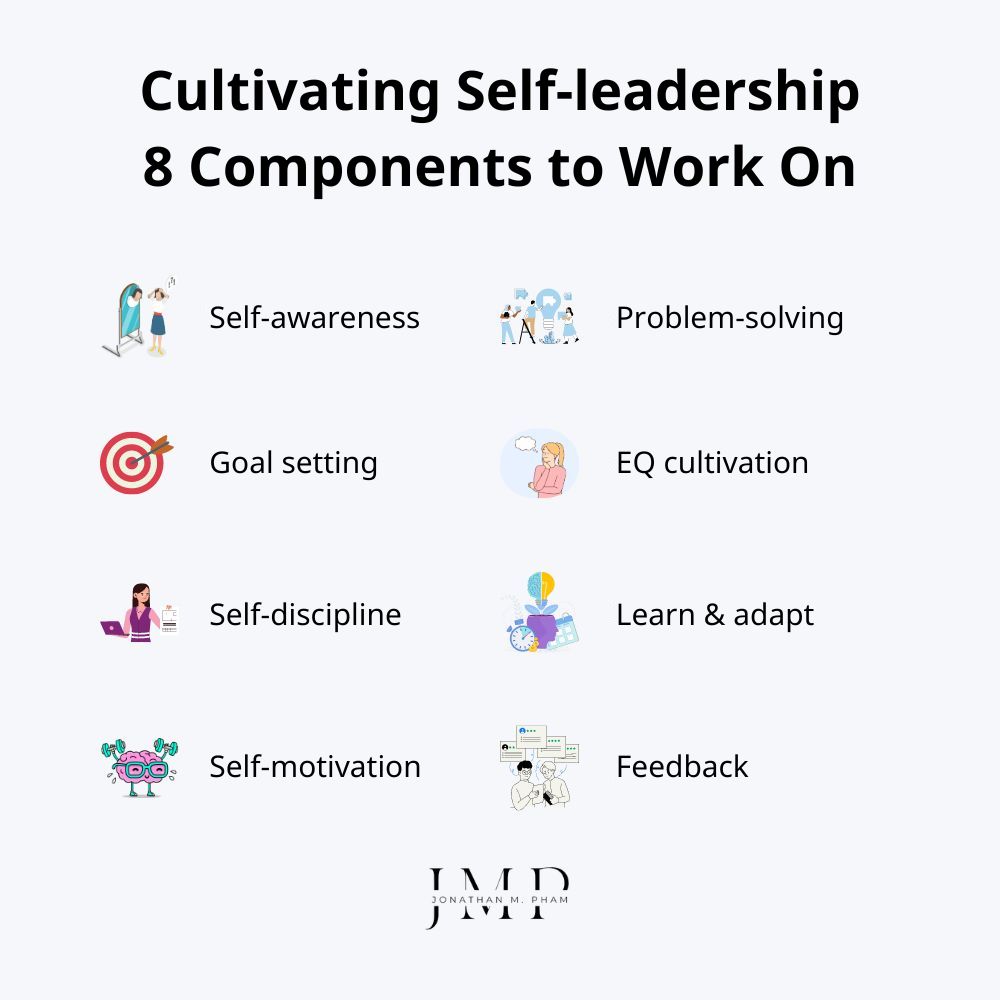
Stages of self-leadership
Self-awareness:
Goal setting:
Self-discipline:
Self-motivation:
Problem-solving & decision-making:
Emotional intelligence:
Learning & adaptability:
Collaboration & support:
Read more: 200 Self-reflection Questions – Toolkit for Life Pilgrims

Self-leadership exercises & activities
Read more: 32 Self Discovery Activities – Embarking on an Adventure Within
Check out more quotes about self-control and self-management here!
Self-leadership is the process by which you influence yourself to achieve your objectives.
Andrew Bryant
Self-leadership is not a rare ability reserved only for the Mark Zuckerbergs and Oprah Winfreys of the world. It is a mindset and skill set that can be learned and taught.
Susan Fowler
Self-leadership is the capacity to lead yourself to overcome your fears and limitations, to achieve what you want in life, and to become the person you want to be.
Brian Tracy
Mastering others is strength; mastering oneself is true power.
Lao Tzu
Knowing yourself is the beginning of all wisdom.
Aristotle
The first and best victory is to conquer self.
Plato
Whoever has no rule over his own spirit is like a city – struck down without walls.
Proverbs 25:28


Self-leadership is a continuous process that requires perseverance and constant effort. It is through this process that we are given the opportunity to discover our personal potential, visualize our vision, and create a fulfilling life. Even if there are challenges along the way, just have faith and work on improving yourself day by day!
Bon voyage!
Other resources you might be interested in:

A long time ago, in a provincial town far, far away… There was a wealthy, cynical landowner named Fyodor Pavlovitch Kara [...]

Let us visit a fictional place: The Village of the Valley. Once upon a time, those who lived there were divided into two [...]

Has this ever happened to you? Let’s say you are suffering from a frustrating health issue, or stuck in a chaotic life d [...]