



0808
Personal Philosophy: What is Your Truth & Stance for Living?
A long time ago, in a provincial town far, far away… There was a wealthy, cynical landowner named Fyodor Pavlovitch Kara [...]
Let us reflect on how to adopt a more meaningful approach to life management – how to align one’s mind, time, and energy with their most authentic self.
Your life is the most beautiful and important creation you will ever be a part of. And yet, so few of us treat it with the care and intention we would give to planting a garden or writing a story.
Instead, we often find ourselves reacting – pulled in a dozen directions by an endless stream of demands, our days dictated by inboxes rather than values. It’s no wonder so many of us feel a frustrating disconnect: a feeling of being constantly busy – but not truly alive.
This isn’t a failure on your part; it’s a symptom of a world that prizes productivity over peace.
Fortunately, there is another way. By learning about the art of life management, we can gradually shift from this reactive state to one of proactive, heartfelt intention.
Highlights
When you hear the term “life management,” what comes to your mind?
For many of us, it sounds… corporate. It brings up images of spreadsheets, optimization, and squeezing every last drop of productivity out of each day. We think of “managing” our lives like a business project.
But what if that’s not what it’s about at all?
What if true “life management” has nothing to do with becoming a high-performance machine and everything to do with… coming home to yourself?
For those who are familiar with that feeling of being constantly busy – but not quite fulfilled, I believe it’s critical that we take a different approach. One that allows us to stop reacting to the world – and instead start living with intention.
In this article, we’re going to explore life management not as a system for productivity, but as a practice of life design. It’s the art of aligning your daily actions with your deepest values. Of consciously organizing the core parts of your life – your thoughts, time, energy, and relationships – to align with the inner voice. Of making this existence feel authentically like your own.
Rather than becoming the “CEO of your life”, it’s about becoming the architect of your own experience.

Examples of how it looks like:
| Aspect | Without Life Management 😬 | With Life Management ✨ |
| Time & Focus | Constantly reacting to incoming demands (e.g., emails) | Proactively protecting time for deep, meaningful work (like a creative project or learning) |
| Schedule Control | Calendar is dictated by others’ priorities | Honoring personal time (rest, hobbies, connection) with the same commitment as an important appointment |
| Outcome | Feeling perpetually busy but not truly productive | Making decisions based on a clear set of personal values |
The old idea that one can separate their “personal” and “professional” selves, building a rigid wall between them, has crumbled. How we live our whole lives – how we rest, how we connect, how we think – is, in fact, all there is.
This is where life management comes in; specifically, it serves as the foundation for a more fulfilling life. Its importance isn’t just about what you do; it’s about how you feel.
Burnout isn’t just a work problem; it’s a soul problem. As researchers and psychologists note, it’s often a “full system shutdown” that stems from a deep disconnection from one’s values and purpose – a result of chronic stress that hasn’t been successfully managed.
Intentional life management – which involves carving out time for play, rest, and quiet contemplation – presents a direct solution to this problem.
Every time you honor a boundary you’ve set, or follow through on a promise to yourself (like taking that walk), you send a message to your inner self: “You matter. Your needs are valid.” This consistency, as concluded in behavioral psychology, is what gives rise to “self-efficacy” – the belief in one’s own ability to manage life’s demands. It’s a cornerstone of emotional stability.
The practice of life design helps move you from a state of reaction (“What does the world demand of me?”) to one of intention (“What do I want to offer the world?”). It allows you to hear your own voice above all the noise.
As you acquire more self-belief and clarity, you naturally become more present, creative, and compassionate – not just for others, but for yourself as well.
Read more: Are You Living or Just Existing? Let’s Find Out!

Before we go on, let’s make one thing clear. Life design is NOT another thing to be perfect at.
The aim is not to achieve a flawless, optimized existence. Rather, it is the iterative practice of noticing, adjusting, and returning to yourself, over and over, with as much kindness as you can muster.
There will be days where you react, where your calendar is a mess, and where you feel completely off-track. That is part of being human, and that is perfectly okay.
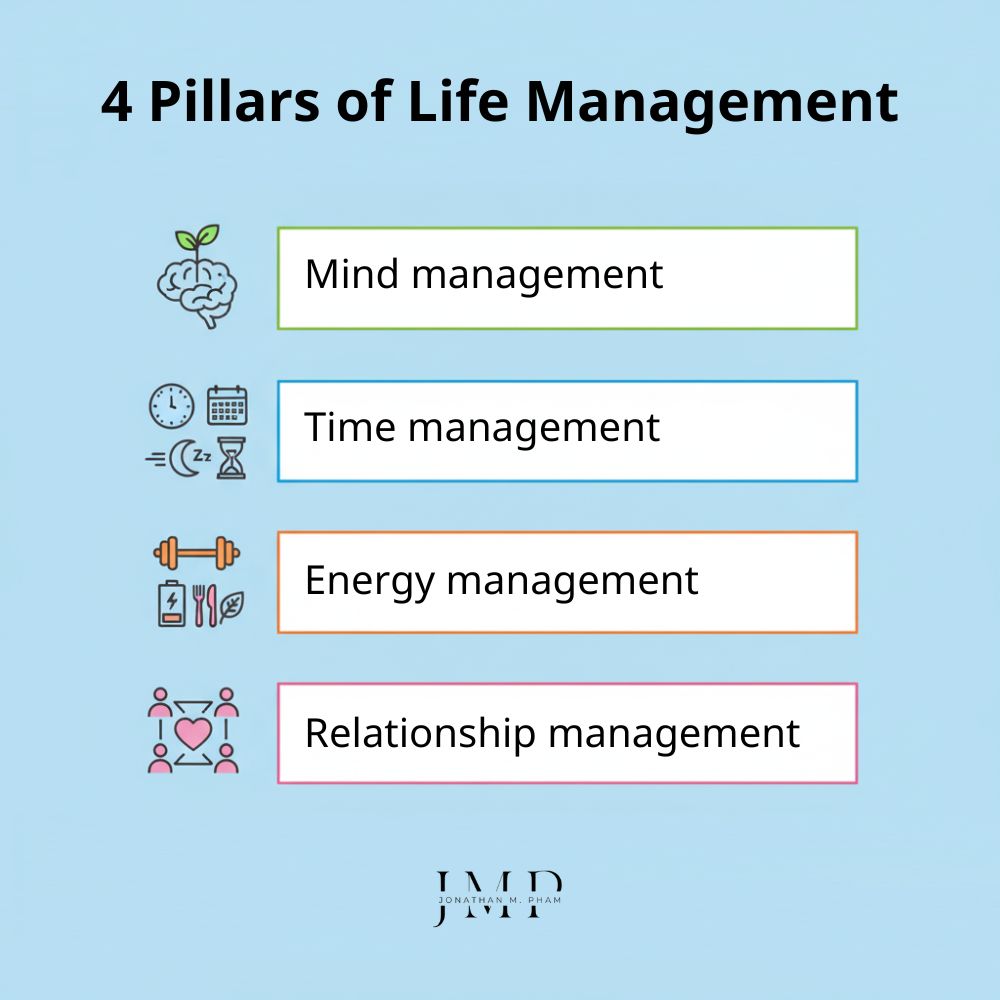
A well-designed life is typically established on the intentional cultivation of four interconnected areas as follows.
What lies within dictates what lies without. As such, it is necessary to start with directing the internal world – your focus, mindset, and self-talk. It’s about being the conscious author of your thoughts, not just a passive observer – so that you may become better equipped to approach challenges with clarity and kindness.
For instance, let’s say you notice your inner critic complaining, “You’re not doing enough”. Mind management, in that case, means intentionally responding with something like, “You are doing your best, and that is enough.”
We all have the same 24 hours, which pass by very quickly. That’s why we need to learn to allocate this finite, precious resource.
When you are clear on your values, you can then schedule your time to reflect them. Specifically, you can distinguish the “urgent” from the truly “important” – and dedicate your best hours to what feeds your soul (e.g. a quiet evening of reading or working on your personal project), not just what meets others’ expectations. (e.g. a social invitation you feel lukewarm about)
Time management is really personal management, life management, and management of yourself.
Brian Tracy
While time is fixed, your energy is a renewable resource that must be actively nurtured. For this purpose, it’s essential that you make commitments to your physical health (sleep, nutrition, and exercise), take regular breaks to avoid burnout, set healthy boundaries to protect yourself from energy-draining activities or relationships, and schedule time for things that truly recharge you.
Example: Instead of scrolling through social media for 30 minutes (and ending up drained – physically and mentally), you decide to instead choose a 15-minute walk outside (and feel restored as a result).
No one walks their own path alone. We are all wired for connection. Hence, we need to intentionally invest in a strong network of supportive, authentic relationships. It means proactively scheduling time to really connect with friends, family, partners, colleagues, coaches/ mentors/ counselors, etc. – to be vulnerable, to listen, and to be seen.
These relationships are not a distraction from your “real life”; they are your real life.
Read more: Not Listening – The Silent Killer in Life
Life management skills
Here are a few simple ways to begin designing your life with greater intention.
Your values are your compass. Hence, you should spend time asking yourself: what truly matters to you?
Write a short personal mission statement that defines what you stand for. You don’t have to show it to anyone. Just review it when you feel lost.
Read more: Meaning of Life – Finding a ‘Why’ to Your Existence
Journaling is a simple, yet amazingly effective tool for untangling your thoughts, celebrating small wins, and understanding your heart. Even five minutes a day is enough to bring immense clarity. On the other hand, you can also consider making use of mindfulness apps like Headspace to help build the crucial muscle of self-awareness.
Read more: Self-coaching – The Art of Being Your Own Coach
Many of us are taught to set SMART goals (Specific, Measurable, etc.). These are fantastic for business projects, but for personal change, they sometimes miss the most important part: how we want to feel.
This isn’t an excuse to be vague or “lazy.” It’s about being more strategic. We’re going to use a two-part method as follows:
1. Set the intentional goal (your ‘why’ or the feeling you’re moving toward).
2. Define the actionable practice (the small, sustainable action you can control).
This way, the practice is your goal, not the outcome. The good feelings follow.
Below is an example to demonstrate the differences between the old and the new way:
◆ The Old Way (Outcome goal): “My goal is to lose 10 pounds.”
The likely (and miserable) process: “I have to force myself to run 3 miles every day and eat nothing but salad.”
The risk: You’ll burn out, hate the process, and give up, feeling like a failure.
◆ The New Way (Intention + Practice):
My intention is: “To feel more vibrant and at home in my body.”
My actionable practice is: “I will move my body in a way I enjoy for 20 minutes, 4 times a week.” or “I will add one nourishing vegetable to my lunch every day.”
Read more: Vision Board – Toolkit for Attracting Abundance
Not everything on your daily checklist is created equal. The key is to direct your best energy to what matters most – by identifying the one or two things that would truly make a difference (e.g. writing, meditating) and doing them first, before the world has a chance to interrupt.
You can do anything, but not everything.
David Allen
In a world of constant distraction, the ability to focus for sustained periods is a true superpower. To maintain concentration and avoid mental fatigue, many people resort to tactics such as the “Pomodoro Technique” (25 minutes on, 5 off).
While it’s definitely a great choice, you don’t have to follow it rigidly. Maybe your rhythm is 45 minutes of deep focus followed by a 15-minute walk. Just listen to your body and decide on a routine that feels nurturing, not punishing.
Read more: Work-life Balance – 14 Tips to Unplug & Recharge
Try to incorporate activities that nurture the soul at specific times of the day. For example, you can design a morning ritual that grounds you (e.g., stretching, reading, no-phone-for-30-minutes) or an evening one that helps you unwind.
Boundaries are the most profound act of self-love. Hence, do not hesitate to respond with a respectful “no” to things that don’t align with your ‘why.’ For example:
“I appreciate you asking, but I don’t have the capacity to take that on right now.” Or,
“I only check work emails until 6 PM, but I’ll look at this first thing in the morning.”
A ‘no’ uttered from the deepest conviction is better than a ‘yes’ merely uttered to please, or worse, to avoid trouble.
Mahatma Gandhi
Don’t leave your most important relationships to chance. Whenever affordable, try to schedule a walk with a friend, a date night, or a long phone call. Treat these connections with the same commitment you would give to any other important appointment.
Read more: Self-leadership – The Art of Leading from Within

Personal life management strategies
These days, we are constantly bombarded with distractions and worries every day, from what to eat to which email to answer. Over time, it depletes our mental energy, making it much harder to make high-quality choices about what truly matters.
Solution: Simplify and automate. The idea is to reduce the number of trivial decisions you have to make each day to conserve your willpower for the truly crucial ones.
Example: This is the principle behind adopting a more minimalist approach or creating strong routines. By planning your outfits for the week on Sunday – or having the same healthy breakfast every morning, you free up your precious mental energy for the choices that truly matter.
When we develop productive (rather than destructive) habits or routines – for example, exercising first thing in the morning, eating the same nutritious breakfast, taking the same hyper-efficient route to work each day – inertia is our friend, keeping us grounded and committed and consistent.
Marshall Goldsmith
We have all been there before, right? Many days, we start with a clear plan, only to later become derailed by “urgent” but unimportant tasks.
Solution: Practice time-blocking. Schedule specific time in your calendar for the most important personal priorities (like that morning writing session or your evening walk). Treat this time with the same discipline you would for an important meeting/ appointment.
The key is not to prioritize what’s on your schedule, but to schedule your priorities.
Stephen Covey
It’s an unfortunate thing, but the fact is that initial enthusiasm for a new routine or system often fades after a few weeks, making it easy for us to revert to old, less effective patterns.
Solution: Start impossibly small. Instead of “meditate for 20 minutes,” start with “sit and breathe for two minutes.” Make it too small to fail. And if possible, try to find a “shared journey” partner – a friend you check in with, not only for “accountability,” but also for shared encouragement and support.
How to manage my life
True life design happens in the moments when you pause to listen to yourself. If you’re feeling called to go deeper, find a quiet space, take a breath, and consider these questions. There are no right or wrong answers – only your own.
On Redefining Life
On The Importance & Self-Compassion
On the 4 Pillars
On Your Strategies & Practices
On Navigating Challenges
Read more: 110 Self Discovery Journal Prompts by Topic

A goal without a plan is just a wish.
Antoine de Saint-Exupéry
The bad news is time flies. The good news is you’re the pilot.
Michael Altshuler
The curious paradox is that when I accept myself just as I am, then I can change.
Carl Rogers
Success is nothing more than a few simple disciplines, practiced every day.
Jim Rohn
We are what we repeatedly do. Excellence, then, is not an act, but a habit.
Will Durant
It is not daily increase but daily decrease. Hack away at the unessential.
Bruce Lee
How we spend our days is, of course, how we spend our lives. What we do with this hour, and that one, is what we are doing.
Annie Dillard
If you don’t prioritize your life, someone else will.
Greg Mckeown
Focus area:Habit formation and behavior change.
Focus area: Personal and professional effectiveness.
Focus area: Science of habits and how to change them.
Focus area: Decluttering and organizing one’s space.
Focus area: Overcoming resistance and unlocking creativity.
Focus area: Turning challenges into opportunities based on the principles of Stoicism.
Focus area: The disciplined pursuit of less; focusing time and energy on the “vital few” things that truly matter.
Focus area: A philosophy of technology use to focus on a small number of carefully selected and optimized online activities.
Focus area: Cultivating authenticity, self-compassion, and embracing vulnerability to live a “Wholehearted” life.
Focus area: Practical and encouraging instructions on writing, life, and overcoming perfectionism and writer’s block.
Focus area: Aligning daily effort with purpose for lasting fulfillment.
Read more: 20 Best Self-discovery Books for Finding Your North Star
🧠 Productivity & Task Management
⏳ Time & Focus
📅 Calendar & Scheduling
🔁 Habits & Goals
🧘 Wellness & Mindfulness
Read more: Daily Life Hacks – 55 Tips for Every Area
Life management, as you may see, is not a one-time event. You don’t just create a plan and follow it perfectly forever.
It is an ongoing practice – one that can get quite messy from time to time. It is a lifelong process of listening to your inner self, making small, intentional choices, and gently returning to the path every time you stray.
It is the art of designing a life that not only looks good, but feels good – one that is a true expression of you.
And above all, it’s not something you write down on paper, but something you do right now. Intentionally, in every moment – every act, thought, and word.
Other resources you might be interested in:

A long time ago, in a provincial town far, far away… There was a wealthy, cynical landowner named Fyodor Pavlovitch Kara [...]

Let us visit a fictional place: The Village of the Valley. Once upon a time, those who lived there were divided into two [...]

Has this ever happened to you? Let’s say you are suffering from a frustrating health issue, or stuck in a chaotic life d [...]