




0808
Personal Philosophy: What is Your Truth & Stance for Living?
A long time ago, in a provincial town far, far away… There was a wealthy, cynical landowner named Fyodor Pavlovitch Kara [...]
Learn about the art of receiving feedback with a growth mindset, plus strategies for turning every insight into a chance for self-discovery.
Receiving feedback is one of the most essential parts of being human. Whether it comes from a partner, a friend, or a manager, feedback is, at its core, a mirror. It provides a glimpse of how we’re perceived, a look into our blind spots, and an invaluable clue to our own growth.
So why does it, many times, feel like an attack?
Our stomachs drop, our cheeks heat up, and a wall of defensiveness goes up instantly.
That’s perfectly normal. It’s just our ego, trying to protect itself. And yet, if we can learn to pause, breathe, and approach that mirror with curiosity instead of fear, we will be able to unlock a profound new level of self-awareness and peace.
The goal is not to become perfect; it’s about becoming whole.
Highlights
When dealing with people, remember you are not dealing with creatures of logic, but with creatures of emotion.
Dale Carnegie
In a purely logical world, all of us would welcome feedback. It’s free data for improvement, so why not?
However, the truth is that we are not purely logical beings. Feedback is hard because, as research confirms, it’s deeply intertwined with our emotional and motivational processes. It strikes at our core needs: to be loved, to be accepted, and to be “good enough.”
Psychologist Sheila Heen, co-author of Thanks for the Feedback, once explained that part of the reason has to do with the activation of our “identity triggers”. We find feedback threatening – because we’re afraid it means we aren’t good enough or will be rejected.
As challenging as it may seem, there are so many good reasons why it’s worth mastering the skill of receiving feedback – and most of them have nothing to do with “organizational success” at all.
It’s easier to see our problems in others than to see them in ourselves.
Marshall Goldsmith
Nobody can see their own face without a mirror. In the same way, we cannot be aware of our own behavioral patterns – how our tone lands, how our actions affect people – without others’ input.
As noted by emotional intelligence expert Daniel Goleman, our self-awareness is limited without external input. In other words, feedback is the only way to see ourselves truly – and realize the bad habits that might be alienating others.
Example: You might think you’re just being “direct” and “efficient,” but in reality, your tone often lands as “harsh” or “dismissive” to your partner. Or, you might have no idea that you have a habit of interrupting people when you’re excited, until a friend gently points it out.

Receiving feedback with a growth mindset
You know what builds trust? Asking someone, “Hey, I really value our friendship. Is there anything I do that makes things hard for you?” and actually listening to the answer.
Being able to do so willingly is proof that you value the relationship more than your own ego. As research has pointed out, this kind of vulnerability is the foundation of authentic connection.
Feedback is not just how we grow – it’s how we connect.
Brené Brown
The growth mindset, a term coined by Carol Dweck, is the belief that one’s abilities can always be developed further. Receiving feedback is the “gym” for that mindset. It’s where you go to actively practice not being fixed and perfect, and to prove to yourself that you are capable of learning and evolving.
The more you hide from potential criticism, the more fragile your self-esteem becomes. On the other hand, when you actively seek feedback, you are telling yourself, “I am strong enough to hear this. My worth is not up for debate.” Over time, it will constitute a resilient core of self-trust and emotional resilience, as you learn to separate your worth from your performance.

Benefits of receiving feedback
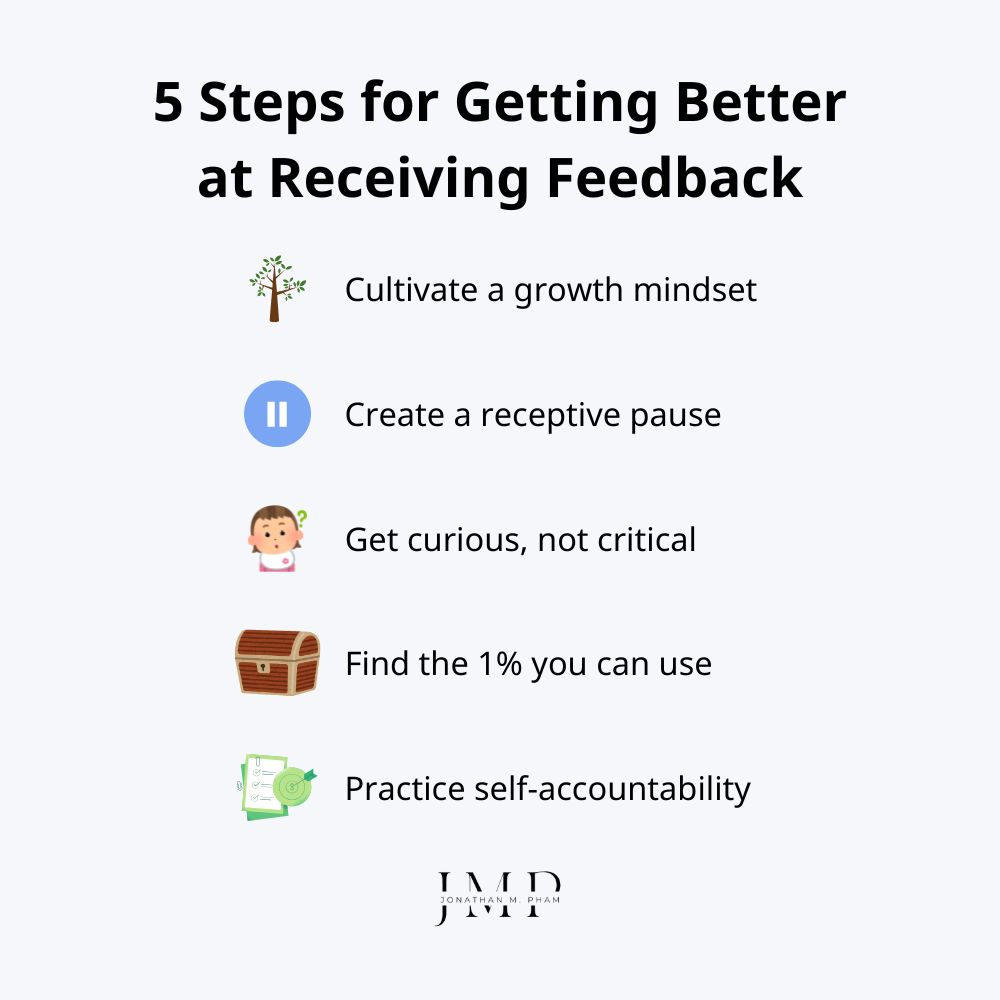
Below are 5 strategies that can be incorporated to influence your acceptance of feedback. It starts on the inside, long before the conversation ever happens.
This is the most important step. People with a fixed mindset believe their qualities are set in stone; as such, feedback, to them, feels like a final, damning judgment. On the other hand, those with a growth mindset believe their qualities can be cultivated – and they are more likely to view input as helpful information on how to do that.
How to practice: When you feel yourself getting defensive, recall this mantra: “This is not a judgment. This is information.” Remind yourself that your worth is not on the table. Only your actions are being discussed.
Our bodies’ tendency is to react to feedback as a threat. Our heart races, our stomach clenches. This is a “fight or flight” response.
Nobody can be curious and defensive at the same time. As such, your first job is to calm your body.
How to practice: Before you say anything other than “thank you,” take one deep, slow breath. Unclench your jaw. Feel your feet on the floor. A tiny pause, yet it creates just enough space between the trigger (the feedback) and your reaction to choose a different path.
Your inner critic will immediately want to jump in and either attack the giver (“They don’t know what they’re talking about!”) or attack you (“I’m such a failure!”). To counteract it, your job is to act as a gentle journalist.
How to practice: Instead of thinking, “That’s not true!” ask yourself, “I wonder what led them to that conclusion?” or “What is the feeling underneath their words?” Curiosity is the antidote to defensiveness.
Read more: Shooting the Messenger – Why Do We Blame Others for Bad News?
Not all feedback is created equal. Some of it is unhelpful, badly delivered, or just plain wrong. But even in a pile of junk, there is often one small, useful nugget.
How to practice: You don’t have to accept 100% of the input. Just sift through it and ask, “Is there any part of this that rings true?” Maybe 90% is off-base, but that 10%… that’s your gold. Take it, and leave the rest.
Example: Imagine a relative says, “You’re so disorganized, your house is a mess, I don’t know how you live like that!” Your defensive mind wants to scream, “You’re wrong! And rude!” But the curious mind asks, “Is there 1% of truth here?”
Maybe 90% of it is their own baggage. But the 1% truth might be… “I have been feeling stressed by the clutter on my desk.” That’s your gold. You can take that 1% (“I’d feel better if my desk was clear”) and let go of the 90% of judgment.
When somebody makes a suggestion or gives you ideas, you’re either going to LEARN MORE or LEARN NOTHING. But you’re NOT going to LEARN LESS.
Marshall Goldsmith, ‘What got you here won’t get you there‘
Self-accountability isn’t about blaming yourself. It’s about taking ownership of your part – while at the same time remembering to practice self-compassion.
How to practice: Acknowledge your misstep. “You’re right, I did cut you off in that meeting. I’m sorry.” Then, instead of spiraling (“I’m such a terrible person!”), remind yourself: “It’s hard for me to be patient in meetings when I’m excited. I’m working on it.”
Read more: Accountability Partner – The Secret ‘Weapon’ for Goal Visualization
Receiving feedback with a growth mindset
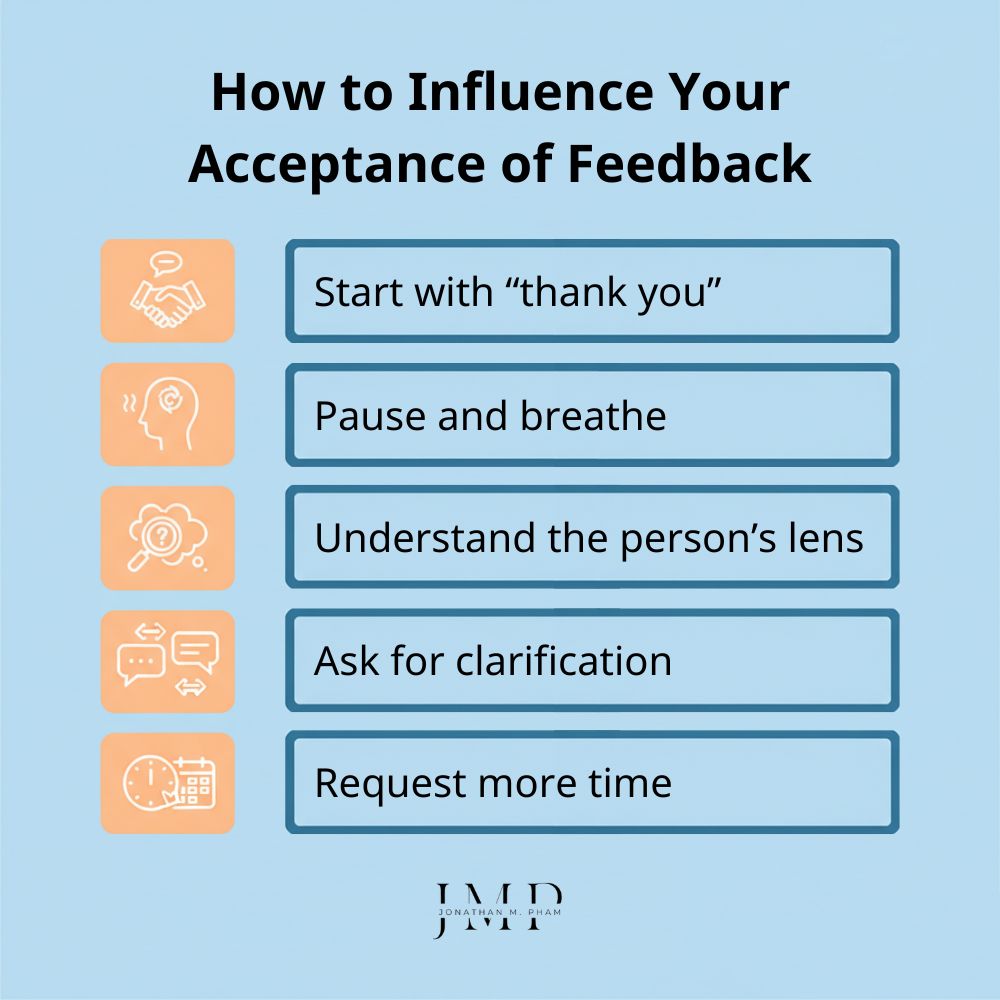
Okay, so you’re in the moment. The feedback is coming, and it stings. Here’s what to do.
This is a “grace-under-pressure” script. It buys you time and signals to the other person that you are not a threat. Many times, a simple, “Thank you for sharing that with me,” or “I really appreciate you taking the time to tell me this,” is all you need.
Do not underestimate the power of one conscious breath.
Instead of just judging the information, consider its source too. Is this person always critical? Then maybe you need to filter their words. Are they usually quiet and this is hard for them? Then their words probably carry extra weight.
The idea is not to dismiss them, but to think about the context of the situation too.
This is a crucial “strategy.” If you don’t understand, ask.
DON’T say: “Why do you think that? I don’t do that!”
DO say: “Can you give me a specific example of when you saw that? It would help me understand better.”
DO say: “Just to make sure I’m following, what I hear you saying is that when I do [X], it makes you feel [Y]. Is that right?”
You are not required to have a perfect, insightful response on the spot all the time. It is 100% acceptable to say: “Thank you so much for this. This is really important, and I want to give it the thought it deserves. Can I take a day to process this and come back to you later?”
Read more: Understanding Emotions – Key to Balance & Success in Life
How to to influence your acceptance of feedback
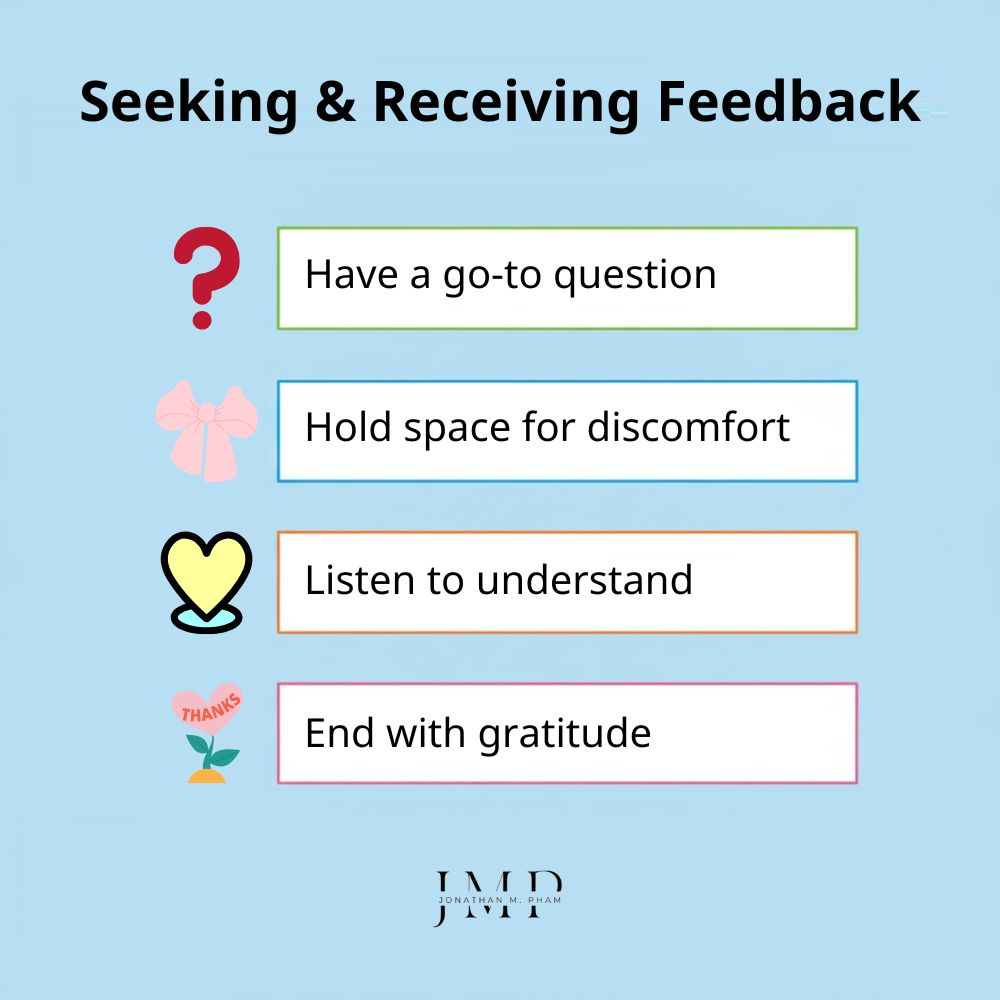
Yes, you CAN ask for it. This is the ultimate growth mindset move.
It may feel awkward to reach out to others and request their opinion. In that case, having a script would make things much easier.
“I’m on a bit of a personal growth journey, and I really value your perspective. Is there one thing you think I do well, and one thing I could work on?”
“How can I be a better friend/partner/colleague to you?”
“What’s one thing I could do differently that would make your life easier?”
Asking for feedback is an uncomfortable experience – not just for you, but for them as well (most of the time, I dare to say). Most people do not want to hurt you. That’s why you should be willing to give them time. Don’t force an answer.
“I know it’s an awkward question, but I’m truly open to hearing it. No pressure, you can always email me later if that’s easier.”
Read more: Coachability – The Secret to Rapid Growth
This is probably the hardest part. Your brain will be screaming to formulate a defense, an explanation, an excuse. You must consciously quiet that voice and remind yourself to just listen.
Remember, you’re a journalist whose only job is to understand the other person’s story.
Read more: Not Listening – The Silent Killer of Relationships and Success in Life
After the conversation (and maybe after you’ve processed it), it’s always a good idea to “close the loop.” Doing so shows you took the person seriously and makes them more likely to be honest and helpful in the future.
Example: “Hey, I wanted to follow up on our chat. I’ve been thinking a lot about what you said regarding [the feedback], and it was really helpful. I’m going to start working on [one small action]. I just wanted to say thanks again.”
Read more: Not Saying Thank You – Why Do We Often Fail to Express Gratitude?
Asking for & receiving feedback with a growth mindset
To find patterns, simple. If one person says you’re “too quiet,” it’s just an individual’s opinion. And yet, if three different people say it, it’s a pattern worth exploring.
Seeking input from diverse sources is key to filtering out personal bias and finding the common, objective truth.
People you trust, who you believe have your best interests at heart, and who have a perspective you value. This could be a coach/ mentor, a trusted friend, a partner, or a colleague you respect.
Not every day! That’s exhausting. Just do it when you feel stuck, after a major project or event, or when you’re starting a new “chapter” and want to set a new baseline for your growth.
The only thing worse than not requesting feedback is not acting on it.
Frank Sonnenberg

More quotes about feedback can be found here!

Receiving feedback with a growth mindset
Mastering the art of receiving feedback is a lifelong journey. You will never be perfect at it. There will be times when you get defensive again – when you feel your feelings get hurt. And that’s perfectly okay.
What’s important is not to become a feedback-receiving robot – but to get just 1% better each time. To shorten the time between feeling defensive and getting curious – from one week to one day, from one day to one hour, from one hour to one minute, from one minute to one second. To treat yourself with kindness whenever you stumble.
Every piece of input is an opportunity to practice. It’s a chance to refine your growth mindset, to pause, to listen, and to see yourself – and others – just a little more clearly.
Other resources you might be interested in:

A long time ago, in a provincial town far, far away… There was a wealthy, cynical landowner named Fyodor Pavlovitch Kara [...]

Let us visit a fictional place: The Village of the Valley. Once upon a time, those who lived there were divided into two [...]

Has this ever happened to you? Let’s say you are suffering from a frustrating health issue, or stuck in a chaotic life d [...]