




0808
Personal Philosophy: What is Your Truth & Stance for Living?
A long time ago, in a provincial town far, far away… There was a wealthy, cynical landowner named Fyodor Pavlovitch Kara [...]
Discover the negative impact of taking credit for others’ work – plus how to address this habit and promote fairness in a team setting.
In the dynamic world of work – where collaboration and teamwork are key, there exists a detrimental behavior that can poison the work environment: taking credit for others’ work. This insidious behavior not only undermines trust and morale – but also diminishes the productivity and effectiveness of individuals and teams.
Highlights
Taking credit for others’ work is a deceptive act that occurs when someone appropriates the achievements of another person – and passes it off as their own. This is a bad habit commonly observed in the workplace and other professional settings – examples include:
Claiming credit for someone else’s work is not only unethical – it also exhibits disrespect towards the original creators. Such behavior disregards the efforts, ideas, and accomplishments of others without providing the appropriate recognition or acknowledgment.
Within a team, this violation of fairness undermines trust – as well as inflicts harm upon the morale and performance of the individuals involved. Furthermore, the reputation and credibility of those who engage in such practices (commonly referred to as “credit stealers”/”credit grabbers”) is often severely tarnished.

The act of taking credit for others’ work presents a compelling ethical dilemma, as it involves a delicate conflict between two fundamental values: honesty and self-interest.
Honesty, a virtue encompassing truthfulness and fairness, plays a pivotal role in establishing trust and fostering respect among individuals. Conversely, self-interest serves as a means to garner recognition for one’s own accomplishments – and propel personal growth within a professional context.
Claiming credits you don’t deserve violates the principles of fair treatment – it implies that you consider yourself superior, and exemplifies a lack of integrity and respect towards the individual who genuinely performed the work. The consequences of such arrogance are often disastrous – including:
The only thing worse than not getting credit for your work is getting credit for someone else’s.
John Wooden

(This section – along with the “Winning at all costs” & “Self-reflection” parts below – is compiled with inspiration from the bestseller ‘What got you here won’t get you there‘, written by World #1 Executive coach, Dr. Marshall Goldsmith)
The act of taking credit for others’ work is a grave transgression that not only robs individuals of the recognition they rightfully deserve – but also unjustly attributes their achievements to ourselves. It is a dual offense.
Now, think of moments in your life – whether in school or at work – where you have accomplished something remarkable and eagerly anticipated compliments from others. You wait – yet eventually, nothing happens.
This scenario is all too common. People often fail to acknowledge your accomplishments, due to the fact that they are preoccupied with their own concerns.
If this had occurred during childhood, you would have expressed feelings of resentment, “It’s not fair!”
Yet, as adults, we learn to accept these disappointments as a facet of life. We told ourselves “That’s life.” This does not negate the fact that you have achieved something exceptional – even if you are the sole witness to your triumph. You redirect your attention towards other matters.
Nevertheless, even the most affable individuals cannot so easily tolerate it – if their unacknowledged merit is suddenly snatched away by someone else. This is precisely what happens when another person claims credit for themselves – they are pilfering your ideas, your self-esteem, and essentially, your very existence.
While we despised such situations during our childhood, as adults, we harbor even greater disdain towards those who appropriate our accolades (partly due to the risks it poses to our careers – and also because of the potential loss of reward, which is far greater).
When a colleague steals the credit for your success, they commit the most exasperating of offenses. This behavior elicits a host of negativity surpassing any other personal failing. The resulting bitterness endured by those affected is indelible.
One may find it OK to forgive others for failing to recognize their outstanding achievements. However, it becomes considerably more challenging to extend forgiveness – when people brazenly seize credit for work that is not their own.
If you have experienced such a situation, you intimately understand the arduous process of letting go and moving forward, as forgetting becomes an uphill battle.
Taking credit for someone else’s work is a surefire way to lose their trust and respect.
Brian Tracy

Stealing someone else’s work is not only dishonest, it’s also a sign of insecurity.
Zig Ziglar
The motivations behind individuals taking credit for others’ work are diverse and can stem from various factors. Some common reasons include:

Taking credit for undeserved accomplishments can be seen as a variant of the desire to win at all costs, under all circumstances.
When it comes to someone else’s resume or academic credentials, it is evident that those achievements belong solely to the individual who earned them. They are meticulously documented and widely acknowledged. There is no way you can take them for yourself.
However, discerning the true contributors to a business’s success in a meeting – or identifying those who have adeptly nurtured relationships with key clients during challenging periods is a much more complex task. Truly, it is challenging to ascertain who genuinely deserves recognition.
Confronted with the choice between claiming credit for ourselves or attributing it to others, we often succumb to the allure of success delusion. We tend to overestimate our own contributions and, over time, begin to genuinely believe in our exaggerated merits.
On the other side, those who fall victim to our arrogance will never forget the injustice done to them.
If you know how it feels like to be the victim, you will likely understand the feelings of those who have been affected by your actions. There is nothing admirable about such behavior, is there?
There are two kinds of people, those who do the work and those who take the credit. Try to be in the first group; there is less competition there.
Indira Gandhi
The detrimental habit of stealing credit can be attributed to various underlying reasons. For instance, it might be that your parents constantly emphasized the importance of being the best, and were never satisfied if your friends – even the closest ones – outshone you.
Although it may be tempting to blame your parents, upbringing, or other factors, focusing on the past won’t provide a solution. Instead of making excuses, it is more productive to direct your attention towards concrete actions and ideas for the future.
The most effective way to break free from this bad habit is to do the opposite – sharing what you have. It may seem like a straightforward exercise, but over time, it will transform you from a self-absorbed person to someone who is willing to acknowledge the merits of those around you.
Dr. Marshall Goldsmith once shared a method in his best-selling book, ‘What Got You Here Won’t Get You There‘. Take a day (or longer, if possible) to pay attention to the moments when you internally congratulate yourself for an achievement, no matter how big or small. Then, jot down those instances on paper.
You will likely discover that you engage in self-congratulation more frequently than you realize. We tend to credit ourselves for everything – from coming up with an exceptional idea for a client to punctuality in meetings, or even presenting a seemingly brilliant proposal to colleagues.
“Hmm, I did a good job, didn’t I?”
These private thoughts are not inherently wrong. The sense of joy we derive from our own accomplishments provides the motivational fuel for us to endure long and challenging working days.
Once you have compiled your self-congratulatory list, take a closer look and ask yourself: Is it possible that someone else deserves praise for “your” achievements?
If you arrive on time for a meeting, is it solely due to your own punctuality and thoughtfulness? Or is it because your assistant diligently sought you out that morning, reminding you of the meeting and making several calls to ensure you left early enough?
If you generate a brilliant idea during a meeting, did it genuinely originate solely from your imaginative prowess? Or was it inspired by an insightful comment from another participant?
As you reflect on your list, ponder this pivotal question:
If someone else were to review these accomplishments with you, would they bestow upon you the same amount of credit that you claim for yourself? Or would they attribute these contributions to others, perhaps even themselves?
You might feel inclined to believe that you deserve all the credits listed. However, if we are truly honest with ourselves, even the most self-centered among us would struggle to arrive at such a conclusion. Human nature is to shape our thinking in ways that favor our own interests.
Read more: Self-questioning – Why Should We Practice It on a Daily Basis?

If you want to be successful, learn to give credit where credit is due.
Eleanor Roosevelt
Acknowledging people for their efforts is not only a gesture of appreciation and respect – but also a catalyst for building relationships and fostering collaboration. Below are tips on how to effectively give credit in the workplace:
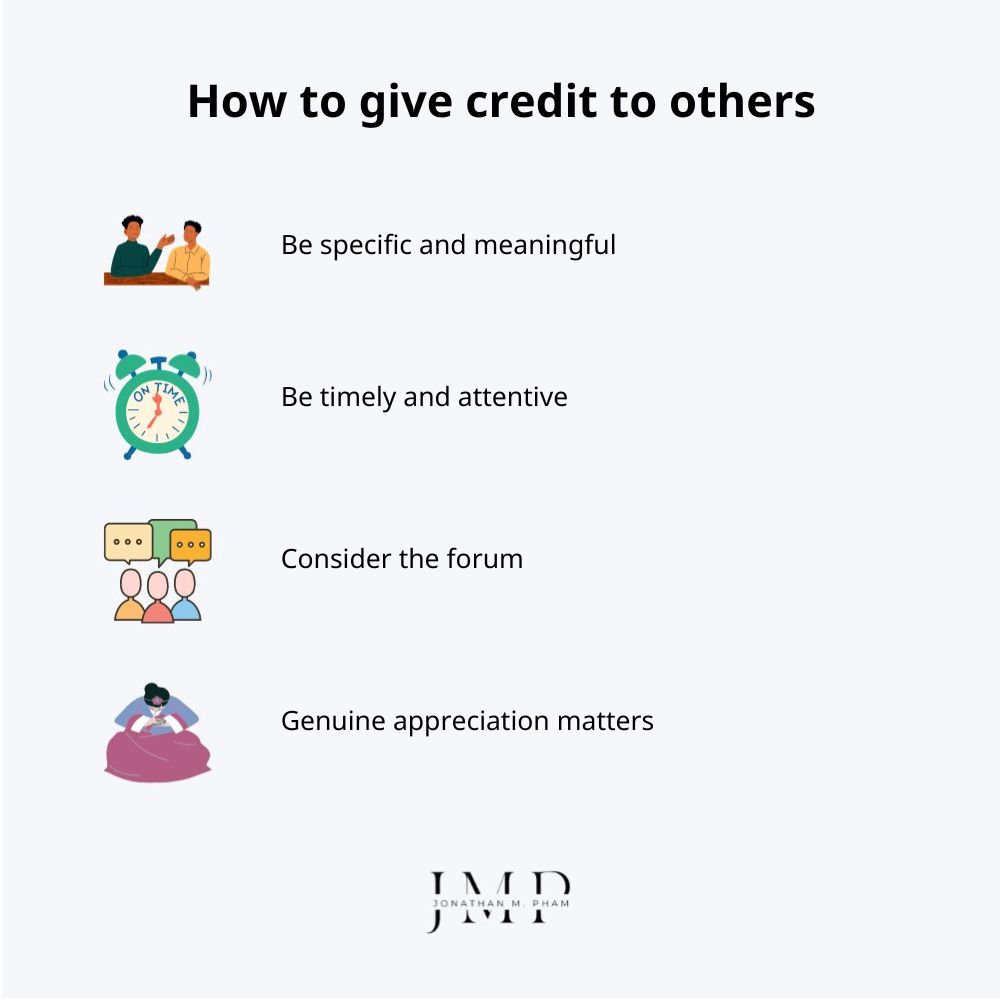
Additional considerations for giving credit:
Here are a few examples of effective credit-giving:
It is more blessed to give than to receive.
Acts 20:35
When faced with the disheartening situation of someone taking credit for your work, it is crucial to respond assertively and professionally. Here are some tips on how to effectively address this issue:
Never wrestle with a pig – because you both get dirty, but only the pig loves it.
Marshall Goldsmith
Resolving the issue of taking credit for others’ work at an organizational level is of utmost importance to maintain a positive work environment and maximize productivity. Here are some recommendations for organizations to tackle this problem:

By recognizing and addressing the detrimental workplace habit of taking credit for others’ work, we can foster an environment where employees feel valued, collaboration thrives, and genuine contributions are acknowledged and rewarded. Through clear communication, transparency, and fair policies, leaders and organizations may cultivate a positive work culture that supports the growth, well-being, and success of individuals and the team as a whole.
You may be interested in:

A long time ago, in a provincial town far, far away… There was a wealthy, cynical landowner named Fyodor Pavlovitch Kara [...]

Let us visit a fictional place: The Village of the Valley. Once upon a time, those who lived there were divided into two [...]

Has this ever happened to you? Let’s say you are suffering from a frustrating health issue, or stuck in a chaotic life d [...]