




0808
Personal Philosophy: What is Your Truth & Stance for Living?
A long time ago, in a provincial town far, far away… There was a wealthy, cynical landowner named Fyodor Pavlovitch Kara [...]
Unlock your potential with this guide to personal development – including key aspects, skills, and tips to promote holistic growth!
Life is a journey of constant evolution; at the heart of that journey lies personal development. It’s not a sprint to a finish line, but a continuous exploration of your potential and a dedicated effort to becoming a better version of yourself everyday. This article is your guide to that exciting quest, offering insights into the key aspects of personal growth, the essential skills to cultivate, and practical tips to navigate the path.
Highlights
Personal development is essentially a lifelong journey of growth and change. A continuous process that happens throughout life – not just at certain times, it involves taking the time to look inward with honesty and effort to understand yourself better. This means regularly thinking about your strengths, the qualities you naturally possess, and what truly gives your life purpose and direction.
Essentially, personal development is about discovering and sharpening one’s potential. It’s about committing to improving yourself in all sorts of ways, not just focusing on traditional measures of success like career or money. Think of it as a journey of significant change driven by intentionally and thoughtfully setting goals. These objectives should be meaningful to you and line up with what you genuinely want in life – as well as what you believe is important. They then serve as “guides”, showing you the way as you work toward becoming the best version of yourself.

The term personal development is often connected with identifying personal goals and working towards them
Personal growth isn’t limited to just one area of life; it touches upon many different parts – including everything from professional goals, interpersonal relationships, physical health, emotional and mental well-being.
Examples:
Think of personal development as “the art of becoming“: a constant process of growth where you actively shape your life course through focused effort, thoughtful self-examination, and consistently striving to realize your potential.
It is hard to keep that which has not been obtained through personal development.
Jim Rohn
One of the biggest advantages of investing in personal growth is gaining a deeper understanding of yourself. It’s about truly knowing who you are, including what’s important to you (values), what you believe in (beliefs), and what you hope to achieve in life (goals). This self-understanding becomes the basis for creating a life that feels genuine and brings satisfaction.
When you become more self-aware, you naturally gain a clearer sense of direction. It’s like having a compass that aids you in navigating all the different options and opportunities.
Once you know what you truly want, it becomes easier to cut out distractions and things that don’t help you get there – as well as spot tasks that will deliver the best results with the time and energy you have. This new clarity not only makes your efforts more efficient – but also makes you feel more productive and effective.
With authentic knowledge of one’s goals comes the realization of why it is necessary to take action immediately. In other words, you become more willing to do the work needed, even if it’s not always fun in the moment. This increased motivation becomes a reliable support for you to keep going toward your personal and career aspirations.
One day you will wake up & there won’t be any more time to do the things you’ve always wanted. Do it now.
Paulo Coelho
Life will always have its challenges. However, the skills you develop as you work on yourself will give you the strength to handle difficult situations with more confidence and flexibility.
As you grow, you become better at recognizing which relationships are healthy, supportive, and therefore worth investing in – as well as which ones might be holding you back and need to be let go of or distanced from. This ability is key to more fulfilling social interactions – it allows you to spend time and energy on those who truly matter, while moving away from those that might hinder your personal growth.
Income seldom exceeds personal development.
Jim Rohn
Back in the day, world-renowned psychologist Abraham Maslow came up with a powerful framework for understanding why human beings naturally want to grow and improve. He proposed a hierarchy of needs made up of different levels. According to him, one needs to meet the lower needs before they can move on to the higher ones.
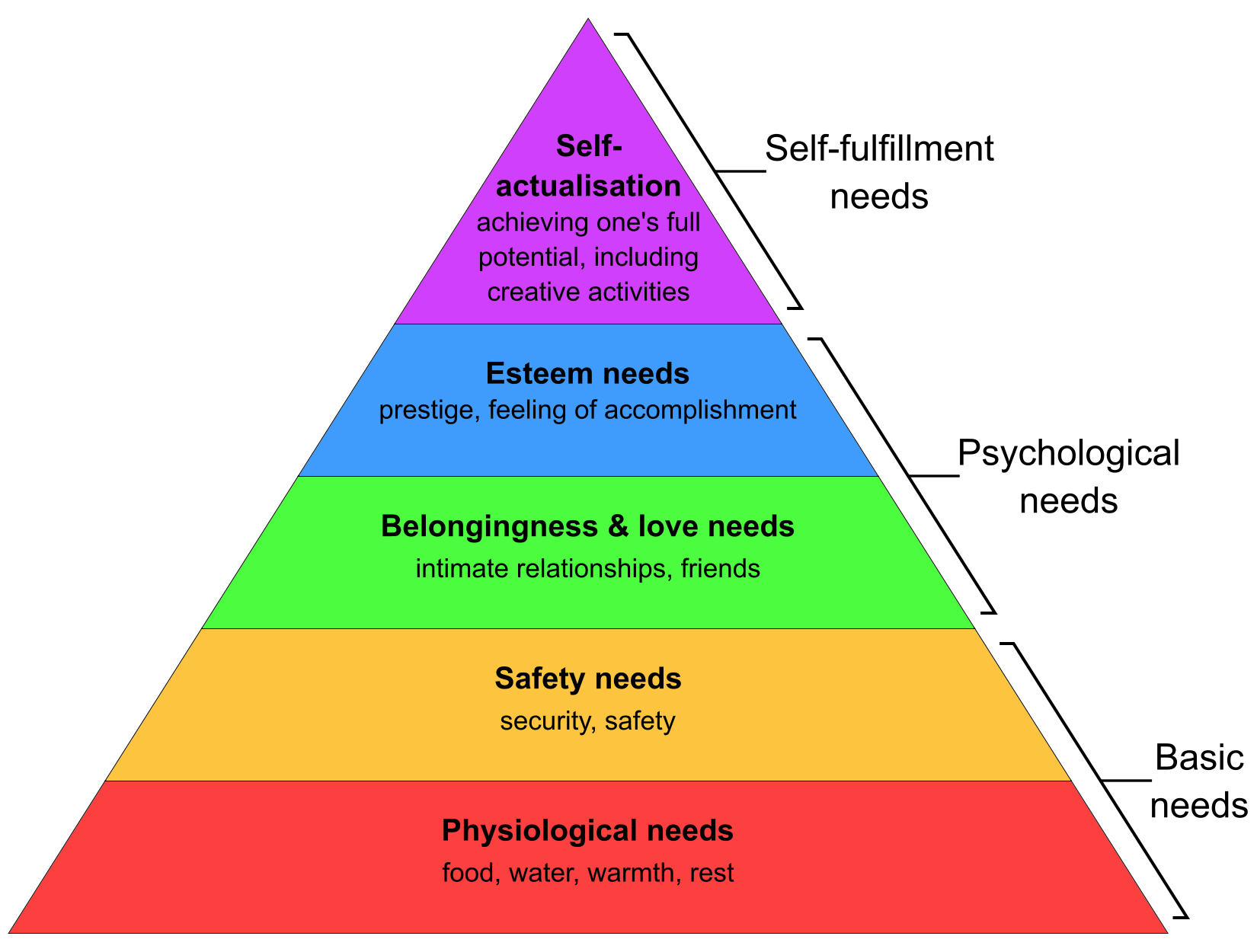
The bottom levels of Maslow’s pyramid are about our most basic requirements: things like food, water, shelter (physiological) and feeling safe and secure (safety). These are the essential things for us just to survive.
Once those basic needs are met, we move up the pyramid, and our focus changes. We start to care more about relationships with others (interpersonal), feeling good about ourselves (self-esteem), and trying to figure out the world and our place in it.
Finally, at the very top of the pyramid is self-actualization – that deep craving we all have to become the best person we can possibly be. As Maslow argued, self-actualization isn’t just a bonus or something extra – it’s a basic human need that we all have from birth. It’s this innate desire to become independent and make sense of our existence (rather than just staying alive) that drives us to engage in activities (e.g. learning, skill development) that promote personal growth.
According to Maslow, the way to self-actualization is made up of different parts, including:
(Maslow, A. H. (1970), Motivation and Personality, (2nd ed.), Harper & Row, New York)
It’s about taking a holistic approach to your body, including things like eating healthy, getting enough rest, being active, and moving your body regularly. The main goal here is to be physically fit and mentally healthy.
It means the ability to skillfully manage different parts of one’s finances – including income, daily expenses, savings, investments, and handling debts. The goal isn’t just about money itself; it’s about attaining the freedom to live the life you want.
These include one’s relationships with other people – family, friends, colleagues, and the broader community. The idea is to cultivate healthy and supportive bonds that allow you to work well with others. Aside, they also help boost self-esteem and improve communication skills.
This aspect of personal growth focuses on what’s going on inside you. It’s about understanding and managing your emotions, feelings, moods, and how you generally approach things. Good emotional health plays a crucial role in deciding how motivated you are, how well you bounce back from tough times, and how happy and satisfied you feel overall.
More than just religious faith, spirituality involves exploration of your inner self and sense of purpose – what you believe in, what’s important to you, what gives your life significance, etc. These factors affect how you see the world, how you define right from wrong, which choices to make, and how much you care about others (i.e. the ability to demonstrate compassion).
Read more: Fulfillment in Life – How to Find Meaning & Passion Every Day
The following competencies, far from being innate talents, can be honed and strengthened through conscious effort.
We are what we repeatedly do. Excellence, then, is not an act, but a habit.
Will Durant

Personal development at work
Read more: Habits in Personality Development – A Comprehensive Guide
(credit to marshallgoldsmith.com)
We know that setting and reaching meaningful goals is at the heart of personal development. That being said, if it’s so important, why do so many people find it hard to stick with it?
Often, when people give up on their goals, it’s because they have run into obstacles. Let’s look at some common roadblocks to understand what can trip us up and how to avoid them:
You might give up if you start to doubt whether your plan will actually work. Basically, if you don’t truly believe in the process or in your ability to change, it’s hard to stay committed.
If you’re trying a new habit but secretly think it’s not for you, you’re less likely to keep going when things get tough.
Personal growth takes time; if you think you should see results immediately, you are likely to get discouraged and give up. It’s important to be patient and understand that meaningful change is a journey, not a sprint.
It’s helpful to be realistic about how long it takes to build a new skill or change a habit, and to also be aware that others might not immediately see the changes in you.
The realization that making changes is harder than one initially thought prompts many of us to get frustrated. Being aware of the challenges from the beginning can help you prepare mentally and prevent discouragement later on.
Life is full of competing demands; it’s easy to get pulled in different directions. If you don’t plan for unexpected challenges and distractions, they can easily derail your progress. Hence, it’s wise to anticipate potential distractions and build in time to handle them.
For example, if you’re trying to wake up earlier, but don’t plan for late-night social events, your goal becomes much harder to achieve.
Personal development is a long-term investment, like planting a tree – you don’t see the full shade immediately. If you expect quick wins, you are likely to give up too soon when you don’t see them.
Remember, the real rewards of personal growth often emerge over time, not instantly.
Reaching a goal is a great achievement; however, true personal development is about making lasting changes. We need to recognize that it is an ongoing process that requires continuous effort to maintain the progress one has made. Think of it like learning to ride a bike – you need to keep practicing to stay proficient.
Success is nothing more than a few simple disciplines, practiced every day.
Jim Rohn

To sum it up, the key to sustainable growth is to come up with goals that are clear and push you to grow, to fully understand the level of commitment you’re making, and to seek help when you need it. This support could come in many forms, like working with a coach, finding a mentor, or joining a supportive community.
Attach your earning to something greater than mere personal ambition.
Dr. Marshall Goldsmith
Life is like a game of chess. To win you have to make a move. Knowing which move to make comes with IN-SIGHT and knowledge, and by learning the lessons that are accumulated along the way. We become each and every piece within the game called life!
Allan Rufus
First, you need to delve deeply into your values, aspirations, and current life state – and carefully consider areas of potential enhancement across (which can cover personal, professional, health, and relationship domains). For example:
| Areas for growth | Description |
| Personal | I often struggle with procrastination; this bad habit has been hindering my productivity and goal achievement. Additionally, I want to improve my public speaking skills, as I sometimes feel anxious and awkward in front of crowds. |
| Professional | I’m aiming for a promotion within the next year, but I need to cultivate stronger leadership skills and demonstrate the ability to manage complex projects. I also need to expand my network within the industry. |
| Health | My physical fitness has taken a backseat lately; hence, I need to prioritize regular exercise and healthy eating habits. I also want to find ways to manage stress better. |
| Relationships | I sometimes have difficulty communicating assertively with my loved ones, which has led to quite a few misunderstandings. I would like to improve my communication skills and strengthen my relationships. |
Next, it’s time to compile a detailed list of objectives. It is recommended that you start with smaller ones to build momentum – and make sure that all of them align with your intrinsic motivation, not external pressures.
Back to the example above, here we have some goals, plus action points to address:
| Areas for growth | Goal | Action |
| Personal | Overcome procrastination and complete tasks on time | Implement a time management system and set realistic deadlines |
| Improve public speaking skills | Join a Toastmasters club or take a public speaking course | |
| Professional | Get promoted to Senior Marketing Manager within one year | Enroll in a leadership development program and volunteer for high-visibility projects |
| Expand professional network | Attend industry events and connect with people on LinkedIn | |
| Health | Exercise regularly for at least 30 minutes, 3 times a week | Join a gym or find a workout buddy to ensure accountability |
| Eat a balanced diet with plenty of fruits and vegetables | Meal prep healthy lunches and snacks in advance | |
| Relationships | Communicate assertively and express my needs effectively | Practice active listening and use “I” statements |
Read more: 250 Bucket List Ideas for Living Your Best Life
Beyond goals, you should also pinpoint the qualities essential for their achievement. For this purpose, it’s essential to holistically assess your current strengths and weaknesses, plus to think about how to enhance and acquire new competencies. For instance:
| Goal | Skills |
| Time management | Project management tools, prioritization techniques |
| Public speaking | Presentation skills, vocal variety, body language |
| Leadership | Communication, delegation, conflict resolution |
| Networking | Conversation starters, building rapport, following up |
| Fitness | Exercise routines, healthy meal planning |
| Communication | Active listening, assertive communication techniques |
For each goal and skill, create a detailed action plan that outlines the tasks, resources, and strategies needed to accomplish them. Set a realistic deadline for each step, and remember to prioritize the most important/ urgent ones.
Explore avenues such as books, courses, workshops, or accountability partners to support your learning journey and overall progress.
Read more: Life Management – How to Design a Life You Love
Dedicate specific blocks of time in your calendar for focused work on your Personal Development Plan (PDP) goals. As usual, consistency is key to ensure that efforts yield results.
Establish methods for tracking and evaluating your progress. Tools such as journals, checklists, charts, or apps may be utilized to document and review both accomplishments and challenges.
Regularly reassess your plan to ensure alignment with your goals and skills. Make sure to celebrate successes and extract lessons from failures. And modify your plan as necessary, either by considering adjustments or introducing more challenging objectives.
Knowing others is intelligence; knowing yourself is true wisdom. Mastering others is strength; mastering yourself is true power.
Lao Tzu
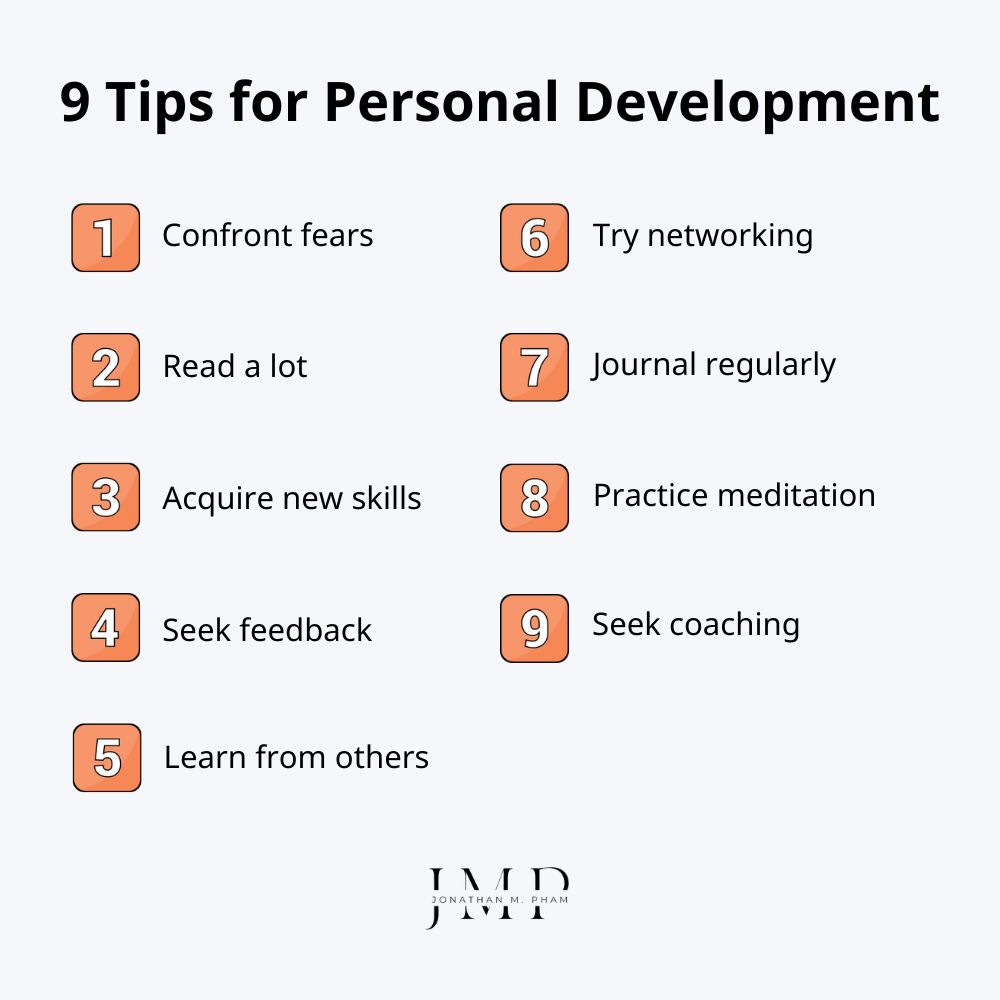
True self-development typically begins with consciously confronting and overcoming your fears. Whether it’s the fear of public speaking, the apprehension of taking calculated risks, or even the discomfort of trying something completely new, actively engaging in activities that push you beyond your comfort zone is crucial.
Facing your fears head-on is like exercising a muscle; it builds resilience, boosts self-belief, and expands what you believe is possible for yourself, directly fueling personal growth. For example, if you’re afraid of networking, commit to attending one industry event and initiating conversations – each time you do, fear’s grip weakens, and your confidence strengthens.
Don’t underestimate the power of reading – it’s a phenomenal gateway to continuous learning and intellectual stimulation. Reading exposes you to new ideas, different perspectives, and vast amounts of knowledge.
It is crucial that you make reading a consistent habit. Set realistic and achievable goals, such as reading a quality educational article each day or dedicating time to a book each month. You’ll be amazed at the profound impact regular reading has on your critical thinking skills, your ability to learn new things, and your overall intellectual growth!
Consider exploring books on topics you’re curious about, even if they seem challenging at first – each book is a new world opened up to you.
Personal development is inherently linked to learning – whether through structured formal training, self-study using online resources, or even picking up a new hobby. In today’s rapidly evolving world, especially considering recent advances in technology, the opportunities for expanding one’s knowledge are endless (e.g. seminars, webinars, online courses, or even personal development software and apps).
Continuous learning not only adds to your skillset but also keeps your mind sharp, boosts creativity, and significantly contributes to your overall self-improvement journey. Think about learning a new language, coding, playing a musical instrument, or even mastering a new recipe.
Absorb what is useful, discard what is not, add what is uniquely your own.
Bruce Lee
Do not be afraid to reach out to your colleagues, friends, mentors, or even family members and ask for their honest opinions on your projects, performance, or even your approach to certain situations. External perspectives are often pivotal for identifying blind spots – including your strengths and areas for improvement that you might not see yourself.
You can consider joining a community of like-minded people – in a professional group, a book club, or an online forum – who can offer support and share relevant experiences and perspectives. Remember to be coachable and genuinely open to constructive criticism. After all, feedback is a gift that can help you improve significantly, so try to receive them with grace and gratitude!
Do you know any people who you genuinely admire? They could be colleagues, family members, historical figures, or public leaders. Observe others closely and consciously identify the specific qualities you adore in them – is it their resilience, communication style, problem-solving approach, or ethical integrity? Once identified, think about how you can consciously incorporate these positive traits into your own behavior. This isn’t about imitation, but about mindful adaptation and growth.
Learning from others offers a practical way to guide your ongoing development by showing you tangible examples of desired qualities in action. If you admire someone’s calm and composed demeanor under pressure, observe how they react in stressful situations and try to apply similar strategies in your own life.
Don’t limit your interactions to your usual circle. Rather, you should intentionally expand your network of relationships by interacting with a diverse range of people – whether through industry events, conferences, workshops, interest groups, online communities, etc.
Connecting with individuals from different backgrounds, professions, cultures, and with different personality types broadens your perspectives significantly and introduces new ideas you might never have encountered otherwise. In addition to fostering personal growth, it also opens doors to new opportunities, collaborations, and support systems.
Make a goal to connect with one new person outside your usual circle each week – you never know what you might learn or what opportunities might arise!
Regular journaling is a powerful tool for self-discovery and reflection. It provides a private space to evaluate recent events in life, analyze your decisions, and reflect on your personal development experiences.
Whether you keep a private diary or share your thoughts publicly through a blog, journaling becomes a valuable platform for goal-setting – writing down your aspirations, tracking your progress, and identifying patterns in your behavior and growth.
Read more: 110 Self Discovery Journal Prompts by Topic
In today’s fast-paced world, finding moments of quiet and stillness is crucial – if not more than ever. It is recommended that you incorporate meditation into your routine to intentionally cultivate inner clarity, reduce stress, and foster a positive mindset. It doesn’t have to be lengthy or complicated – even taking just a few moments of quiet reflection each day, or scheduling short breaks from work for mindfulness exercises, can make a significant difference.
Regular meditation supports a healthier, more balanced, and more focused approach to personal growth, enhancing your emotional well-being, improving concentration, and reducing the impact of daily stressors. Start with just 5-10 minutes of daily meditation and gradually increase the time as you become more comfortable.
Read more: Self-questioning – Why Should We Practice It on a Daily Basis?
A mentor can be someone you admire and respect, like a manager, a professor, a senior colleague, or even someone from your broader network. Their insights, experience, and support may provide valuable direction and encouragement as you work towards your goals.
Moreover, sharing your personal development plan with a mentor or coach adds an element of accountability – knowing you’ll be discussing your progress with someone often makes you more committed to follow through.
Alternatively, or additionally, you can consider signing up for a professional coaching course to learn from and be directly guided by seasoned experts in the field, gaining structured knowledge and personalized feedback.
Read more: 32 Self Discovery Activities for Everyone
Strive not to be a success, but rather to be of value.
Albert Einstein
One can choose to go back toward safety or forward toward growth. Growth must be chosen again and again; fear must be overcome again and again.
Abraham Maslow
We can’t become what we need to be by remaining what we are.
Oprah Winfrey
Twenty years from now you will be more disappointed by the things you didn’t do than by the ones you did. So throw off the bowlines. Sail away from the safe harbor. Catch the trade winds in your sails. Explore. Dream. Discover.
Mark Twain
Remember that wherever your heart is, there you will find your treasure.
Paulo Coelho
Take criticism seriously, but not personally. If there is truth or merit in the criticism, try to learn from it. Otherwise, let it roll right off you.
Hillary Rodham Clinton
Many of life’s failures are people who did not realize how close they were to success when they gave up.
Thomas Edison
The will to win, the desire to succeed, the urge to reach your full potential… these are the keys that will unlock the door to personal excellence.
Confucius
Be patient with yourself. Self-growth is tender; it’s holy ground. There’s no greater investment.
Stephen Covey
Someone is sitting in the shade today because someone planted a tree a long time ago.
Warren Buffett
It is futile to put personality ahead of character, to try to improve relationships with others before improving ourselves.
Stephen Covey
Sample self-development planning template
Read more: 50 Push Yourself Quotes to Inspire Success
Read more: 10 Self-help Fiction Books – Rewrite Your Story

Personal development, as we’ve seen, is not a quick fix, but a journey without end. And that’s where its beauty lies. It’s in the continuous striving, the constant learning, and the daily dedication to growth that we truly come alive.
Now, the most exciting part begins – taking the first steps, embracing the ongoing process, and actively shaping the well-rounded ‘you’ that you are capable of becoming. The journey is yours to own and to enjoy, every step of the way!
Bon voyage!
Other resources you might be interested in:

A long time ago, in a provincial town far, far away… There was a wealthy, cynical landowner named Fyodor Pavlovitch Kara [...]
Let us visit a fictional place: The Village of the Valley. Once upon a time, those who lived there were divided into two [...]

Has this ever happened to you? Let’s say you are suffering from a frustrating health issue, or stuck in a chaotic life d [...]