




0808
Personal Philosophy: What is Your Truth & Stance for Living?
A long time ago, in a provincial town far, far away… There was a wealthy, cynical landowner named Fyodor Pavlovitch Kara [...]
Earning your life is a philosophy that challenges us to continually strive, grow, and adapt. From the art of asking for help to maintaining consistency and self-awareness, let us explore what it requires to adopt such a lifestyle.
Highlights
In his bestseller “The Earned Life“, world renowned executive coach – Dr. Marshall Goldsmith – introduced a concept called “Earning your life”, which involves making conscious choices to “visualize” the desired “us” that we long for. It is the opposite of living a “default” life, one where decisions are made by inertia or external forces (therefore often leading to a sense of regret and unfulfillment).
According to Goldsmith, our choices play a vital role in shaping our fate. Life is not merely a series of events that happen to us; rather, it is a culmination of decisions we make that define who we become.

Earn your life
What is the difference between an earned life and a life of achievement?
Despite seemingly sharing similarities – including the visualization of goals and attainment of success, the two approaches actually differ in their underlying philosophies.
An earned life emphasizes the journey itself, personal growth, and fulfillment as the true markers of success – NOT external accolades and outcomes. Focusing solely on outcomes is a common cause of disappointment, as we disregard the lessons and character development chances that stem from the process of striving toward our goals.
To earn your life means to align your choices with your ultimate purpose – knowing that true fulfillment arises when your actions resonate with your deepest values and aspirations. It’s not just about achieving, but about living in a manner that feels genuinely earned and meaningful.
We are living an earned life when the choices, risks, and efforts we make in each moment align with an overarching purpose in our lives, regardless of the eventual outcome.
Marshall Goldsmith
| Feature | Earned Life | Life of Achievement |
| Focus | Journey, personal growth, fulfillment | External accolades, outcomes, attainment of success |
| Definition of Success | Internal satisfaction, alignment with purpose | External recognition, reaching specific goals |
| Importance of Process | Crucial for lessons and character development | Often secondary to the end result |
| Driver | Alignment with ultimate purpose, deepest values | Visualization of goals |
| Outcome Emphasis | Less important than the alignment and effort | Primary focus |
| Key Aspect | Meaningful living, actions resonate with values | Reaching milestones and targets |
According to Dr. Goldsmith, when it comes to earning your life, one must take into account the following considerations:
Motivation is the driving force behind one’s actions and decisions. It’s the inner spark that propels us toward our goals and aspirations.
Someone who is motivated to lead a healthier lifestyle is more likely to come up with fitness goals, such as running a marathon, and work diligently to achieve them. Their motivation stems from a desire for improved well-being – as well as the sense of accomplishment associated with completing the marathon.
Ability encompasses the skills, knowledge, and competencies necessary to turn motivation into tangible results. It involves continuous learning, self-improvement, and acquiring the necessary tools to visualize success.
Continuing with the previous example, running a marathon requires physical stamina – plus the expertise necessary for long-distance running. For this purpose, one may seek guidance from a running coach and invest time in training and learning about nutrition.
Awareness of oneself and others is pivotal for holistic growth and healthy relationships. For instance, let’s say you decide to improve your leadership skills. In this case, you need to have a very clear picture of your own strengths and weaknesses as a leader (self-awareness) and also to empathize with the perspectives and needs of your team members (empathy) – so as to excel in management positions.
Confidence is the belief in one’s abilities to overcome challenges and visualize goals. For example, an entrepreneur launching a new startup venture must demonstrate unwavering faith in their vision and problem-solving skills. Additionally, they need the courage to take calculated risks, such as securing investors or entering new markets, even in the face of uncertainty.
In one’s life journey, a support system is an extremely valuable asset. This might include friends, family members, mentors, and colleagues – anyone who can provide encouragement, guidance, and a sense of belonging (i.e. anyone capable of acting as an accountability partner).
The marketplace represents the external environment where people are able to apply their skills and seek opportunities. Among the current rapidly evolving job market, someone seeking career advancement must continually adapt to changing industry trends and technological advancements. They must remind themselves to never stop acquiring new skills and pivoting their professional path.
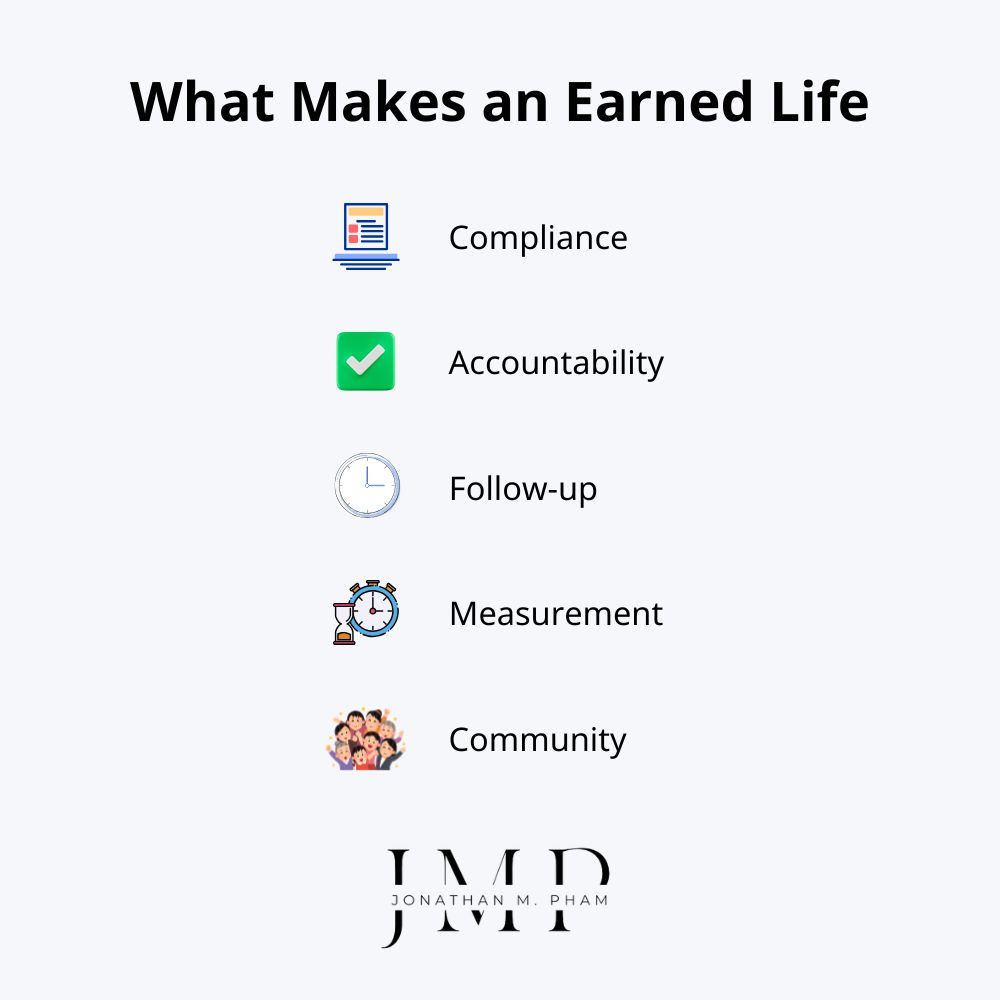
Compliance refers to the ability to adhere to external rules and policies. It is a real challenge for all of us; despite how simple it may seem, we too often find ourselves resisting orders and recommendations. Only in extreme situations that threaten us with pain or severe consequences (e.g: failing to stick to a dietary plan means death) may we find it easier to comply.
Another crucial component of earning your life, accountability differs from compliance in that it involves the expectations we impose on ourselves. There are two forms of accountability:
Follow-up serves as a crucial link between compliance and accountability. Its primary function is to introduce a level of oversight that enables us to stay on course.
Perhaps the most significant benefit of following-up is its impact on promoting self-awareness – an indispensable element to earn your life. Specifically, it requires us to answer questions like:
Such an introspection may seem uncomfortable initially; and yet, it is indispensable as a tool for personal improvement.
Follow-up may take multiple diverse forms, ranging from self-assessments and periodic check-ins with a mentor/ supervisor – to automated reminders and progress reports. Whatever the form, it serves as a consistent, non-biased mirror reflecting our sustained efforts and outcomes.
A cornerstone of effective goal setting and progress tracking, Measurement functions as an indicator of one’s priorities. Whatever we choose to measure shapes our behavior, as we naturally channel our efforts toward areas that are quantified and evaluated.
While some measurements are objective and easily quantifiable (e.g: the number of steps taken in a day), others are more subjective, but still equally meaningful (e.g: one’s level of happiness or job satisfaction).
When paired with follow-up, measurements create a dynamic feedback loop that guides us toward our objectives. By regularly assessing and adjusting our actions, we ensure alignment with our vision and pave the way for continuous improvement.
Community is the vital thread that weaves together the aforementioned building blocks of an earned life. After all, nobody can flourish in isolation; only within a nurturing and empathetic society may we truly thrive.
Such interconnectedness extends far beyond the mere exchange of shared values; it embodies the ethos of mutual assistance. In a thriving community, people offer support without hesitation when someone declares, “I need help.” Here, the response is not driven by self-interest or the question of “What’s in this for me?” – but by an innate understanding that in helping others, we collectively elevate ourselves. That each person’s progress enriches the entire community.
How to earn your life
The Life Plan Review method (LPR), introduced by Dr. Marshall Goldsmith in his bestseller “The Earned Life”, presents a powerful framework to bridge the gap between what we plan to achieve in our lives and what we actually accomplish. Its objective is to help enhance one’s life by shifting their focus to continuous improvement and self-monitoring.
One of the key benefits of the LPR method is versatility; specifically, its well-structured approach makes it adaptable to specific individual objectives. As a result, it can be applied to virtually any domain or aspect in life, from personal development and career aspirations to health and relationships
The framework is made up of four key steps as follows:
First, practicing the LPR method requires us to attend weekly meetings – in which participants take turns reporting their answers to a set of questions designed to measure the progress towards their goals. For example:
Each question is answered by rating one’s level of effort on a scale from 1 to 10 – with an emphasis on the quality of trying rather than the outcome. The dynamic nature of this process allows for continuous improvement, where one may adapt and refine the prompts to better suit their evolving goals and aspirations.
Read more: 200 Self-reflection Questions – Toolkit for Life Pilgrims
A cornerstone of the LPR method, daily self-monitoring emphasizes the importance of consistent reflection and assessment in one’s daily routine. In this step, individuals are encouraged to adopt the habit of tracking the questions outlined previously into their daily activities.
Key benefits:
While measuring effort focuses on the quality of trying, occasionally assessing the attainment of the overall purpose ensures that you are making meaningful efforts toward goals that still hold significance – and avoid investing time and energy into pursuits that are no longer relevant.
The Life Plan Review is not therapy, but a gathering of successful people with shared goals for the future.
Marshall Goldsmith
If possible, do not work on your life plan in isolation. Instead, collaborating with others in a select company is essential to enhancing the effectiveness of the LPR process.
Sharing your vision and experiences with others not only exposes you to new insights and support – but also adds a layer of accountability, motivation, and fulfillment.
Read more: Vision Board – Toolkit for Attracting Abundance

The leader of the past knew how to tell; the leader of the future will know how to ask.
Peter Drucker
Traditionally, asking for help has been perceived as a sign of weakness, reserved only for situations where we feel a lack of knowledge, skills, or resources. Due to fears of exposing ignorance or incompetence, we too often find ourselves unable to request assistance from others. And for those who have attained a certain degree of success, their inflated sense of self often drives them to adopt the “I can do it alone” mindset – that they should strive to handle things on their own.
However, in the pursuit of an earned life, we must learn to seek assistance from others – whether one-on-one or within a group. Asking for help is not a sign of weakness; rather, it indicates that you are fully aware of the resources you own, and the importance of coordinating with those around you to achieve common goals and contribute to life.
The pursuit of fulfillment demands the willingness to make sacrifices – which go beyond monetary considerations. Specifically, one must invest maximum efforts in what truly matters, accept necessary atonements, and face the specter of failure with determination.
Despite how obvious it seems, far too often, we find ourselves coming up with excuses to avoid paying such prices. Reasons for this include:
Human tendency is to lean toward avoiding loss rather than seeking equivalent gains. This natural inclination makes us hesitate when faced with the prospect of sacrificing our current comforts/ resources for future benefits.
When given options to consider, we are frequently blinded by what we will lose and fail to see how great the gains will be.
Sacrifice involves investing efforts and resources now for rewards that may manifest far into the future. This clashes with our innate desire for immediate gratification – specifically, we are prompted to spend resources on immediate pleasures, rather than save and patiently watch compound interest accumulate over time.
Some people perceive sacrifice as a zero-sum game, where choosing one path means losing out on another (which is, in truth, quite misleading). When one commits to paying the price for a challenging and risky endeavor, they eliminate other options, including the “sure thing.”
Making sacrifices means stepping out of one’s comfort zone. It pushes us to confront challenges, take calculated risks, and explore uncharted territories. As difficult as it might seem, such discomfort is crucial for growth and transformation to take place.
We are born, we get sick, we die.
Buddha
To earn your life is an enduring journey that doesn’t conclude with a single achievement; it’s a commitment to re-earning that life, title, or status repeatedly. After the initial triumph and the well-deserved celebration, the cycle continues – you must continually prove your worth, adaptability, and resilience.
An earned life isn’t sustained by resting on past laurels – but rather, by embracing the challenge of maintaining and surpassing your achievements, and accepting that the path to fulfillment is an ongoing voyage of self-improvement and relentless dedication.

Earn your life
For this purpose, here are a few rules you need to take into consideration:
Life is marked by transitions – some are expected, some are not. Proactive preparation is key to navigating such shifts.
Interpreting your life’s journey is a personal choice – you can’t discern if you’re earning your next beginning until you acknowledge you’re in transition. For this reason, it is essential to develop a method for marking these turning points and earning your beginning to appreciate the progress you have made.
Embracing an earned life entails letting go not only of past achievements – but also of your former identity and ways of doing things. While reflecting on the lessons of the past is valuable, dwelling on it isn’t recommended.
Part of learning is unlearning – and you need to let go of your old self to welcome the new one.
Habit formation typically involves a sequence of Stimulus, Response, and Outcome – of which the critical part is the response/ behavior. You cannot control what will happen to your life; yet you have all the power to control and modify your response.
This is why building good habits requires focusing on this middle step, Response, in order to visualize transformative changes.
Read more: 20 Bad Habits in Life That Impacts Relationships & Success
Golfers are not obsessed with past shots nor future holes; they focus solely on the shot at hand. This level of presence is habitual for them.
Likewise, in our life, we must remind ourselves to continuously concentrate on the task at hand and stay in the moment – until it becomes an inherent habit that leads to consistent and successful outcomes.
Read more: Choosing Your Life – From ‘Drifting’ to ‘Defining’
Don’t aim for success if you want it; just do what you love and believe in, and it will come naturally.
David Frost
Have the courage to follow your heart and intuition.
Steve Jobs
Success is not the key to happiness. Happiness is the key to success. If you love what you are doing, you will be successful.
Albert Schweitzer
The meaning of life is to find your gift. The purpose of life is to give it away.
Pablo Picasso
The journey of a thousand miles begins with a single step.
Lao Tzu
Fulfillment in life isn’t handed to us; it is only achievable through dedication and the willingness to continually ask, strive, and evolve. To earn your life means to embark on an ongoing journey of self-discovery and improvement, in which we are committed to continuously re-earning your aspirations, titles, and statuses, without ever resting on past laurels.
Compiled with inspiration from the bestseller “The Earned Life” by Dr. Marshall Goldsmith.
Other resources you might be interested in:

A long time ago, in a provincial town far, far away… There was a wealthy, cynical landowner named Fyodor Pavlovitch Kara [...]

Let us visit a fictional place: The Village of the Valley. Once upon a time, those who lived there were divided into two [...]

Has this ever happened to you? Let’s say you are suffering from a frustrating health issue, or stuck in a chaotic life d [...]