


0808
Personal Philosophy: What is Your Truth & Stance for Living?
A long time ago, in a provincial town far, far away… There was a wealthy, cynical landowner named Fyodor Pavlovitch Kara [...]
Stop feeling like life is happening to you! Learn the importance of choosing your life and steps to take control of your destiny now!
Have you ever felt like you’re simply drifting through life, carried by the currents of circumstance or the expectations of others? I know I have.
For years, I navigated a path that felt pre-ordained, until I realized the truth: life isn’t something that just happens to you; it’s something you actively choose.
This realization was among the factors that sparked my journey of self-discovery, a process of learning to step into the driver’s seat and shape the contours of my own existence.
And this article is a reflection on that journey, a sharing of insights and tools that I hope will empower you to do the same!
Highlights
Choosing your life is about stepping into the driver’s seat of your own existence. It means consciously making decisions, both big and small, that actively shape your life direction, rather than passively letting circumstances or the expectations of others dictate your path. It’s about embracing intentionality and recognizing your own agency – the power you have to influence your journey.
This conscious act of choosing manifests in various aspects of our lives, some carrying more weight and long-term impact than others. Many times, we have to make pivotal decisions that have the power to define our whole trajectory:
Beyond the major life decisions, the accumulation of our daily choices also plays a crucial role in shaping our existence. How you choose to spend your time, the media you consume, the conversations you engage in, and even the habits you cultivate all contribute to the overall direction you are heading. While seemingly small, these consistent choices subtly nudge you closer to or further away from the life you envision.

Choose a life you want
It’s important to acknowledge that life inevitably presents us with circumstances beyond our direct control (e.g. unexpected events, societal structures, and the actions of others). However, choosing your life is not about having absolute command over everything that happens. Rather, it’s about focusing on the power you do have within your sphere of influence – how you respond to those circumstances, the choices you make within them, and the attitude you adopt.
Even when faced with challenges, you still retain the power to choose how you navigate them and what meaning you derive from the experience.
In essence, choosing your life is an ongoing process of self-awareness, intentional decision-making, and proactive engagement with the world around you. It’s about taking ownership of your journey and consciously crafting a life that aligns with your values, passions, and aspirations.
He who is everywhere is nowhere.
Seneca
Why is it so vital to make a choice? Isn’t it easier to just go with the flow, follow the well-trodden path, or let circumstances dictate your direction?
While that might seem like the path of least resistance, consciously choosing your life is fundamental to experiencing true fulfillment and well-being.
Some might argue that life is largely predetermined by fate, genetics, or societal structures. It is true that these factors undoubtedly play a role; that being said, people still retain a certain degree of freedom within these constraints.
In fact, history is filled with stories of people who have overcome challenging circumstances to forge their own paths:
Actively choosing your life empowers you to take control of your narrative. It allows you to move beyond simply reacting to life’s events and instead become the author of your own story.
When you align your choices with what truly excites and motivates you, life becomes more authentic and meaningful. Each decision, whether it leads to success or perceived failure, provides valuable learning experiences – as well as a chance to build resilience, strengthen your problem-solving skills, and acquire a deeper awareness of your own strengths, weaknesses, and values.
On the other hand, if you do not make conscious decisions about your career, relationships, or personal pursuits, you risk ending up on a path that feels unfulfilling and leaves you with a sense of “what if?”. You might find yourself in a job you dislike, in relationships that don’t nourish you, or in a state of being that doesn’t truly reflect who you are.
If you don’t take the initiative to choose, others might inadvertently (or even intentionally) decide for you.
And worse, you have no one to blame but yourself for not taking the reins.
Various studies have shown a strong correlation between pursuing one’s dreams and increased job satisfaction. For example, a survey by Mashable found that only 22% of adults pursue their childhood dream jobs, but those who do report an overwhelmingly high level of job satisfaction (nearly 90%).
Similarly, entrepreneurs who build businesses based on their passions are often more resilient and successful – because their work is fueled by genuine enthusiasm and intrinsic motivation.
Choosing your life is the most important decision
Read more: 28 Success Stories in Real Life for Motivation
Everyone seems to have a clear idea of how other people should lead their lives, but none about his or her own.
Paulo Coelho
Despite being well aware of the profound importance of actively shaping one’s life path, many of us find ourselves feeling stuck, unfulfilled, or simply going through the motions. The path to consciously choosing your life isn’t always straightforward, and there are numerous obstacles, both external and internal, that may hold us back.
The world often exerts powerful forces on how we feel about our own agency. Many times, these external pressures subtly or overtly steer us away from our authentic desires:
Identifying these external influences requires self-awareness – taking the time to reflect on whose expectations you are truly trying to meet. Learning to communicate assertively and set healthy boundaries is also crucial.
Often, the biggest obstacles to choosing our life reside within ourselves:
Despite all the challenges above, we need to remind ourselves that life is not a race, and everyone’s journey unfolds at its own pace. Hence, we should not let the perceived timelines of others dictate our choices or make us feel inadequate.
Think about people like Donald Trump and Joe Biden – both of whom became presidents at ages when many people have already retired. Or, how about Mark Zuckerberg, who became the world’s youngest self-made billionaire at a relatively young age?
These examples highlight the fact that there is no “right” time to achieve certain milestones or make significant life changes. Your timeline is unique to you.
It all boils down to the “now”. What are you going to do now?
You are never too old to set a new goal or to dream a new dream.
C. S. Lewis

Choosing your life isn’t a one-time event, but rather an ongoing journey that involves a series of interconnected steps. Think of it as a cyclical process that you can revisit and refine as you learn and grow.
It starts with taking the time for introspection to explore your inner world. This means delving into your values, core beliefs, principles, interests, passions, etc. – so as to establish an inner compass that will guide your decisions. Techniques such as journaling, meditation, and quiet contemplation may be leveraged during this stage.
Read more: 110 Self Discovery Journal Prompts – Daily Growth Toolkit
Once you have a solid understanding of yourself, the next step is to actively seek out different options and possibilities that align with your values, interests, and passions. Whether through researching different career paths/ hobbies/ lifestyles, immersing yourself in new experiences, reading books/ articles/ online resources, or engaging in conversations with others, the important thing is to be bold and not to limit yourself to what’s immediately familiar or comfortable!
This stage involves evaluating the various paths you’ve explored, weighing the pros and cons of each option, and picking the ones that best honor your values. In addition to input from trusted coaches, mentors, friends, family members, or accountability partners, you should not forget to take into account your own gut feelings too.
Once you’ve made a decision, it’s crucial to take action and put your choices into practice. This is where your intentions translate into tangible steps.
As you go through life, you will inevitably learn new things about yourself and the world around you. This learning may lead you to revisit earlier stages of the process. You might find that your values evolve, your interests shift, or new opportunities arise. If that’s the case, be open to adapting your choices as needed!
To provide a clearer framework for actively shaping your existence, let’s explore the concept of the “Triple A’s”: Action, Ambition, and Aspiration.
The first “A” focuses on what you are doing in the present moment. These actions are the tangible steps you undertake to move towards your goals and desires. No matter how small they may seem, they are the fundamental building blocks of the life you are actively creating, day by day.
It’s important to recognize that every day presents a landscape of both risk and opportunity, and what you do are often influenced by how you perceive and navigate these elements.
The second “A” is about looking towards the future and centering around what you would like to achieve. Ambition involves setting clear goals and aspirations, whether in your personal or professional domain. It’s the driving force that motivates you to strive for success, pushing the boundaries of your current capabilities to reach new heights.
Read more: Vision Board – Toolkit for Attracting Abundance & Supercharging Your Life
The third “A” delves into who you want to become as an individual. Unlike Ambition, which typically entails specific endpoints, Aspiration is an ongoing, continuous process with an infinite time horizon. It’s about a commitment to constant self-discovery and lifelong self-improvement.
Aspirations are not limited by specific achievements; instead, they revolve around the continuous pursuit of becoming the best version of yourself, cultivating positive character traits, and embracing lifelong learning in all aspects of your being.
These three dimensions – Action, Ambition, and Aspiration – are not meant to be viewed in isolation. When successfully integrated, they shape what can be referred to as an “earned life” – one where your daily actions are aligned with your future ambitions.
In an earned life, you are not simply reacting to circumstances, but actively engaging in behaviors that contribute to your long-term goals and ongoing self-improvement. Your aspirations provide the ethical and personal compass, your ambitions set the direction, and your daily actions are the vehicle that moves you forward!
What determines your life path
Read more: Law of Attraction – Tips for Manifesting Abundance
Choosing your life is a deeply personal journey; sometimes, all you need is the right prompt to unlock your inner wisdom. The following questions are designed to encourage self-reflection and shed light into what you truly want in different areas of life.
Values & priorities
Passions & interests
Goals & aspirations
Fears & obstacles
Ideal future
When it comes to self-questioning, do not be too eager to come up with the “right” answers. Just take your time, be honest, and allow what’s “in here” to guide you!
Read more: 60 Existential Questions to Ask – Explore Life’s Depths
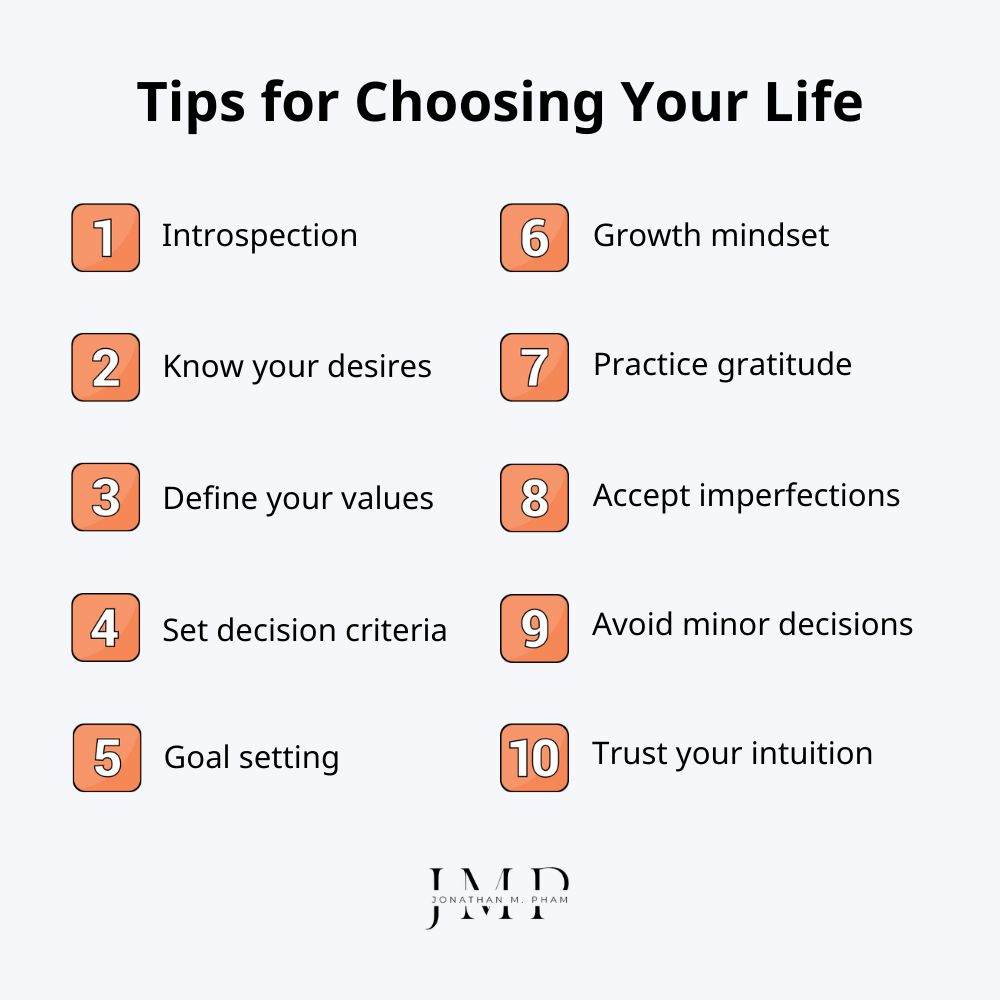
Knowing yourself deeply is the bedrock of choosing a fulfilling life. It goes beyond fleeting desires to understanding your core motivations and what truly resonates with your soul.
If possible, try to dedicate 15-30 minutes each day or week for undistracted reflection. You might journal about your emotional responses to different situations or meditate on your long-term aspirations.
Read more: Understanding Emotions – Key to Balance & Success in Life
Knowing what you want isn’t passive; it requires active engagement and exploration. Don’t wait for clarity to strike – instead, you should actively seek it out by:
Regularly paint a vivid picture of your ideal future. Imagine a typical day – what are you doing, who are you with, how do you feel? Reflecting on this should reveal hidden desires you might have not noticed.
Freely jot down all your interests, passions, and potential life paths, without censoring yourself. Even seemingly unrealistic ideas can spark amazing insights.
For instance, when I first did this, one of the things I wrote down was ‘learn to sing like an opera singer’ despite never having attended any singing class and rarely even going to karaoke! It felt a bit outlandish, but it allowed me to realize how much I crave self-expression, the challenge of mastering a complex skill, and the emotional impact of music.
Read more: 11 Essential Singing Tips for Beginners – Unlock Your Vocal Potential
Step outside your comfort zone and try new things. Take a pottery class if you’re curious about art, volunteer at an animal shelter if you love animals, or shadow someone in a career field you’re considering. First-hand experience is crucial to ensuring clarity.
Reflect on moments of intense pride, deep satisfaction, or significant frustration. What underlying principles were at play? Common values include honesty (e.g., always striving for truthfulness), kindness (e.g., prioritizing compassion in interactions), independence (e.g., valuing autonomy), achievement (e.g., seeking accomplishment and growth), and community (e.g., contributing to a larger group).
Not all values hold the same weight though. Once a list is finished, you need to determine which ones are most important to you, as they will serve as your primary compass when facing significant choices.
Now, think back to times when you felt truly conflicted about a decision. Which values were in tension?
Maybe you might have been torn apart between financial security and creative freedom.
When faced with a stable but uninspiring job versus a risky but passion-driven venture, understanding which value takes precedence for you at this stage of your life becomes crucial.
What are the most important factors to consider when making a particular decision? This could include things like financial stability, work-life balance, personal growth opportunities, location, or impact on others. Whatever they are, try to assign a weight or level of importance to each criterion to help you prioritize.
For instance, if work-life balance is paramount, it should carry more weight than a slightly higher salary. This prioritization allows you to make choices that you are less likely to regret later.
Goals provide direction to better translate actions into tangible outcomes. These should include short-term (e.g. within weeks or months) and long-term ones that you aim to achieve over a longer period (e.g. years).
During the goal-setting phase, you should critically assess whether each objective chosen genuinely reflect your values and aspirations. Are you pursuing them because they truly matter to you, or because of external pressures?
Choosing your life often involves stepping outside your comfort zone and taking risks. As such, it is essential you believe that your abilities and intelligence can be developed through dedication and hard work. Such a mindset allows you to see challenges as opportunities for learning.
Cultivating gratitude shifts the focus from what’s lacking to what you already possess, fostering contentment and providing a positive perspective throughout your journey. As such, it is recommended that you regularly carve out time to acknowledge the good things in life, both big and small. This could be through a daily gratitude journal or simply taking a few moments each day to appreciate what you have – the roof over your head, a supportive friend, the ability to learn something new, or even a beautiful sunset!
The path to choosing your life won’t always be smooth. You will likely make choices that don’t turn out as expected. If that’s the case, ask yourself – what can you learn from this situation? How can you adjust your approach moving forward?
Don’t beat yourself up over missteps. Instead, treat yourself with the same compassion you would offer a friend.
Everyone falters; it’s just part of the growth process!
Read more: Shikata ga nai – Finding Serenity in Acceptance
Your time and energy are finite resources; in other words, you should direct them towards decisions that truly align with your values and long-term vision. For this purpose, it is essential that you discern between choices that are likely to leave a significant impact on your life and those that are relatively minor – and then focus on the former.
Example: A significant decision might be choosing a career path, deciding whether to move to a new city, or ending a long-term relationship. In contrast, minor decisions could be what to wear each day, what to have for lunch, or which route to take to the grocery store. While the latter still require some thought, they shouldn’t consume the same mental energy as the life-altering choices.
At the same time, it also means that you should master the Art of saying “no” – i.e. learning to politely decline commitments that don’t align with your priorities, so as to create space for the things that truly matter. For instance. if your priority is to dedicate evenings to working on your passion project, do not be afraid to politely decline an invitation to a social event that doesn’t particularly excite you.
While logic and external advice are valuable, your intuition often holds profound insights that can guide you towards the right path. As hard to believe as it may seem, studies have consistently demonstrated that our gut feelings carry wisdom that the conscious mind hasn’t yet fully processed.
Read more: Are You Living or Just Existing? Let’s Find Out!
How to choose the right path in life
Read more: Subconscious Mind Power – Explore the Hidden Force Within
If you concentrate always on the present, you’ll be a happy man. You’ll see that there is life in the desert, that there are stars in the heavens… Life will be a party for you, a grand festival, because life is the moment we’re living right now.
Paulo Coelho
It’s crucial to balance the enthusiasm of choosing your life with a sense of realism and groundedness. Otherwise, you risk setting yourself up for disappointment or making impulsive decisions that might not serve you in the long run.
Think about the logistical aspects of your choices. For instance, if you dream of becoming a full-time artist, consider how you will support yourself financially during the transition. This doesn’t mean abandoning your dreams, but rather approaching them with a plan that takes into account your current circumstances and potential challenges.
Examples:
At the same time, you need to remind yourself that change takes time, and progress is rarely linear. There will be challenges, setbacks, and moments of doubt. Expecting instant perfection or a completely smooth ride only gives rise to discouragement and makes you more likely to give up when things get tough. Rather than striving for perfection, it is advisable that you focus on making consistent progress, learning from your experiences, and adapting as you go. After all, “done is better than perfect”.
And finally, you should be mindful of the fact that life is inherently dynamic and ever-changing. As mentioned, the choices you make today might need to be adjusted in the future as your circumstances and desires evolve. This acceptance allows you to be more flexible and less attached to rigid outcomes, making it easier to navigate life’s inevitable shifts.

Decide what kind of life you want then say no to everything that isn’t that
A good practice to stay grounded in the moment is the “Every Breath Paradigm” technique by Marshall Goldsmith. Inspired by Buddhist philosophies, it invites us to recognize that with every inhale and exhale, life unfolds, and with each breath, the world is in constant flux.
In other words, with every breath you take, a new you is born.
The Every Breath Paradigm encourages us to embrace the transitory nature of existence, acknowledging that nothing remains static. By observing the world’s impermanence within each breath, we gain deeper insights into the constantly changing nature of everything around us – from then, we are better equipped to live more intentionally.
The main idea here is that we should learn to appreciate the beauty of the moment – for each breath carries with it a unique experience that will never be replicated. Being fully present in every breath allows us to let go of attachments to the past and anxieties about the future. This mindfulness enables us to make conscious choices and savor the richness of life as it unfolds.
Instead of getting bogged down by the enormity of life choices, concentrate on what you can do right now to move in the direction of your chosen life.
Every breath I take is a new me.
Buddha
Read more: Memento Mori – A Reminder of Life’s Impermanence & How to Live the Right Way
One of the most significant hurdles in actively designing your life is the fear of making “wrong” decisions. This fear can be so potent that it causes many of us to stay stuck in unfulfilling situations rather than risk taking a step that might lead to a less desirable outcome.
While understandable, the idea of a “wrong” choice is, most of the time, just an illusion.
In reality, life rarely presents us with a single, clearly defined “right” path. What might seem like a misstep initially may lead to unexpected opportunities, valuable lessons, and growth that you wouldn’t have encountered otherwise. Think of it as taking a detour on a road trip – you might not reach your planned destination in the exact way you intended, but you might stumble upon a hidden gem or a breathtaking view along the way.
For instance, I myself initially pursued a career in the Digital industry, assuming it would be my long-term path. While it didn’t end up being the perfect fit for me, the time I spent there allowed me to really hone my research skills and develop strong logical reasoning abilities, which are now proving to be incredibly valuable as I transition towards a more academic-oriented career.
Making mistakes is an intrinsic part of the learning process. Each perceived “wrong” path provides feedback, helping us to refine our knowledge and make better decisions in the future. Without these experiences, our growth would be stunted, and our understanding of ourselves would remain limited.
Each time you face a setback, learn from it, and keep moving forward, you strengthen the ability to handle future difficulties and increase confidence in your decision-making abilities. You learn that you are capable of weathering storms and finding new paths when one closes.
Read more: 40 Spiritual Lessons – Wisdom for Life’s Journey
For those who are interested, check out a full list of deep quotes about life choices here.
Life is not a matter of holding good cards, but of playing a poor hand well.
Robert Louis Stevenson
Life is about choices. Some we regret, some we’re proud of. Some will haunt us forever. The message: we are what we chose to be.
Graham Brown
Your time is limited, so don’t waste it living someone else’s life.
Steve Jobs
It’s the possibility of having a dream come true that makes life interesting.
Paulo Coelho
The most difficult thing is the decision to act, the rest is merely tenacity. The fears are paper tigers. You can do anything you decide to do. You can act to change and control your life; and the procedure, the process is its own reward.
Amelia Earhart
You can steer yourself any direction you choose. You’re on your own. And you know what you know. And YOU are the one who’ll decide where to go.
Dr. Seuss
The most important thing is to enjoy your life – to be happy – it’s all that matters.
Audrey Hepburn
Looking back on my own journey of learning to choose my life, I’ve realized that it’s less about finding all the ‘right’ answers and more about embracing the questions and being courageous enough to experiment. There will be stumbles and detours, but each one offers a chance to learn and realign.
My hope is that this exploration has provided you with some insights and the encouragement to take ownership of your own narrative. The power to choose is within you; just trust it, nurture it, and allow it to guide you towards a vision that truly resonates!
Compiled with inspiration from the bestseller “The Earned Life” by Dr. Marshall Goldsmith.
Other resources you might be interested in:

A long time ago, in a provincial town far, far away… There was a wealthy, cynical landowner named Fyodor Pavlovitch Kara [...]

Let us visit a fictional place: The Village of the Valley. Once upon a time, those who lived there were divided into two [...]

Has this ever happened to you? Let’s say you are suffering from a frustrating health issue, or stuck in a chaotic life d [...]