



0808
Personal Philosophy: What is Your Truth & Stance for Living?
A long time ago, in a provincial town far, far away… There was a wealthy, cynical landowner named Fyodor Pavlovitch Kara [...]
Discover the essence of the Ikigai philosophy – the secrets to living with intention, balance, and a profound sense of meaning!
Rooted in ancient wisdom, the Japanese philosophy of Ikigai offers a profound blueprint for a life filled with fulfillment. The concept goes beyond the conventional notion of life purpose – it weaves together the threads of numerous elements into a harmonious tapestry. As we embark on our own journey of self-discovery, let us explore the principles of Ikigai – how they serve as a guiding light that illuminates our path to a more satisfying existence.
Highlights
Ikigai (hiragana: いきがい; kanji: 生き甲斐; pronunciation: ee-kee-ga-ee) is a Japanese concept typically translated in simple words as your ‘reason for being’. Derived from two Japanese words, ‘iki’ (生き – meaning life) and ‘kai’ (甲斐 – pronounced as ‘gai’, meaning effect, result, value, benefit, or worth), the term embodies the synthesis of a reason to live, a purpose that transcends the mundane routine of day-to-day living. It is something that drives us to get out of bed in the morning, keeps us going no matter what, and makes us feel like we’re making a difference.
Ikigai encapsulates the intricate interplay of one’s talents, passions, and profession, interwoven with a sense of connection with the broader community. It is about discovering the nexus where personal fulfillment converges with societal impact.
Ikigai is often attributed to be the source of happiness and longevity for many Japanese people, especially in Okinawa, where it originated. Within recent decades, the concept has become popular worldwide – and is often mentioned when it comes to topics such as finding one’s passion and meaning in life.
A concise definition of ikigai could be “the value one finds in day to day living.”
Nicholas Kemp

Beyond these individual instances, there have been various notable figures in history who are said to have discovered and lived in alignment with their Ikigai:
The roots of Ikigai stretch deep into Japan’s history – the earliest documented reference is found during the Heian period (794-1185). The term ‘kai’ (甲斐) means ‘shells’ – which were of great worth and used as a type of currency at that time. As such, Ikigai implies something precious – the intrinsic value associated with one’s existence.
The Kokin Wakashū, a collection of poems from this period, poetically captured Ikigai as the “flame that burns within” – something that propels people forward in their pursuit of purpose.
Despite its long history, the concept only became popular in the 20th century – with the work of Japanese psychiatrist Mieko Kamiya. In 1966, Kamiya authored “On the Meaning of Life” (生きがいについて, ikigai ni tsuite), in which she delved into the psychological and social dimensions of Ikigai and its correlation with happiness and mental health. Notably, her research extended beyond theoretical exploration; she conducted interviews with survivors of leprosy, a stigmatized and incurable disease during that time. What she discovered was profound – those facing adversity often possessed a strong sense of Ikigai, which serves as a coping mechanism in the face of challenging circumstances.
Since Kamiya’s work, Ikigai has become a subject of extensive discussion and research, both in Japan and internationally. It gained particular prominence in studies examining the longevity and well-being of the people of Okinawa, recognized for having one of the highest life expectancies globally. The exploration of Ikigai aligns with broader investigations into regions known as “Blue Zones,” where people exhibit exceptional longevity and health. These areas, including Okinawa, are all characterized by a strong sense of community, a close connection to nature, and a focus on purpose in life.

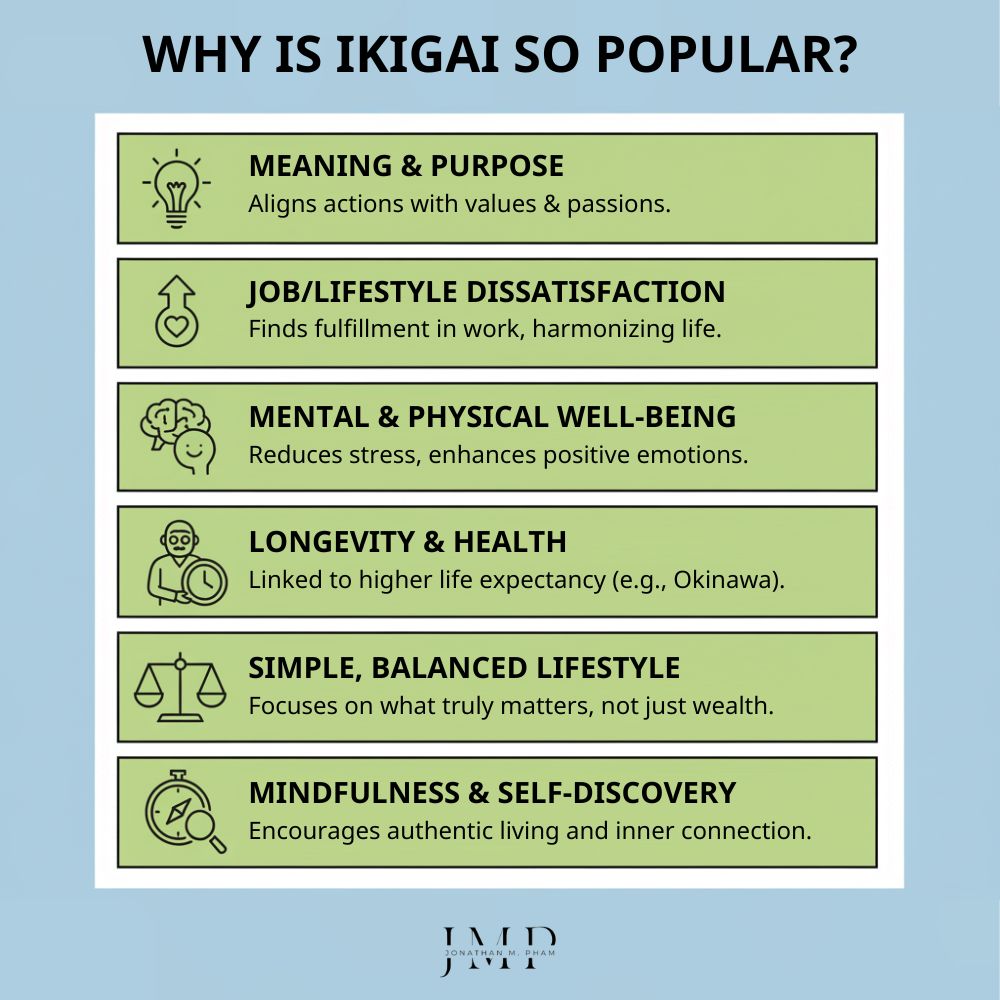
In an era marked by relentless speed and mounting stress, Ikigai has been attracting the attention of numerous people – for a variety of reasons.
In the current fast-paced world, people often find themselves adrift – they crave seeking connection with something truly significant. Ikigai offers a pathway to rediscovering life’s essence, fostering fulfillment by aligning one’s actions with values and passions.
The growing dissatisfaction with existing jobs, careers, or lifestyles has propelled many towards the allure of Ikigai. As individuals yearn for fulfillment and satisfaction, Ikigai becomes a guiding philosophy, enabling the pursuit of dream careers or uncovering joy and value in existing vocations. It acts as a catalyst for harmonizing personal and professional spheres, ultimately contributing to a sustainable and gratifying existence.
As awareness of stress, anxiety, and mental health concerns grows, people seek methods to cope and overcome these challenges. Ikigai emerges as a holistic approach, diminishing negative emotions and enhancing positive ones by providing a compelling reason to greet each day – and encouraging engagement in activities that bring joy and benefit others.
Japan is ranked second globally in life expectancy (e.g. the average life span in Tokyo is about 88 for women/ 81 for men) – and Ikigai is often linked to the country’s impressive health statistics. The island of Okinawa, renowned for its centenarians, attributes its longevity not only to diet but also to a well-defined sense of Ikigai. Various studies – conducted by the Japanese government as well as international researchers – have affirmed that those working for their Ikigai generally report a significantly lower risk of functional decline compared to those driven solely by financial motives.
Another appealing factor is the philosophy’s focus on adopting a simple, balanced lifestyle – which stands as a stark contrast to the prevailing relentless pursuit of success and material wealth. In a world consumed by the desire for more, Ikigai advocates for a life centered on what truly matters – a refreshing departure from societal norms.
Ikigai places a strong emphasis on present-moment awareness, inner connection, and living authentically in line with one’s values. As people seek a deeper understanding of themselves, the philosophy offers a roadmap to self-discovery, resonating with the broader cultural shift towards mindfulness.
Discovering your Ikigai is not merely a philosophical pursuit; it is a transformative journey with far-reaching implications for your overall well-being, longevity, and fulfillment. The significance of finding your Ikigai lies in its holistic impact on various aspects of one’s life:
Studies reveal that having Ikigai is linked to reduced anxiety and depression, heightened positive emotions, and increased life satisfaction. The pursuit of your Ikigai contributes to a well-balanced secretion of neurotransmitters such as serotonin, dopamine, and endorphins, fostering a profound sense of happiness and contentment.
Ikigai is a potent force that has the potential to influence immune function, increase life expectancy, and reduce the risk of functional disability, dementia, strokes, and cardiovascular disease. The reduced stress levels associated with Ikigai contribute to overall improved health.
Research in places like Kyotango in Kyoto, known for its high population of centenarians, suggests a correlation between Ikigai and increased levels of DHEA, a hormone associated with longevity. Engaging in daily hobbies that bring joy and satisfaction may boost this “longevity hormone,” potentially contributing to a longer and happier life.
Having Ikigai serves as a powerful motivator, enhancing self-efficacy, resilience, and optimism. It acts as a guiding force that empowers one to pursue their goals, overcome challenges, and navigate through life’s complexities with determination.
In times of difficulty, a strong sense of purpose is what allows us to remain balanced. Those with a well-defined Ikigai are more likely to bounce back from setbacks and challenges, drawing strength from their intrinsic sense of purpose.
Ikigai stimulates curiosity, imagination, and inspiration. It propels us to generate and implement novel and valuable ideas – contributing not only to personal growth but also to the broader creative landscape.
Understanding what truly matters to you allows your action to align with your core values – which enables the cultivation of a deep sense of satisfaction and purpose, ultimately leading to a more meaningful and fulfilling life.
When connected to something larger than themselves, one is more likely to build strong, meaningful connections with others who share similar values and visions. As such, they are better equipped to display empathy, compassion, and altruism toward others.
Being aware of your Ikigai provides a clear framework for decision-making – one that enables us to make choices that align with our values and long-term goals, facilitating a more intentional and purpose-driven life.
The focused pursuit of Ikigai encourages one to set meaningful goals and pursue them with passion and determination – which is the foundation for unlocking their full potential. At the same time, such a quest for growth also allows one to inspire and motivate others toward a common vision – a crucial quality for being an effective leader.
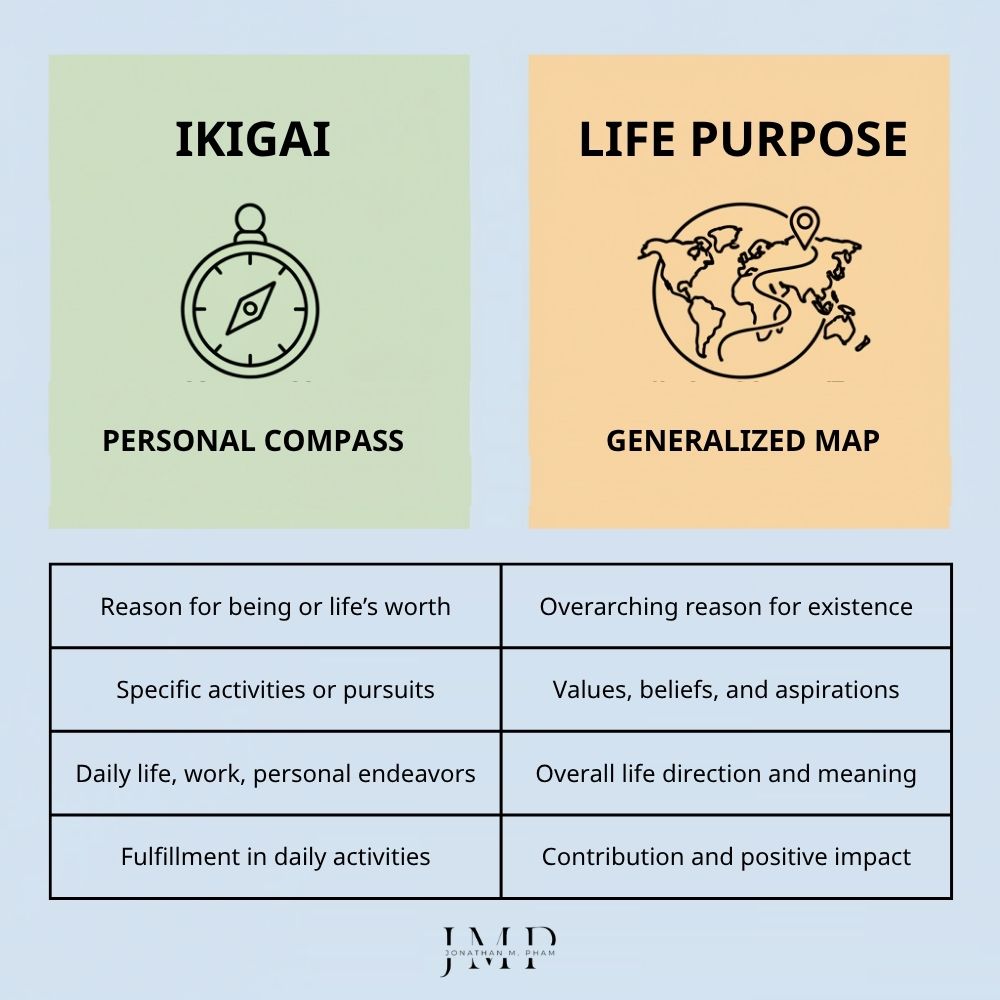
Ikigai and life purpose, while often used interchangeably, refer to distinct facets of one’s journey toward a meaningful existence. The former is more like your personal compass – it is meant to provide orientation and help you find the true “north” in your day-to-day journey. Unlike the latter, Ikigai is a subjective and dynamic concept that can be adapted to the shifting landscape of your passions, skills, needs, and values.
On the other hand, life purpose is a broader and more objective term. It encompasses the overall direction and meaning in your life – including your values, beliefs, and aspirations. As such, it acts as a generalized map that guides your actions/ decisions – and can be shared with others.
From the analysis above, you may realize the complementary nature of the two terms. Ikigai is the practical manifestation of your life purpose. It represents specific activities or pursuits that align with the broader sense of purpose encapsulated in your life. It’s the tangible expression of the abstract idea of a life purpose – a way to live out the overarching mission.
Here’s a table summarizing the key differences:
| Feature | Ikigai | Life Purpose |
| Definition | Reason for being or life’s worth | An overarching reason for existence |
| Focus | Specific activities or pursuits | Values, beliefs, and aspirations |
| Application | Daily life, work, and personal endeavors | Overall life direction and meaning |
| Objective | Fulfillment and meaning in daily activities | Contribution and positive impact |
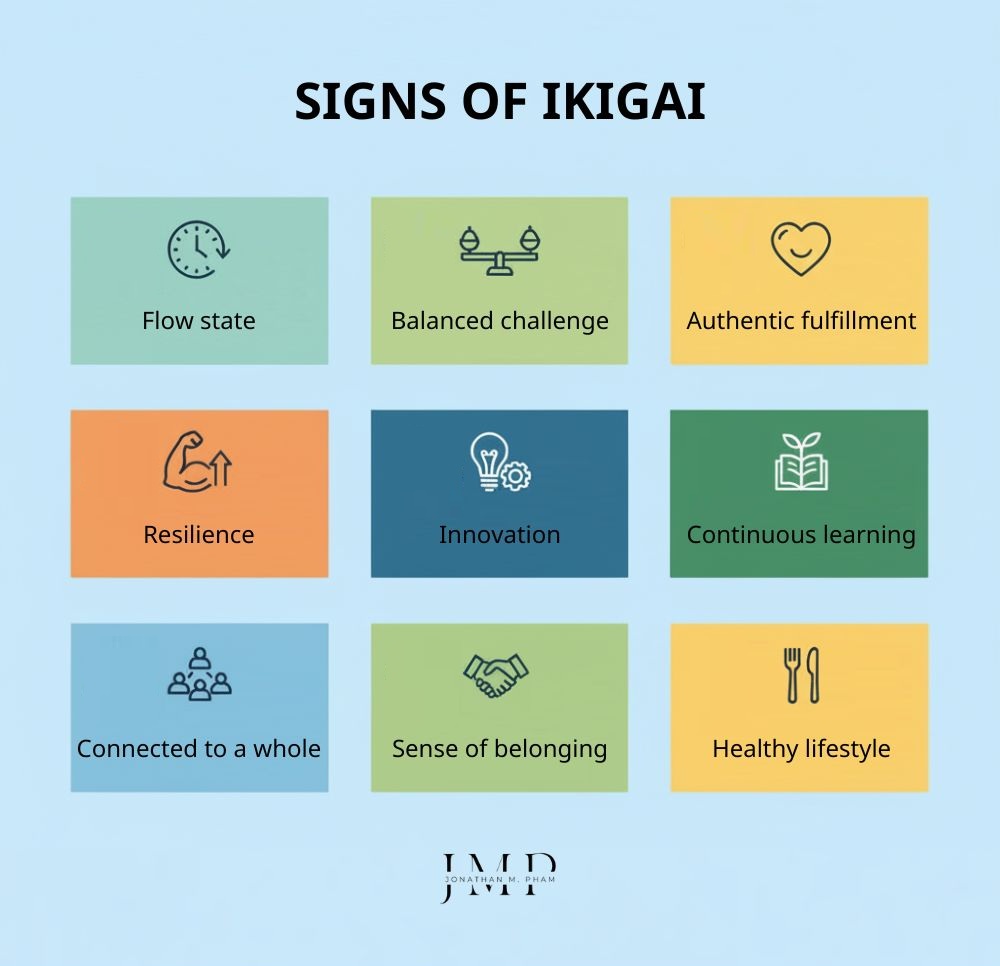
One of the unmistakable signs of Ikigai is the experience of a flow state. When engaged in activities aligned with your purpose, time seems to not exist at all. You find yourself fully immersed, so absorbed in the task at hand that the world fades away. As such, you are highly focused and productive.
Difficulties are now catalysts for growth rather than sources of stress. You navigate a delicate balance – feeling challenged enough to foster a sense of accomplishment, yet not overwhelmed to the point of discouragement.
A profound sense of happiness and fulfillment permeates your work and life. You relish what you do, recognizing the inherent value and impact of your contributions. Satisfaction arises not just from achievements – but from a deep understanding that your endeavors matter – that you are making a positive difference in the world.
You possess clear visions and goals, pursuing them with enthusiasm and perseverance. Stress and adversity are met with resilience, mistakes are seen as opportunities for learning, and an innate sense of optimism and confidence propels you forward.
Genuine curiosity and interest in various aspects of life drive you to use imagination and inspiration to generate novel and valuable ideas. Openness to new experiences and perspectives becomes a natural outgrowth of living in alignment with your Ikigai.
Pursuing your Ikigai is synonymous with a commitment to continuous learning and growth. The quest for new challenges and opportunities becomes an inherent part of your journey, propelling you to expand your knowledge and skills as you evolve.
Living in alignment with Ikigai instills a deep sense of connection to something larger than yourself. Whether it’s a community, a cause, or a broader sense of humanity, the awareness of contributing to a collective purpose enhances the significance of your individual journey.
A strong sense of belonging and connection emerges as you engage with others who share your values and vision. Empathy, compassion, and altruism become guiding principles, leading to meaningful collaborations and support.
When Ikigai is woven into the fabric of your life, a balanced and healthy lifestyle naturally follows. Care for your physical and mental well-being becomes a priority. Nutritious habits, regular exercise, sufficient sleep, and finding joy in the present moment replace dwelling on the past or worrying about the future.
Your Ikigai lies where your talents and the needs of the world intersect.
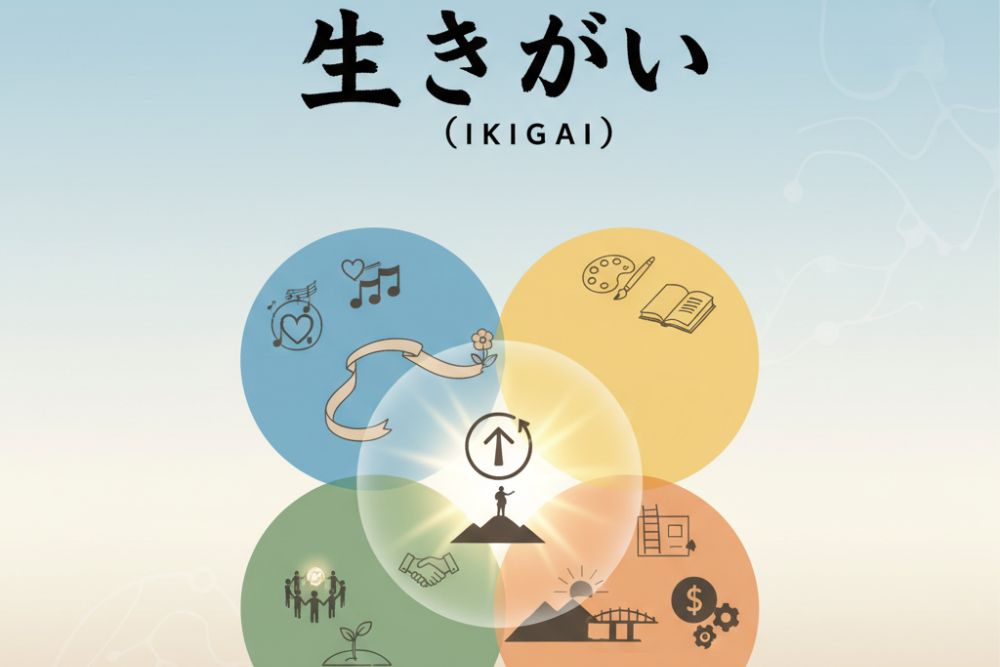
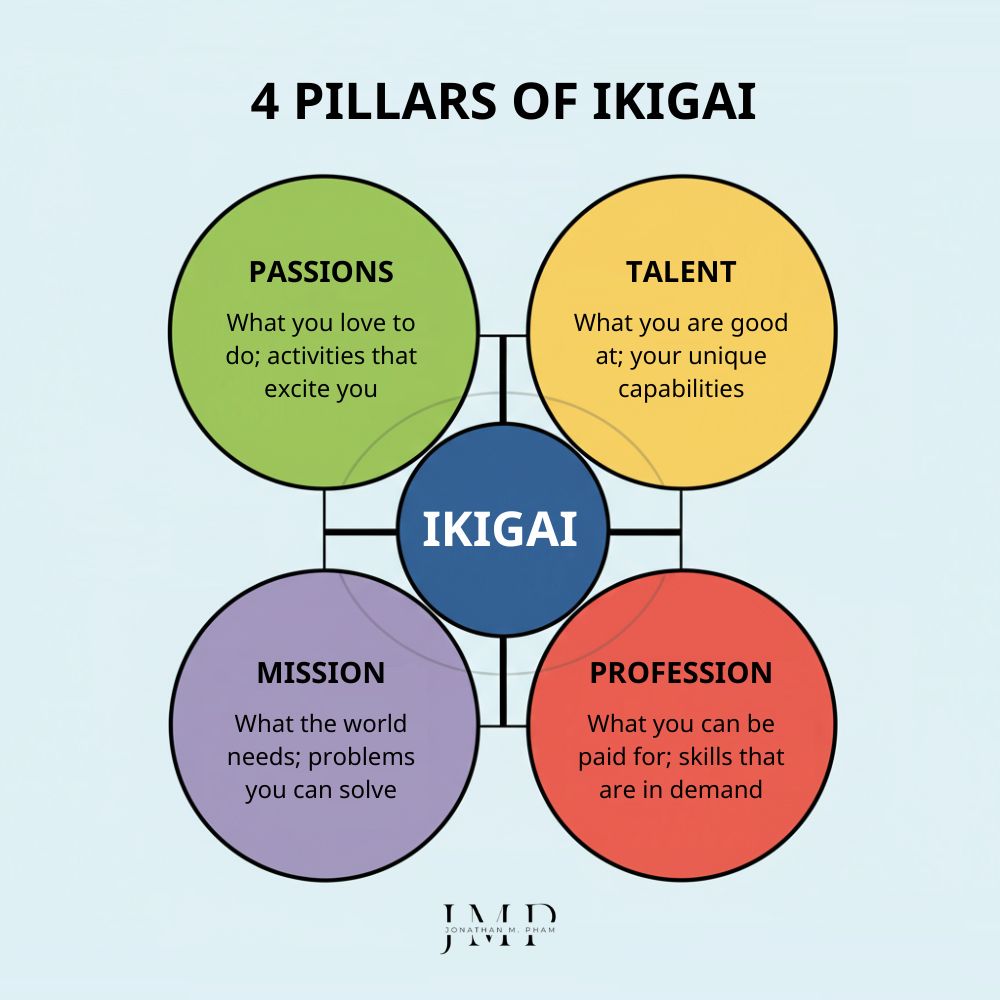
How does Ikigai work? Most contemporary studies on the topic are based on the Venn diagram of Andres Zuzunaga – according to which the Ikigai formula is comprised of 4 major spheres:
The first pillar delves into your innermost desires and joys – what you love. It encapsulates your passions, interests, and hobbies, the activities that ignite a sense of happiness and excitement within you.
To unravel this dimension, self-introspection is key. Ask yourself the following questions:
The second component explores what you excel at – the skills and talents that define your unique capabilities. It is an acknowledgment of your proficiency and confidence, an area where improvement and learning are perpetual. Discovering what you are good at requires you to reflect on your strengths:
The third pillar extends beyond personal boundaries, delving into the realm of societal contribution. It embodies your mission – problems you aspire to solve, needs you aim to fulfill, and opportunities to create positive change.
Here are some questions to help you identify this component of Ikigai:
Completing the quartet is the pillar of sustainability – what you can be paid for. It encompasses your profession and vocation; as such, it requires reflection on the market demand for your skills and the monetization potential of your endeavors. Ask yourself:
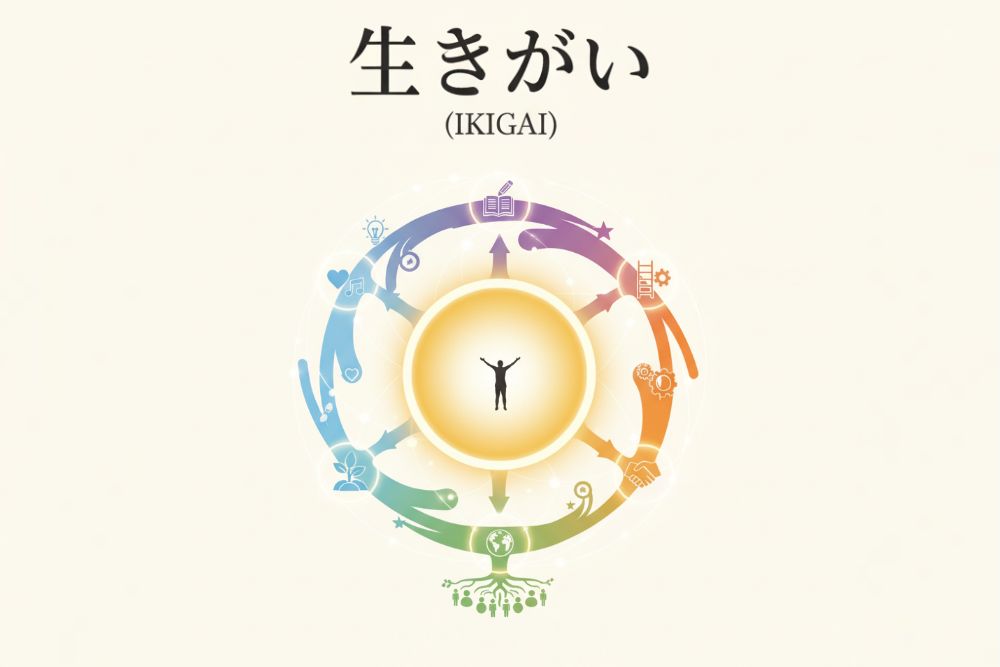
The crux of the Ikigai framework lies in discovering the harmonious intersection of the above-mentioned four pillars. It is at this juncture that your Ikigai emerges – the nucleus of your attention and energy, guiding your journey towards a purposeful and fulfilling life.
Read more: 200 Self-reflection Questions – Toolkit for Life Pilgrims
Where does Ikigai come from? What are the things that truly bring meaning to life?
Most people discover a specific force or focus that becomes their personal Ikigai, propelling personal development and cultivating a profound sense of life satisfaction. Examples include:
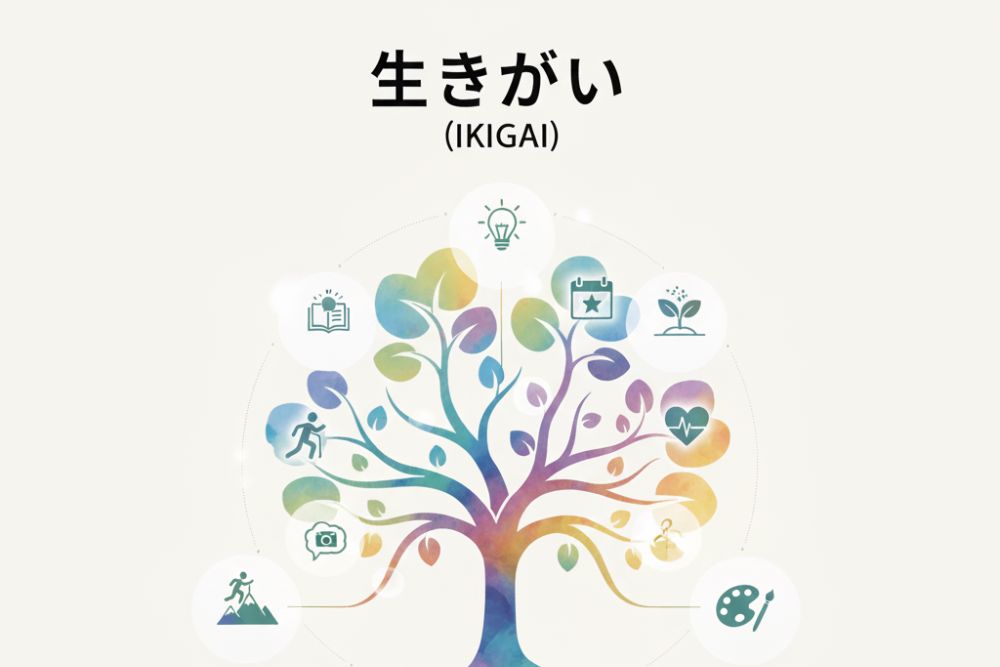
These various types of Ikigai contribute to a set of positive feelings known as Ikigai-kan:
One of the primary pitfalls is falling prey to siloed thinking – perceiving elements of life such as work, family, and passions as isolated fragments. The essence of Ikigai lies in recognizing the interconnectedness of these aspects. Everything is intertwined; as such, realizing this interconnected tapestry is fundamental to unlocking the true meaning of Ikigai.
For example, if you are passionate about painting, you could find a job as a graphic designer or art teacher. That way, you incorporate your passions into your work – transforming it into something more than just a means to an end (paying bills, supporting family).
Equating Ikigai solely with one’s profession is another common misstep. While work is a component of the Ikigai framework, it’s vital to expand the scope beyond career boundaries. Ikigai is not confined to what one does for a living but encompasses the broader spectrum of what lends life meaning and purpose.
For instance, outside of work, you may spend time on activities that spark joy and ignite curiosity. Whether it’s painting, playing music, or exploring nature, immersing yourself in pursuits that bring you genuine pleasure – so as to unveil hidden talents and foster a sense of purpose.
In fact, according to a survey conducted by Japan’s Central Research Services, only 31% of respondents considered work as their Ikigai. Instead, they found value in other things – family, dreams, spiritual practices, etc.
Economic status does not essentially correlate with Ikigai. Ikigai is an intrinsic sense of a life worth living, not contingent on financial standing. Genuine behaviors that evoke Ikigai are born out of spontaneous activities, driven by personal passion and fulfillment rather than financial gain.
Instead of seeking happiness through material possessions or external validation, cultivate a sense of gratitude for the simple pleasures that enrich your life. Appreciating the beauty of nature, savoring a delicious meal, or experiencing a moment of connection with loved ones may all spark your Ikigai.
Striving to fulfill all four spheres of Ikigai (as mentioned above) at once is not always a realistic approach. Many times, the four pillars may not always intersect. As such, pursuing all of them simultaneously may prove to be overwhelming and time-consuming – leading to burnout and frustration.
In such cases, it may be better that you start with a selective stance – e.g. focusing on what you love to do and what you are good at first. Once you have a good foundation in these areas, you can move on to exploring ways to make a positive impact on the world and finding a career that aligns with your values.
The societal pressure to pursue grand and ambitious goals as the epitome of success is what leaves many of us disillusioned. Rather, Ikigai can manifest in very modest pursuits – in the most straightforward and everyday aspects of life (e.g. having a loving family, enjoying a hobby, etc.).
You don’t have to be a celebrity or make any major achievements. As long as you are able to derive pleasure from what you do, you are already living up to your Ikigai.
Ikigai can be something small or something big. In a nutshell, Ikigai is a spectrum. And the complexity of Ikigai actually reflects the complexity of life itself.
Ken Mogi

The Western mindset “I’ll be happy when…” is a pervasive challenge for those seeking to attain long-lasting fulfillment. Ikigai is not a destination; it is a continuous journey. It’s about emphasizing the importance of being present, appreciating the most trivial things in daily life, and enjoying happiness in the current moment.
Many of us believe that we don’t have enough time to embark on the journey to discover Ikigai. In fact, dedicating just one hour daily can make a significant difference over time!
We are living in a world where a lot of things are distracting us from what really matters in life. Many waste their time on activities such as playing games and surfing social media – which consume a lot of time and energy, leaving little room for exploring their passions and talents.
Neglecting mindfulness and self-reflection inhibits the Ikigai discovery process. Allocating time for introspection and being present in the moment is vital for uncovering the layers of one’s purpose.
Fear of the unknown can paralyze one’s progress in discovering their Ikigai. We may be afraid to step outside of our comfort zone and try something that we’ve never done before, despite our hunch that it aligns with our inner values. Additionally, many are worried about what others will think if they pursue a career or path that is unconventional or doesn’t fit into the traditional mold.
Many of us fall prey to the belief that we can only have one singular, ultimate Ikigai. In fact, your Ikigai can evolve over time, and multiple ones can coexist throughout life.
For example, in your 20s, your Ikigai may be to travel the world and experience new cultures. In your 40s, it may be to raise a family and build a strong community. And yet, in your 60s, you may be passionate about mentoring others and sharing your wisdom.
The assumption that only elderly individuals can experience Ikigai is erroneous. Ikigai is not bound by age – rather, it can be discovered at any stage of life.
Procrastination, driven by the reluctance to embrace change, is what hinders one’s progress. Experimenting with new experiences and shedding old, bad habits is essential for personal growth and Ikigai discovery.
Read more: Habits in Personality Development – A Comprehensive Guide to Self-improvement
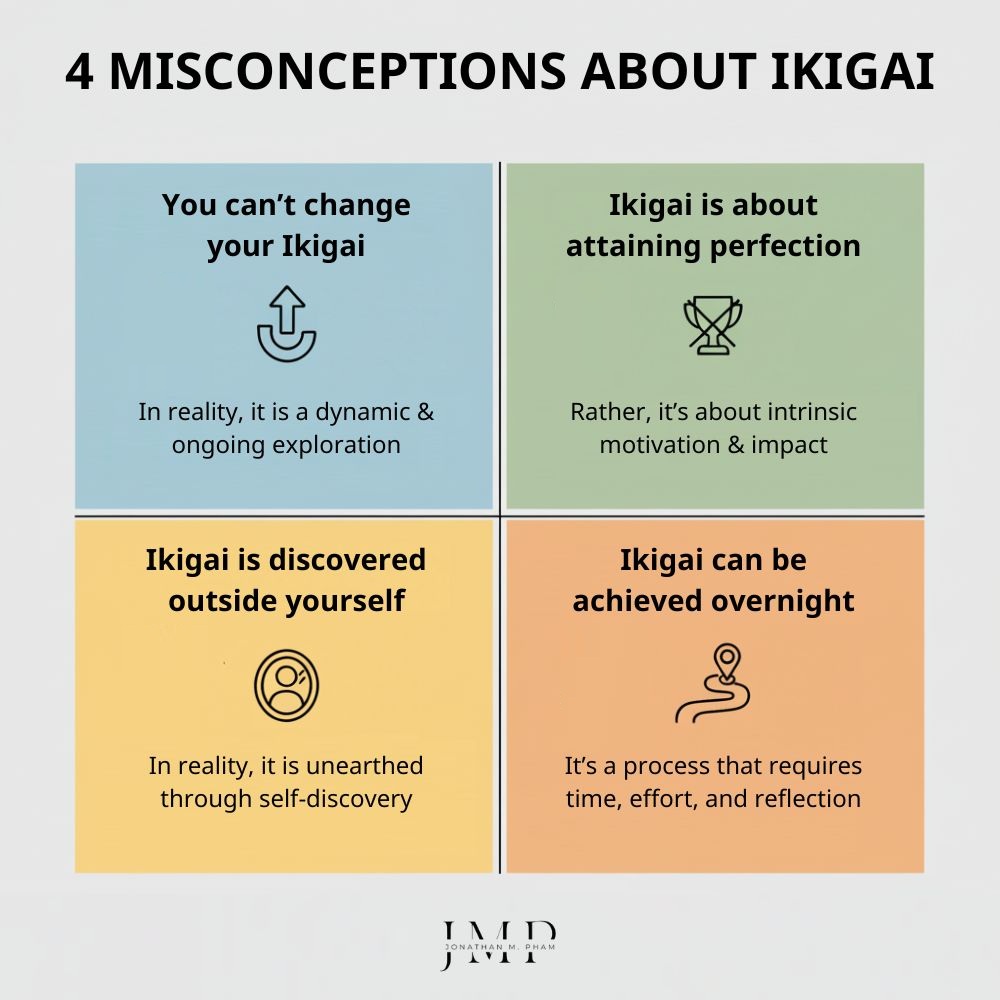
One prevailing misconception is the belief that Ikigai is a fixed point or a concrete goal. In reality, it is a dynamic force, an ongoing exploration rather than a destination.
The assumption that one cannot change their Ikigai overlooks the fluidity of life and personal evolution. What sparked passion a decade ago may differ from current aspirations. The key point is to ensure that your actions always align with your core values, allowing for growth and adaptation.
Contrary to popular belief, Ikigai is not synonymous with achieving perfection in a particular aspect of life – be it career, talent, wealth, or fame. The essence of Ikigai transcends external markers of success – it emphasizes alignment with personal values and passions. True fulfillment arises from intrinsic motivation and positive impact – rather than the pursuit of external validation.
Ikigai is not a destination; it’s a way of life.
Ikigai is often misconstrued as something external, a quest to be found outside oneself. In reality, it lies within, waiting to be unearthed through introspection and self-discovery. It’s not a serendipitous encounter or a gift from someone else; rather, it is an internal journey that involves delving into one’s passions, values, skills, and experiences.
Now, let’s consider the story of Haruki Murakami, the renowned Japanese novelist. As a young man, Murakami pursued a career in jazz music, despite his lack of formal training. While he achieved some success as a musician, he eventually realized that his true passion lay in writing. After years of introspection and experimentation, Murakami found his Ikigai in crafting captivating stories that resonate with readers worldwide.
Murakami’s journey exemplifies the internal nature of Ikigai. He didn’t stumble upon his calling by chance or receive it as a gift from someone else. Instead, he delved into his passions, values, and experiences, gradually discovering his unique voice and purpose.
The misconception that Ikigai is a goal achievable overnight is what leads to frustration and impatience. Finding one’s Ikigai is a gradual process that requires time, effort, and self-reflection. Patience is a companion on this journey of exploration, as you learn about yourself, your passions, and the unique contributions you can make to the community.
Read more: 28 Motivational Success Stories – Making the Impossible Possible
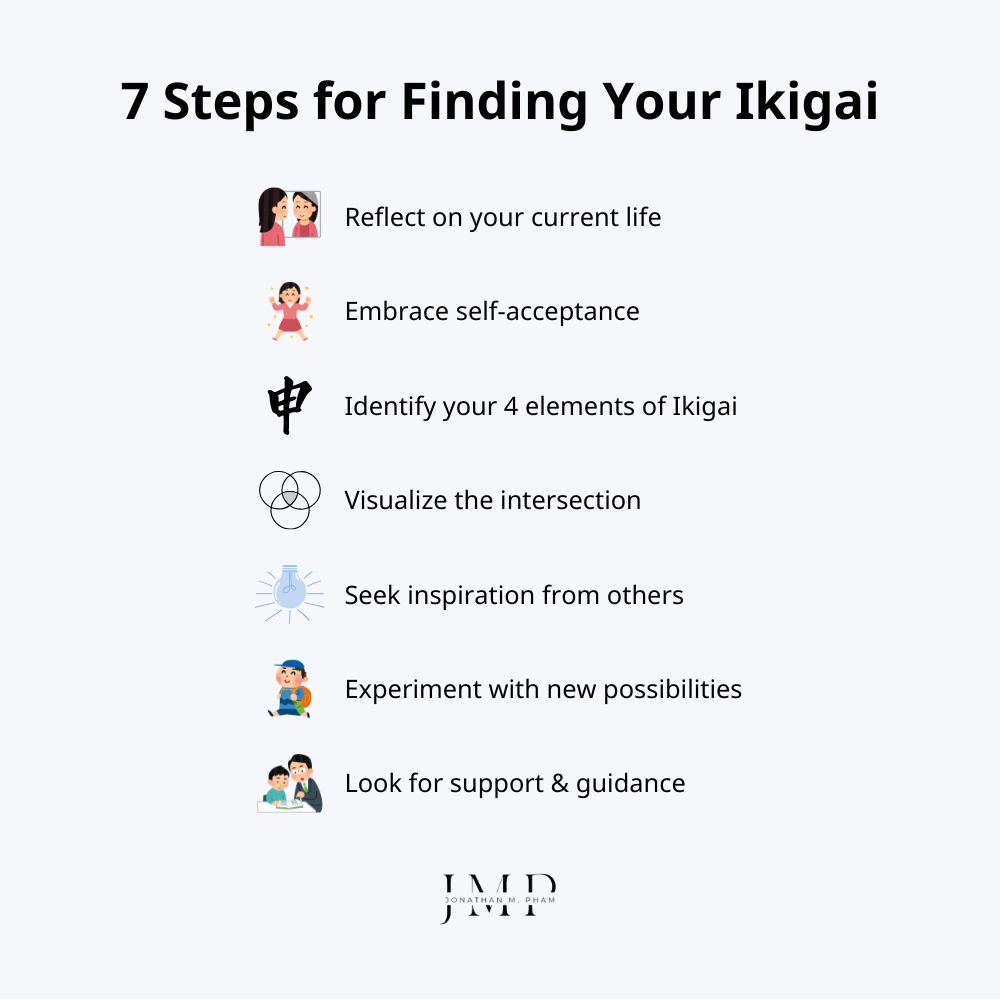
Discovering your Ikigai is a profound journey of self-discovery, requiring reflection, awareness, and a willingness to explore. Follow these steps to embark on the quest for your unique purpose and fulfillment.
Start by gaining awareness of your present circumstances. Reflect on your past experiences and compile a list of the top activities you’ve engaged in recently. Evaluate whether these activities contribute to a sense of purpose in your life – whether they bring you real joy and satisfaction (make sure to be honest with yourself).
Example:
Sarah, a 35-year-old accountant, had been feeling increasingly dissatisfied with her work. She found the daily tasks repetitive and uninspiring, and she had a nagging feeling that she was meant for something more. Sarah decided to embark on a journey to discover her Ikigai.
She started by reflecting on her current situation. She realized that she spent most of her time sitting at a desk, staring at a computer screen. As such, she felt disconnected from her colleagues and her work didn’t seem to make a real difference in the world.
Sarah then took a trip down memory lane, recalling moments when she felt a sense of purpose and joy. She remembered how much she enjoyed volunteering at her local animal shelter and helping to find homes for abandoned animals. She also cherished the memories of spending time in nature, hiking, camping, and simply appreciating the beauty of the world around her.
Sarah made a list of activities she had engaged in recently. This included her work as an accountant, her volunteer work at the animal shelter, her hobbies of hiking and camping, and her involvement in a local environmental conservation group.
Sarah then evaluated each activity based on the criteria of joy, purpose, and skill utilization. She realized that her work as an accountant brought her little joy or satisfaction, and she didn’t feel like she was making a positive impact on the world. On the other hand, her volunteer work at the animal shelter, her hobbies of hiking and camping, and her involvement in the environmental conservation group all brought her a sense of joy, purpose, and fulfillment.
Sarah was honest with herself about her feelings and realized that her Ikigai lay in helping others and connecting with nature. She decided to start making changes in her life that would align her actions with her passions and values.
Sarah’s journey to discover her Ikigai is still ongoing. She has started exploring options for transitioning out of her accounting career and into a field where she can make a more direct impact on the lives of animals and the environment. She has also joined a local hiking group and is planning a backpacking trip through a national park.
Read more: 32 Self Discovery Activities for Everyone
Understanding and accepting who you are is imperative in the journey to finding your Ikigai. Embrace your strengths, acknowledge your limitations, and cultivate self-compassion. This foundation of self-awareness sets the stage for aligning your actions with your authentic self.
Read more: Learning to Love Yourself – 16 Handy Tips for Fostering Self-esteem Every Day
Define the components of your Ikigai by answering crucial questions:
Do you love spending time in nature? Do you enjoy creative pursuits like writing, painting, or music? Do you find satisfaction in helping others? Reflect on activities that bring you joy and excitement – what makes you lose track of time and fully engages your enthusiasm.
What did you excel in at school or university? Are there any certifications or qualifications you hold that indicate your expertise?
What have you learned through your work, hobbies, or volunteer experiences? Are there any particular skills that you consistently receive praise or recognition for?
What have you pursued out of sheer curiosity or passion? Are there any skills or talents you’ve acquired through self-directed learning or exploration?
Recognize your skills and talents developed through education, experience, or personal interest. Aligning with your capabilities is key to discovering your Ikigai.
What do you believe in? What are the causes you care about? Examine your values and principles – as well as the problems/ needs you are passionate about solving. This provides a moral compass for your Ikigai. Explore organizations, initiatives, or communities that align with your values and where you can utilize your skills to make a meaningful contribution.
Explore areas where your skills and passions can meet market demand. Research industries, occupations, or freelance opportunities that align with your expertise and interests. In addition, connect with individuals who share your interests and passions and seek their advice on career paths or business opportunities.
Create a mental or physical representation of the intersection of your four elements of Ikigai. Visualization offers clarity and serves as a constant reminder of your purpose. Whether through diagrams, vision boards, or written statements, visually articulate the convergence of what you love, what you are good at, what the world needs, and what you can be paid for.
Example:
Emily, a 28-year-old graphic designer, had always felt a strong connection to nature and a passion for art. However, she felt unfulfilled in her current job, which involved designing corporate logos and marketing materials that didn’t align with her personal values or interests.
Step 1: Identifying Passions
Emily decided to embark on a journey to discover her Ikigai. First, she reflected on the activities that brought her joy and excitement. She realized that she spent her happiest moments outdoors, whether hiking in the mountains, camping under the stars, or simply enjoying a walk in the park. She also found immense satisfaction in creating art, particularly painting and drawing, which allowed her to express her creativity and emotions.
Step 2: Recognizing Skills and Talents
Emily considered her education, experience, and personal interests. She had always excelled in art classes throughout her school years and had won several awards for her paintings and drawings. She also had a strong foundation in graphic design, which allowed her to combine her artistic talents with technical skills.
Step 3: Understanding the World’s Needs
Emily examined her values and principles. She was deeply concerned about environmental conservation and believed in the power of art to educate and inspire. She wanted to use her skills and passions to make a positive impact on the world and connect people with nature through art.
Step 4: Exploring Market Opportunities
Emily researched industries and freelancing opportunities that aligned with her interests and expertise. She discovered a growing demand for sustainable design and eco-friendly branding, as well as opportunities to create art for environmental organizations and nature-themed publications.
After careful introspection, Emily created a visual representation of her Ikigai using a vision board. She started to transition into a more fulfilling career path, combining her graphic design skills with her passion for environmental conservation. She is also actively involved in creating art for local environmental organizations and has even started her own small business selling nature-inspired prints and designs.
Draw inspiration from those who have successfully pursued their passions. Read books, watch documentaries, or attend events/ talks related to your interests. Learning from others’ journeys can illuminate possibilities and provide valuable insights into your own Ikigai.
Step out of your comfort zone and experiment with new activities, hobbies, or volunteer opportunities. Embrace the exploration process without fearing failure. Trying diverse experiences can uncover unexpected connections and lead to the discovery of your true passions.
If at first, you don’t succeed, try, try again.
Surround yourself with a supportive community that encourages your exploration. Seek guidance from mentors, life coaches, or like-minded individuals who can provide constructive feedback and support. Collaborative efforts enhance the journey and foster personal growth.
Embarking on the Ikigai journey involves a mindful and intentional approach to life. Here are a few strategies to practice the philosophy in your daily existence:
If you find yourself blocked because change is difficult, try adding some new thing to your life: a new hobby, new circle of friends, or a new job on the side.
Hector Garcia
For beginners, initiate your journey by incorporating small changes into your life. Whether it’s waking up one hour earlier or changing your daily routine just enough to be able to do what you enjoy, such daily tweaks will eventually become habitual and result in profound things later.
I strongly advise that you adopt the Japanese philosophy of Kodawari (拘り or こだわり – ‘commitment’), which emphasizes the relentless pursuit of refinement in one’s work or craft. Take it slow, understanding that greatness is achieved through diligence, patience, and attention to detail. Embrace the journey one step at a time, while continually striving for improvement and innovation (in other words, adopting the mindset of Kaizen – 改善).
Practice releasing yourself from expectations and judgments, both towards yourself and others. Cultivate a childlike sense of wonder, curiosity, and joy. Embrace the present moment with openness, exploring new adventures without the burden of past regrets or future anxieties.
Read more: Healing Your Inner Child – 15 Steps to Unearthing the Happy, Healthy You Within
Incorporate healthy habits into your lifestyle, including regular exercise and a well-balanced diet. I suggest you embrace the Japanese principle of ‘hara hachi bu’, which revolves around mindful eating and consuming until 80% full.
This goes in tandem with the Japanese philosophy of Ichi-go ichi-e (一期一会, meaning “one time, one meeting”). Every moment in our lives is unique and does not occur again; as such, it is critical that we learn to cherish each second of our existence.
You should strive to appreciate the simple pleasures and sensory moments in life. Reflect on the effort and skill invested in your daily activities. Identify what brings you genuine joy, and focus on enhancing those experiences. Cultivate gratitude for your talents, relationships, and the beauty around you.
For example, instead of eating mindlessly, take the time to savor the flavors, textures, and aromas of your food. Notice the different ingredients, the cooking methods used, and the effort put into preparing the meal. Appreciate the skill and dedication of the people who grew the food, transported it, and prepared it.
Adopt a mindful approach to life by striving to live in the present moment. Regularly reflect on your emotions, experiences, and aspirations. Practice meditation to enhance self-awareness and develop a deeper connection with your inner self.
Maintain an active lifestyle and avoid adopting a “retirement” mentality. You can create a daily, weekly, monthly, and yearly checklist to keep yourself engaged and motivated. Techniques like the “daily question” method by Dr. Marshall Goldsmith may be utilized to enhance accountability and purpose.
I recommend you embrace the Japanese aesthetic of wabi sabi – which refers to finding beauty in imperfection, impermanence, and simplicity. Focus on what you can control and appreciate the inherent beauty in the imperfect aspects of life.
Promote a sense of community by sharing your passions and engaging in meaningful conversations. Connect with others not only about goals but also about the small joys in life. Create common bonds and consider finding an accountability partner to share your journey.
A key focal point of the Ikigai philosophy is to strive for balance and harmony in your life, respecting both nature and society. Consider the sustainability of your social and natural environment. Recognize Ikigai as a motivational force that aligns your actions with a greater purpose, promoting harmony with your surroundings.
Avoid isolation by actively participating in community activities. Strive to create common bonds with people around you, absorbing and reciprocating positive energy. Be mindful of the impact of social connections on your overall well-being.
People who isolate themselves can’t have ikigai – meaning or purpose. Meaning and purpose are only found in interpersonal relationships.
Tatsuzō Ishikawa

Worksheets:
Tests and quizzes:
Exercises: Exercises such as journaling, guided meditations, and creative activities (e.g. painting, singing, etc.) provide the chance to stimulate your imagination and get in touch with your passions and values – which is crucial to discovering your Ikigai.
In the dynamic landscape of modern business, practicing and promoting the Ikigai philosophy can be a transformative strategy to foster a workplace culture that prioritizes meaning, purpose, and individual well-being. Here’s a deeper exploration of how businesses can integrate Ikigai principles for enhanced productivity, engagement, and overall success:
Encourage employees to embark on a journey of self-discovery by exploring their passions, skills, values, and aspirations. Provide platforms for self-reflection, such as workshops or coaching sessions, enabling team members to recognize and articulate their unique strengths and interests.
Create a seamless connection between employees’ personal Ikigai and the broader organizational mission and objectives. This alignment instills a profound sense of purpose, encouraging people to view their contributions as integral to the collective success of the company. Establish learning and development programs that empower employees to acquire new skills and explore areas of interest.
Recognition is a powerful motivator. Acknowledge and celebrate the accomplishments of both individuals and teams within the organization. This celebration not only boosts morale but also reinforces the idea that every contribution, no matter how small, plays a vital role in the overall success of the business.
Recognize the importance of work-life balance in cultivating a thriving work environment. Encourage employees to maintain a healthy equilibrium between professional responsibilities and personal pursuits. Consider implementing flexible work arrangements, well-being programs, and mental health support to underscore the organization’s commitment to holistic employee development.
Business leaders serve as the guiding force in shaping the organizational culture. As such, they should exemplify the principles of Ikigai in their own work, showcasing passion, purpose, and commitment to the company’s success. Demonstrating an authentic alignment with personal values and organizational goals sets a powerful example that inspires and motivates the entire team.
Build a culture of collaboration and inclusivity, where diverse talents and perspectives are valued. Encourage open communication, idea-sharing, and mutual support among team members. A collaborative environment enhances the sense of belonging and purpose, contributing to the overall Ikigai experience.
Foster a culture of innovation by empowering team members to explore new ideas and approaches. Provide platforms for experimentation and creative problem-solving. Allowing people to contribute to the innovation process aligns with the principles of Ikigai, as it taps into their natural curiosity and desire for meaningful contributions.
Invest in continuous learning and development opportunities for employees. Support them in acquiring new skills and expanding their knowledge base. A commitment to ongoing growth aligns with the principle of constant improvement – potentially leading to increased job satisfaction and engagement.
Find your Ikigai – by Dr. Jack Canfield
How to Ikigai | Tim Tamashiro | TEDx Talks
Dr. Ken Mogi: Finding Purpose – The 5 Pillars of Ikigai
Interview with elderly Japanese people
Check out a full list of Ikigai quotes here!
What man actually needs is not a tensionless state but rather the striving and struggling for some goal worthy of him.
Viktor Frankl
In the West, ikigai is often used as a career-finding diagram. In Japan, ikigai is a way of life.
Roger Spitz
Just possibly, ikigai, makes a Peter Pan of all of us.
Ken Mogi
And there is no greater love than to give humans their ikigai.
Mieko Kamiya
Only staying active will make you want to live a hundred years.
Ikigai can be defined as a sense of being alive now, an individual’s consciousness as a motive to live.
Aikihiro Hasegawa
The journey to Ikigai is not about finding answers; it’s about asking the right questions.
Unknown
The happiest people are not the ones who achieve the most. They are the ones who spend more time than others in a state of flow.
García & Miralles
The key to ikigai is it’s what makes life really seem worth it. It’s when you feel “Damn! It’s good to be alive!”
Gordon Mathews
A timeless exploration of Ikigai, this book delves into the Japanese philosophy of finding purpose and joy in life. It shares the experiences of Okinawan centenarians – and provides practical exercises to guide readers in discovering and embracing their own “reason for being”.
This publication extends the concept of Ikigai into the realm of leadership and organizational culture. The author explores how leaders and organizations can integrate Ikigai principles to cultivate passion and purpose in their work.
Mitsuhashi’s work offers an intimate look into the daily lives of individuals who embody the essence of Ikigai. Covering aspects such as work, leisure, relationships, and health, the author illustrates how the Japanese find joy and gratitude in the ordinary.
Tamashiro’s guide offers a straightforward approach to discovering and embracing one’s Ikigai. Drawing from personal experiences and interviews with numerous Japanese individuals, the book provides practical lessons on finding happiness and purpose. It also explores the connection between Ikigai and financial well-being, offering insights into achieving a harmonious balance.
Ken Mogi’s book delves into the scientific and psychological aspects of Ikigai, exploring how it impacts happiness and creativity. The author introduces the five pillars of Ikigai: starting small, releasing oneself, harmony and sustainability, finding joy in little things, and being present in the moment.

Research suggests affirmative responses, with several studies highlighting the potential benefits of embracing Ikigai:
According to Hector Garcia’s book, there are ten guiding principles for embracing Ikigai:
Although Ikigai is not inherently tied to any particular religion or doctrine, it shares resemblances with spiritual practices and concepts:
Whether Ikigai is deemed spiritual is subjective. Some find deep alignment with spiritual beliefs due to its emphasis on purpose and connection. Others view it as a practical framework for a meaningful life, devoid of specific spiritual connotations. Regardless, the philosophy’s principles offer valuable guidance for a more purposeful existence.
Read more: 37 Spiritual Activities to Nurture the Soul
Maintaining a commitment to your Ikigai, or reason for being, can be demanding, especially when confronted with challenges. Yet, there are effective strategies to sustain focus and resilience through adversity:
Read more: Gaman (我慢) – The Unspoken Power of Japanese Endurance (Plus Its Relevance in Today’s World)
Ikigai is a powerful guiding force for living a fulfilling life. Embracing this life philosophy allows us to navigate the complexities of the modern world with a renewed sense of direction, grounded in the pursuit of what truly matters.
Other resources you might be interested in:

A long time ago, in a provincial town far, far away… There was a wealthy, cynical landowner named Fyodor Pavlovitch Kara [...]

Let us visit a fictional place: The Village of the Valley. Once upon a time, those who lived there were divided into two [...]

Has this ever happened to you? Let’s say you are suffering from a frustrating health issue, or stuck in a chaotic life d [...]