



0808
Personal Philosophy: What is Your Truth & Stance for Living?
A long time ago, in a provincial town far, far away… There was a wealthy, cynical landowner named Fyodor Pavlovitch Kara [...]
Ever feel overwhelmed by life’s curveballs? Dive into the world of “Shikata ga nai,” the Japanese art of finding serenity in acceptance. Explore its meaning, its practical applications, and how it can transform your approach to life’s challenges!
Years ago, I started to develop a strong fascination with Japanese culture. Their stress on adopting a minimal and mindful lifestyle, the remarkable resilience of the Japanese spirit, and concepts like Ikigai (生き甲斐), wabi-sabi, etc. all resonated with me profoundly. As I delved deeper, I stumbled upon the phrase ‘Shikata ga nai’ – which intrigued me and prompted me to embark on a quest to understand its significance.
Highlights
Shikata ga nai (Kanji: 仕方がない, Hiragana: しかたがない) or Shouganai (しょうがない), literally meaning “it cannot be helped” or “there is nothing to be done,” is a Japanese concept that goes beyond a simple shrug of resignation. It’s a philosophy centered on acceptance and moving forward.
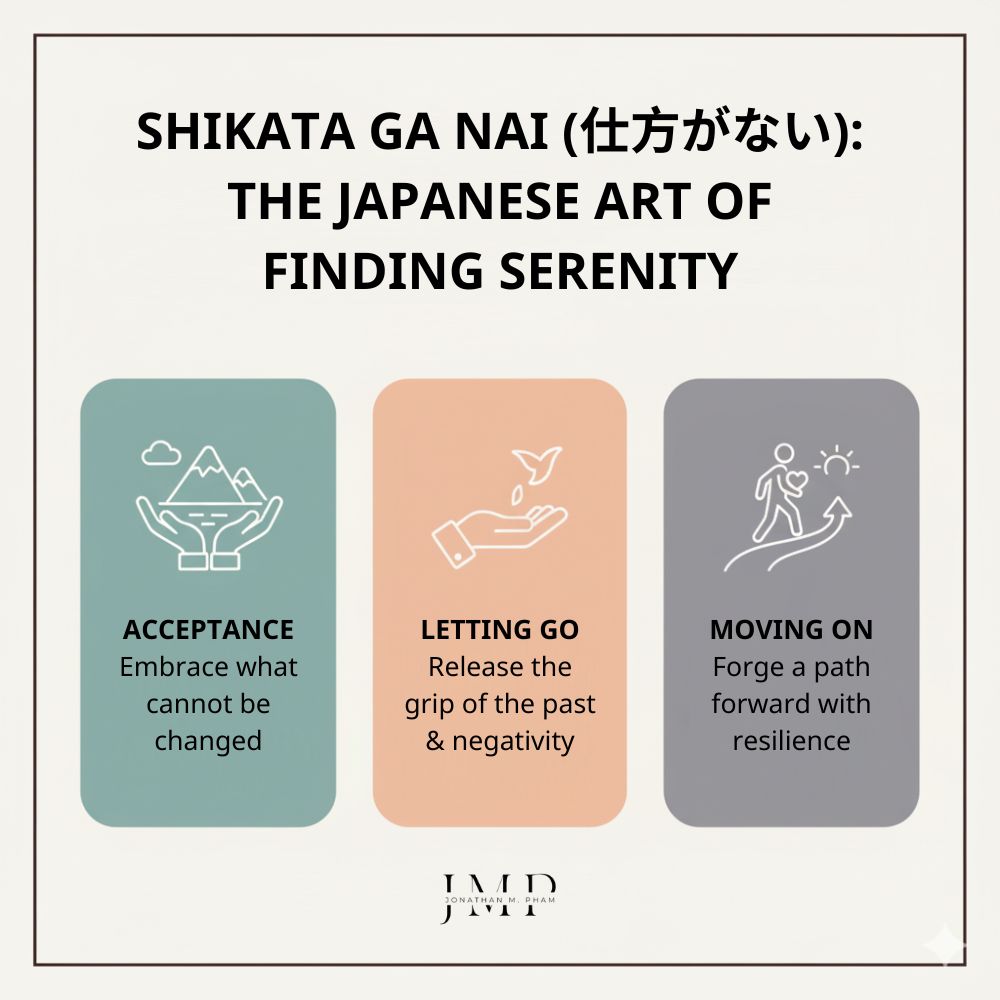
A common misconception about the philosophy is that it promotes inactivity and pretending things are okay when they’re not. Rather, its core message is about maintaining one’s sense of perspective and emotional control under all circumstances.
Shikata ga nai doesn’t mean being apathetic or ignoring reality. It’s about acknowledging the situation while focusing our efforts on what we CAN ACTUALLY influence (e.g. our actions, reactions, and perspectives) – so as to avoid feeling overwhelmed and powerless. In other words, we are encouraged to zoom out and observe the situation in a larger context – without getting bogged down in the emotions of the immediate moment. Challenges are inevitable, but they don’t have to define us.
While emotions are a natural part of human beings, Shikata ga nai discourages getting overly emotional about things beyond our control. Taking a more measured approach allows for clearer thinking and more effective problem-solving.
In essence, Shikata ga nai is a philosophy for navigating life’s inevitable ups and downs with grace, resilience, and a focus on what truly matters.

Shikata ga nai symbol – Paper cranes
The concept of Shikata ga nai shares interesting parallels with other philosophies around the world – namely Stoicism and Buddhism.
Like Shikata ga nai, Stoicism emphasizes focusing on what we can control (our thoughts and actions) and accepting what we can’t (fate, external events). Both philosophies encourage practitioners to detach from negative emotions caused by uncontrollable forces – and learn to live in the present.
That said, Stoicism might be seen as a more proactive approach – in that it places a greater emphasis on maintaining logic and reason in the face of adversity. On the other hand, Shikata ga nai promotes a more accepting and emotionally nuanced stance toward difficult situations. Specifically, we are to admit the emotional impact of challenges – while also letting go of those emotions, rather than necessarily suppressing them.
Buddhist philosophy, including Zen, shares the concept of acceptance with Shikata ga nai. Both aim at achieving inner peace through realizing the impermanence of life – and letting go of attachment to desires and expectations, a source of suffering.
The difference between them is that Shikata ga nai focuses on external uncontrollable events, while Buddhism stresses the importance of abandoning internal attachments as well. In addition, the latter has a more spiritual foundation compared to the former’s more secular and practical nature.
| Feature | Shikata ga nai | Stoicism | Buddhism/Zen |
| Focus | Accepting uncontrollable external events | Accepting what you can’t control (fate, external events) and focusing on what you can (thoughts, actions) | Accepting the impermanence of life and letting go of attachments (desires, expectations) |
| Goal | Inner peace through acceptance | Inner peace through reason and logic | Inner peace through detachment from suffering |
| Emotional response | Acknowledge emotional impact and let go | Suppress negative emotions | Abandon attachment to desires, which cause suffering |
| Emphasis | Acceptance and emotional nuance | Proactive, logical reasoning | Letting go of internal and external attachments |
| Nature | Secular and practical | Practical with philosophical underpinnings | Deeply spiritual |
Japanese culture has always placed a strong emphasis on social harmony (wa – 和) and collectivism. People are often expected to prioritize the group over the individual. As such, Shikata ga nai becomes a way to accept situations that might cause personal inconvenience for the greater good. A train delay? Shikata ga nai. A noisy neighbor? Shikata ga nai (sometimes). It’s a way to acknowledge the situation and move on without letting it ruin the day or damage group cohesion.
The philosophy is strongly complemented by the Gaman (我慢) notion, which promotes a type of “Stoic endurance” – that one needs to persevere and bear hardship without complaint. Additionally, it is also interconnected with the Wabi-sabi (わび・さび – 侘寂) concept, which highlights the beauty that can be found in imperfection and impermanence, and Oubaitori (桜梅桃李), which emphasizes that we need to realize each individual’s uniqueness and stop making comparisons to others. Together, they create a cultural framework for navigating challenges without disrupting social harmony.
Aside from daily life, the mindset of Shikata ga nai is particularly relevant when it comes to natural disasters like earthquakes, which are a constant threat in Japan. The Tohoku Earthquake and Tsunami (2011) is a prime example. Despite Japan’s world-leading disaster preparedness, the sheer power of the disaster caused immense devastation. In the aftermath, the concept of Shikata ga nai played a significant role, as people acknowledged the immense natural forces at play and focused their energy on helping each other rebuild.
Again, it’s important to remind that Shikata ga nai doesn’t equal passive resignation. It’s a recognition of limitations – coupled with a proactive approach to choosing the most effective course within those confines.
Despite the universal emphasis on emotional control, Japanese culture has outlets for expressing emotions. Activities like karaoke or venting to close friends allow for emotional release alongside Shikata ga nai’s focus on acceptance.

While the exact origin of Shikata ga nai (仕方がない) is unclear, its roots are deeply embedded in Japanese history and culture:
Spilt water will not return to the tray. (Fukusui bon ni kaerazu – 覆水盆に返らず)
The benefits of Shikata ga nai go beyond a simple checklist. It’s a way of life that teaches us to navigate the world with a realistic outlook. It doesn’t mean giving up; rather, by accepting what is and focusing our energy on what we can control, we become empowered to find solutions, maintain a positive attitude, and ultimately live a more fulfilling life.
Shikata ga nai isn’t just a resigned shrug. It’s a philosophy that combines realism with hope and acceptance. It reminds us that while life throws curveballs, we always have the power to choose our response.
Think about recent crises like the Covid-19 pandemic. What could be a better example of when the philosophy of Shikata ga nai became so relevant? The virus itself and its spread were largely out of our control. Lockdowns, travel restrictions, and business closures became necessary responses, even though they disrupted daily life. That is not to mention the possibility of getting sick – and even facing death at any time.
While the overall situation wasn’t controllable, individuals could still decide what to do – hygiene practices, social distancing, and following public health guidelines.
Shikata ga nai’s philosophy offers a powerful tool for navigating the stress and constant change of the modern world. By acknowledging what’s beyond our control, we can focus our energy on what we can influence, leading to better stress management and a more balanced life. This acceptance also fosters resilience in the face of unexpected challenges, allowing us to adapt without discouragement.
Additionally, recognizing our limitations helps us prioritize effectively, avoiding wasted effort and directing our focus towards areas where we can make a real difference. As we navigate life’s inevitable challenges, we also learn about the importance of compassion and empathy – both for ourselves and others.
Despite its benefits, the concept is often misunderstood in Western cultures, which tend to value individual achievement and control over one’s destiny. As such, Shikata ga nai’s emphasis on acceptance is frequently misconstrued as passivity or resignation. In addition, the “get things done” attitude prevalent in the West may make Shikata ga nai seem like an excuse for inaction – while in reality, it’s about choosing our battles and focusing efforts where they can be most productive. In doing so, not only may one attain a sense of serenity, but they also free themselves from the risk of burnout and frustration due to the relentless pursuit of vanity goals.
Accept what is, not what should be.

Read more: Memento Mori – A Reminder of Life’s Impermanence & How to Live the Right Way
Adopting the Shikata ga nai philosophy often proves challenging, especially for those coming from a very different cultural background. Here’s how some common traits may clash with the concept’s core principles:

Shikata ga nai, while a powerful philosophy, comes with its potential downsides. Here’s a breakdown of the challenges and how to navigate them effectively:
Tips to overcome the above-mentioned issues:
Here’s an analogy: Imagine life as a flowing river. Sometimes, you can paddle upstream and make progress. Other times, the current is too strong, and you need to go with the flow while strategically positioning yourself for when the current weakens. Shikata ga nai teaches us to discern these situations and respond accordingly.
Read more: Asking for Help – The Power That Comes From Vulnerability


All in all, don’t expect to master Shikata ga nai overnight. It’s a philosophy that takes time and consistent practice to integrate into your life. Be patient with yourself and celebrate your progress along the way!
Read more: 12 Stoic Principles to Live by in the Modern Life
Since I first came across the term “Shikata ga nai,” it has become a constant companion in my mind. Many times, I find myself muttering it during frustrating commutes or unexpected setbacks. While adopting this philosophy fully has proven more challenging than I initially anticipated, it’s a journey I’m determined to continue – one that I believe will continue to enrich my life (and yours too) for years to come!
Other resources you might be interested in:

A long time ago, in a provincial town far, far away… There was a wealthy, cynical landowner named Fyodor Pavlovitch Kara [...]

Let us visit a fictional place: The Village of the Valley. Once upon a time, those who lived there were divided into two [...]

Has this ever happened to you? Let’s say you are suffering from a frustrating health issue, or stuck in a chaotic life d [...]