

0808
Personal Philosophy: What is Your Truth & Stance for Living?
A long time ago, in a provincial town far, far away… There was a wealthy, cynical landowner named Fyodor Pavlovitch Kara [...]

This is a typical modern morning these days, right?
We wake up to alarms tracking our sleep cycles, consume content at 1.5x speed to maximize efficiency, and try to monetize our hobbies into “side hustles.” Many of us treat our bodies as machines to be optimized—and nature as a mere backdrop for our productivity.
In a sense, humanity lives in an era where we are conditioned to be “Human DOINGS” rather than “Human BEINGS“.
The underlying philosophy of modern life is one of absolute mastery. Since the Industrial Revolution, humanity has largely viewed themselves as the “lords” or “masters” of the earth. We treat the world—and even each other—as a giant warehouse of resources to be calculated, extracted, and manipulated for personal use.
But this relentless drive to conquer and optimize comes with a heavy cost. In fact, we see it everywhere: epidemic levels of chronic burnout, the degradation of the natural environment, and a lingering sense of alienation.
We are more productive than ever, yet many feel entirely disconnected from the actual experience of living.
Years ago, this crisis of the human soul was observed by the German philosopher Martin Heidegger. In his 1947 essay Letter on Humanism, he argued that our anthropocentric (human-centered) obsession with dominating reality had isolated us from the truth of It. According to Heidegger, the true essence of humanity is NOT to be the conqueror or the “tyrant” of reality, but rather its guardian.
He called this role the “Shepherd of Being“. (der Hirt des Seins)
Highlights
Before analyzing what it means to be a “Shepherd,” we need to start with two foundational terms of Heidegger’s philosophy: Being (Sein) and Being-there (Dasein).
Upon hearing the word “Being,” most of us would, normally, think of a NOUN—a specific entity, a person, or even a “supreme being” like the God in traditional Western metaphysical systems.
However, Heidegger believed this was a great mistake of Western philosophy. To him, “Being” (Sein) is not a THING at all. NOT a rock, a beast, a machine, or even an angel.
Instead, Being is a VERB. It is the invisible “event” of reality unfolding. The IS-NESS of things.
To better internalize the “vibe” of Being, let us think of a piece of music. You can measure the soundwaves, analyze the mathematical intervals of the notes, and study the wood of the violin. Yet none of those scientific calculations capture the actual PRESENCE of the music that brings tears to your eyes.
The raw, unexplainable reality that the music exists and is revealing itself to you in this exact moment—that is BEING.
What is Being? It is IT itself. The thinking that is to come must learn to experience that and to say it. ‘Being’—that is NOT God and NOT a cosmic ground. Being is farther than all beings and is yet nearer to man than every being, be it a rock, a beast, a work of art, a machine, whether it be an angel or God.
Martin Heidegger, ‘Letter on Humanism’

If Being is the event of existence, then what are we?
To address this question, Heidegger coined the term Dasein, which literally translates to “Being-there”.
While a tree or a rock simply exists, humans are unique in that we are the only entities whose own existence is an issue for itself. Specifically, we can feel dread, ask questions about our mortality, and wonder why “there is something rather than nothing”.
Dasein [Being-there] always understands itself in terms of its existence—in terms of a possibility of itself: to be itself or not itself.
Martin Heidegger, ‘Being and Time‘
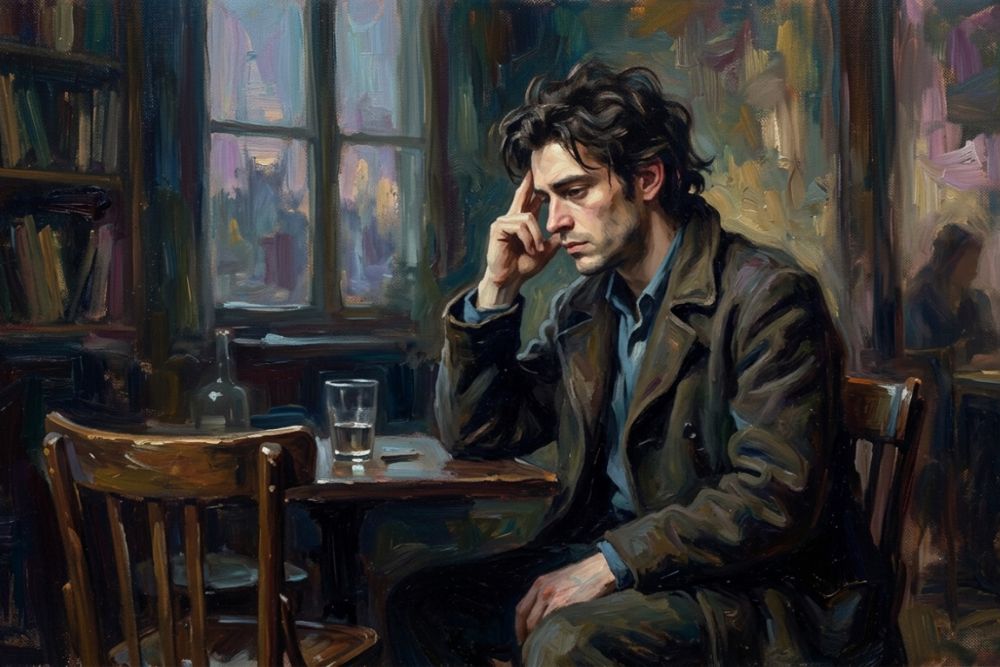
Because of this unique capacity to question and witness, Heidegger used a metaphor to describe our place in the world: The Clearing (Lichtung).
Imagine walking through a dense, dark forest. Suddenly, you step into an open space where the trees part. Thanks to this physical clearing, light can finally enter the dark woods, allowing the grass, the sky, and the animals to be seen.
Human consciousness (Dasein) is that clearing. We provide the open “space” where the universe can finally show up and be understood.
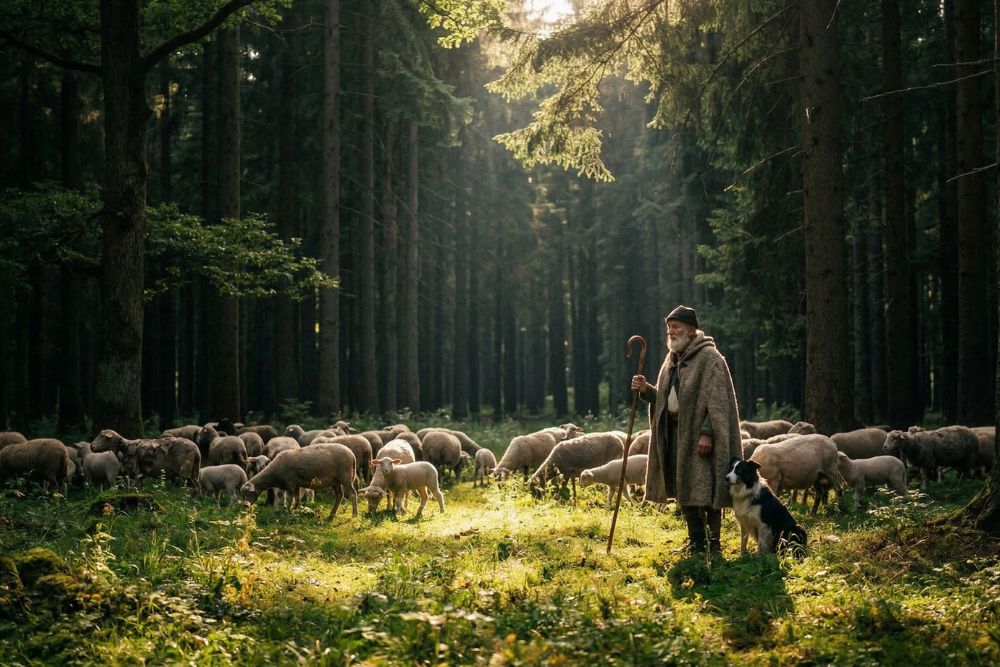
This brings us back to the concept of the Shepherd of Being. (also called the “Pasture of Being”) A shepherd does not create the sheep, nor do they build the pasture. Rather, their job is simply to watch over and protect the flock.
As human beings, we are NOT supposed to manufacture or exploit reality. Our highest calling is to stand quietly in the clearing, deeply attentive, guarding the mystery of existence so that it can reveal itself.
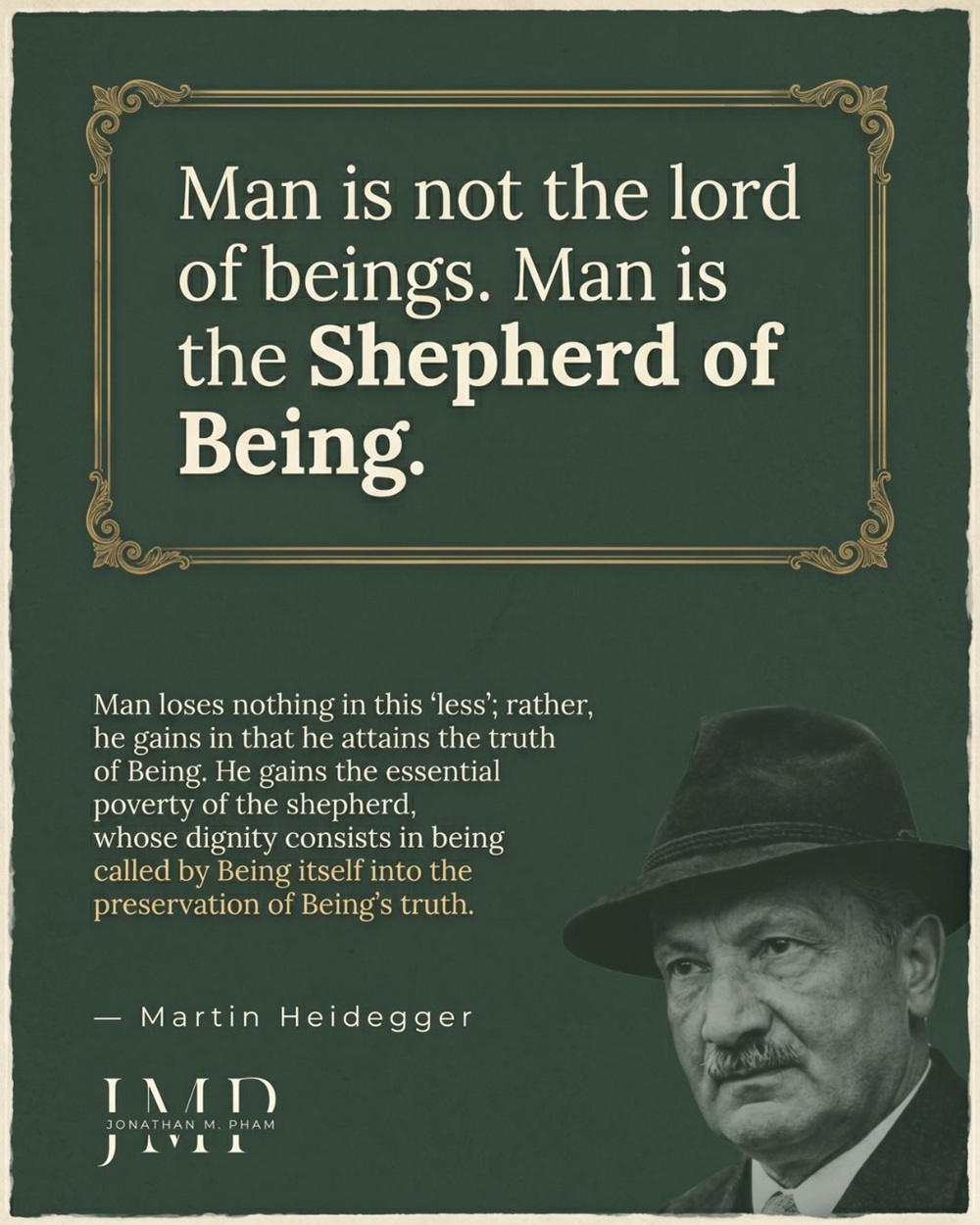
Man is NOT the lord of beings. Man is the Shepherd of Being. Man loses nothing in this “less”; rather, he gains in that he attains the truth of Being. He gains the essential poverty of the shepherd, whose dignity consists in being called by Being itself into the preservation of Being’s truth.
Martin Heidegger
According to Heidegger, there are two fundamentally different ways human beings can choose to interact with reality. Most of us are, unfortunately, trapped in the first mode; our “salvation” only comes when we transition to the second.
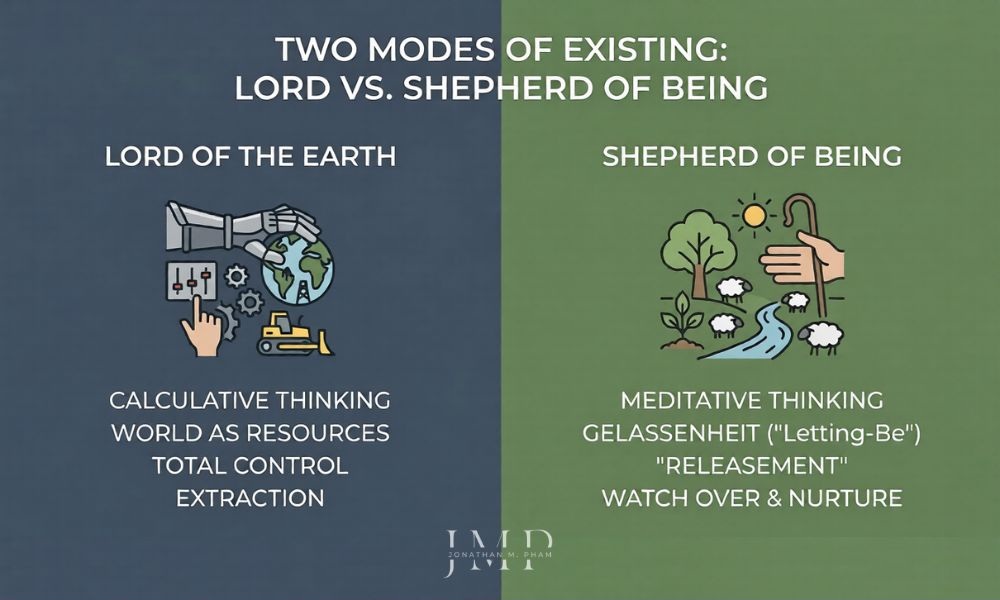
As discussed before, in Western thought—particularly since the Enlightenment and the Industrial Revolution—we have adopted the role of the “Lord” or master of the earth. This mode is driven by what Heidegger called “Calculative thinking”.
When operating as Lords, we treat the entire world—and even other human beings—as a warehouse of resources to be optimized, categorized, and consumed. The advance of modern technology further reinforces this mindset; it encourages many to view reality as a “standing-reserve” (Bestand), essentially reducing existence to a cosmic gas station meant solely for extraction.
To the Lord of the Earth, a tree is not a living entity; it is merely “timber”. A rushing river is not a force of nature; it is just “hydroelectric power” waiting to be harnessed.
The goal, therefore, is always total control, efficiency, and mastery.
The exact opposite of the technocratic Lord is the “Shepherd of Being”. Instead of calculation, the Shepherd operates through “Meditative thinking”. They interact with the world through a profound state Heidegger called Gelassenheit. (a term he borrowed from medieval mysticism) Typically translated as “releasement” or “letting-be“, Gelassenheit involves a passive-active state where a person stops trying to force their ego and will upon the world.
Just think about the literal role of a shepherd. A shepherd does not create the sheep out of clay, nor do they manufacture the pasture. Their role is simply to watch over, protect, and guide the flock, remaining deeply attentive to the weather, the environment, and the predators.
To be a Shepherd of Being means to hold space for things to reveal their true nature, nurturing them without trying to forcefully control them.
Instead of extracting, you LISTEN.
| Feature | The Lord of beings | The Shepherd of Being |
| Relation to Nature | A resource to be exploited and categorized. | A mystery to be guarded and witnessed. |
| Human Stance | Assertive, calculating, and constantly busy. | Receptive, meditative, and patiently “waiting”. |
| Primary Goal | Total control, optimization, and efficiency. | Protecting the “Openness” of truth so things can simply be. |
Read more: Amor Mundi – To Love the World From an Authentic Heart
As of now, I suppose some of you may be doubting the idea of Gelassenheit—”letting-be”. If we are told to stop imposing our will on the world—and to relinquish our role as “Lords,” does that mean we should just give up?
In fact, many readers initially viewed Heidegger’s later philosophy as a shift toward determinism or fatalism—as though he was abandoning human agency entirely, asking us to sit back passively while life happened to us.
But this is a misinterpretation. Being a Shepherd of Being is NOT an enslavement to fate; it actually promises a much deeper form of freedom.
As thrown, Dasein has indeed been delivered over to itself and to its potentiality-for-Being, but as Being-in-the-world. As thrown, it has been submitted to a ‘world’, and exists factically with Others.
Martin Heidegger
To step down from the throne of the “Master” does not mean you become a victim. Instead, you adopt what can be called a relational or responsive freedom.
Now, let us think of a person trying to navigate a rushing river.
The Shepherd of Being, therefore, represents the humility and willingness to listen to the truth of the world.
Do everything in your human power, and then wait for the decree of heaven.
As I have figured, the Shepherd of Being, in many ways, serves as a bridge between Western existentialism and Eastern philosophy.
Historically, Western existentialism has been highly focused on the isolated individual asserting their will against a meaningless universe (think of Nietzsche’s Übermensch carving out new values by force). Eastern traditions, on the other hand, tend to emphasize interconnectedness and surrender. As such, the two had been viewed as fundamentally irreconcilable for decades.
Heidegger’s Shepherd offers a solid philosophical middle ground. By adopting the posture of the Shepherd, one retains the profound existential weight of personal responsibility—i.e. they remain the active guardian of their life—while also stripping away the toxic, ego-driven need to dominate reality.
Read more: Authenticity in the Abyss – How to Stay Human in the Mess
Shepherd of Being – the “Middle Path” of Existentialism
Humanity is living through a period of unprecedented modernization, technological disruption, and ideological polarization. The collapse of old structures has left us with widespread uncertainty, and the default response has been to double down on trying to control everything.
The modern business-oriented mindset and the pervasive “hustle culture” demand that we constantly optimize our lives—i.e. tracking our steps, monetizing our hobbies, and branding our personalities. As such, most have transitioned from human beings into human doings—viewing oneself as a machine meant for constant output. No wonder problems like burnout, cynicism and apathy have become alarmingly widespread these days.
The Shepherd of Being model offers the permission to adopt a slower, more compassionate life stance. It serves as a reminder that one’s primary ontological duty is not to be perfectly efficient, but to be PRESENT. There’s absolutely NO need to “produce” value every second of the day to justify one’s existence.
We live among things, but we have forgotten how to let them BE.
Martin Heidegger
As AI and technological advancements accelerate, people cannot help but confront a fundamental existential threat: “If a machine can write, code, and calculate faster and better than I can, what is my purpose?“
Long before the Internet, Heidegger had already anticipated the above-mentioned dilemma. He warned people against this thing called Gestell (Enframing)—the technological mindset that views everything, including humans, as a “standing-reserve” (Bestand) to be extracted and used.
If we define human worth purely by our ability to calculate and produce, AI will inevitably defeat us.
However, AI cannot “shepherd”. A machine cannot stand in the clearing of existence and feel the weight of a moment.
By shifting from the “calculating” Lord to the “listening” Shepherd, we insulate our humanity against the threat of automation. We reclaim the uniquely human capacity for mindfulness and awe.
We can say ‘Yes’ to the unavoidable use of technical devices, and yet also deny them the right to dominate us, and so to warp, confuse, and lay waste our nature.
Martin Heidegger
The global environmental crises humanity is facing these days are the direct result of the “Lord of the Earth” mentality. For centuries, industrialization has treated the natural world as a giant cosmic gas station meant solely for human extraction.
The philosophy of the Shepherd of Being, as such, has now become highly influential in eco-philosophy and environmental ethics. It provides a philosophical foundation for treating the Earth not as a resource, but as a shared home.
Just as a shepherd does not pave over the pasture, humanity is tasked with the mission of a guardian, so that life can continue to unfold organically.
There can be obligations of justice toward non-sentient beings not because they have their own interests, but because there is a way things best fit together to enable the well-being of all that lives on earth, including ourselves as the beings called upon to heed our essence by taking care of things.
Sonia Sikka, ‘Heidegger, Morality and Politics: Questioning the Shepherd of Being‘ (2017)
It’s a disheartening fact that we are now witnessing a rise in ideological polarization and fanaticism. Whether in politics, secular ideologies, or religion, the phenomenon is deeply rooted in the “Calculative” desire to possess the truth completely and force it upon others. Fanatics do not trust reality; they cling to their rigid beliefs and try to build dams to control the river.
The Shepherd of Being, however, operates differently—they simply listen.
Unlike those who think of life like a puzzle to be conquered, the Shepherd treats it as a “mystery” to be guarded.
When we stop trying to aggressively impose our worldview on everything we encounter, we create space for genuine dialogue and reduce unnecessary friction. We learn to live with uncertainty without being terrified by it.
The ultimate business of philosophy is to preserve the force of the most elemental words in which Dasein expresses itself, and to keep the common understanding from levelling them off to that unintelligibility which functions in turn as a source of pseudo-problems.
Martin Heidegger
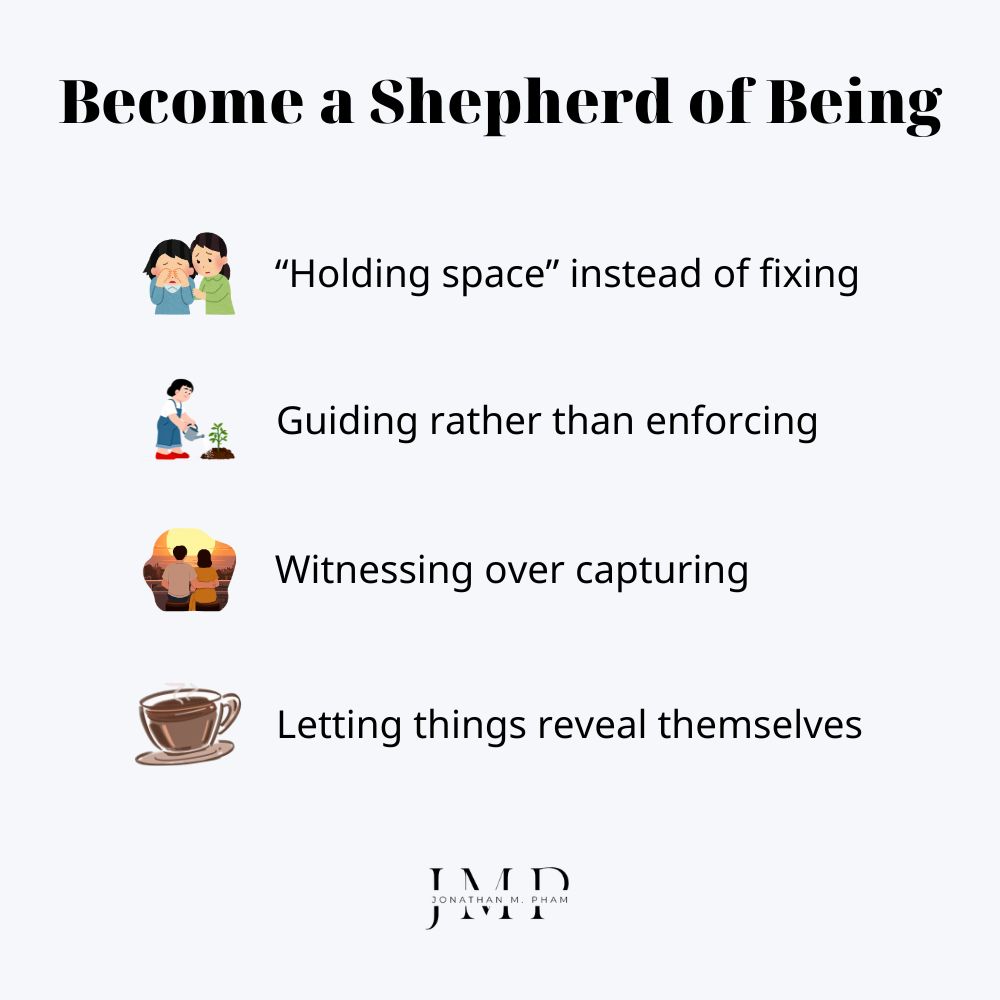
Stepping down from the throne of the “Lord of the Earth” does not require moving to a monastery. (though that does help, for a time!) All that is needed is a shift in posture—choosing patience over force, and witnessing over controlling—in one’s daily moments.
Here is what it looks like to practice being a Shepherd of Being.
Modern culture, as discussed, trains us to be relentless problem-solvers. When a friend or partner comes to us in distress, our immediate instinct is usually to present a solution, give advice, or “fix” the issue. We treat their sadness as a mechanical error that needs repairing.
To be a shepherd in your relationships means learning to simply sit with someone who is grieving or frustrated. To resist the urge to offer empty platitudes—and instead, allow them to feel exactly what they are feeling.
In doing so, you are protecting their right to exist in their current state, guarding their humanity rather than trying to “optimize” their mood.
Read more: Platinum Rule vs Golden Rule – How the Principles of Empathy Have Shifted
It is incredibly common to view our work, projects, and even the people under our guidance as raw materials to be molded into a specific shape of success.
I myself have experienced this mindset firsthand during my time working as a teacher. For most teachers (as well as those in leadership positions), it is so tempting to treat those we are in charge of as “projects” to be optimized for grades, forcing them to learn at the same pace or fit a standardized mold.
But the younger generations no longer respond to blind obedience or rigid authority like older people often do.
A shepherd does not build a sheep out of clay; they watch over it as it grows.
True mentorship requires acting as a facilitator rather than an enforcer. When you notice one’s quirky interest or unique learning style and encourage it to flourish, you are “shepherding”.
You are helping them discover who they already are, rather than turning them into a mini-version of yourself.
Read more: Self-identity – A Contemplation on Being & Becoming
Many people tend to interact with the natural world as a mere backdrop for their own lives, taking from it what they want to consume. However, that is not what a Shepherd of Being would do.
Think of the last time you saw a breathtaking sunset or a striking landscape. The modern reflex would be to immediately pull out a phone to capture it for social media. Most of us, subconsciously, would feel an anxious need to “own” the moment, to “extract” its value.
The next time you are in nature, try to resist that urge. Just stand there and let the beauty unfold. Let the sunset just be a sunset.
By refusing to “consume” the experience, you act as a quiet guardian of that fleeting reality, acknowledging that you belong to the earth, not the other way around.
Imagine you have just returned from a trip into space. You step off your vessel onto our green planet and find yourself standing in a deep green forest. Rays of light filter through the trees towering above you. Fallen leaves soften the ground, and deep-green moss envelops the trunk of a fallen tree. Ferns cover the ground all around you. The sounds of life permeate the air – the flapping of wings, the calling of birds, and the wind whistling through the trees and shaking the leaves.
As you take a deep breath of cool air and let the scents of pristine nature fill your body, you have a deep realization that this is your planet and your birthright. And that is why you must love it and why you do.
Masaru Emoto, ‘The Secret Life of Water’
Given the rushing nature of the modern world, no wonder many constantly “label” and categorize things to move through the day faster. A chair is just “a thing to sit on”; a mug is just “a caffeine-delivery vessel to fuel our productivity.”
However, have you ever had a quiet moment—perhaps drinking the morning coffee—where you suddenly noticed the warmth of the mug, the way the light hit the table, the steam rising, and the stillness of the room?
For that brief second, the morning wasn’t just a stepping stone to the workday, and the mug wasn’t just a tool. You stopped calculating.
You were simply allowing the everyday world to reveal its simple, yet profound existence to you.
You were standing in the clearing, letting things be.
To listen to Being, we must silence the noise of certainty.
Martin Heidegger
Language is the house of Being. In its home man dwells. Those who think and those who create with words are the guardians of this home.
Only man, and indeed man alone, is ‘called’ by Being to the preservation and guarding of the truth of Being in the clearing.
The call comes as the throw from which the thrownness of Da-sein derives. In his essential unfolding within the history of Being, man is the being whose Being as ek-sistence consists in his dwelling in the nearness of Being. Man is the neighbor of Being.
No. (well, it also depends on how you define ‘religion’!) While Heidegger’s language may sound poetic and deeply spiritual, it is, perhaps, better described as “secular mysticism“.
After all, Heidegger did not tell people to believe in a supernatural deity or a specific theology. Rather, he insisted that we fundamentally change our psychological posture: moving from an aggressive conqueror of nature to a receptive, attentive guardian of reality.
Not at all. “Letting-be” (Gelassenheit) does not promote passive fatalism, laziness, or giving up on one’s ambitions. It’s just about the way you pursue them.
Healthy striving means working with the natural “flow” of reality, much like a sailor navigating the currents of a river. Toxic control—which Heidegger warned against—means trying to force the river to flow backward to suit your ego, viewing everything only as a tool for your own success.
Read more: 27 Best Existentialism Books – A Seeker’s Guide to Finding Meaning
In an age defined by digital noise, chronic burnout, and the relentless pressure to perform—to live in “bad faith“, humanity is, indeed, in desperate need of a “new way to exist” in the world. For centuries, we have been acting as the “Lords” of the earth, forcing reality to bend to our will—and treating everything as a resource to be extracted.
But sitting on that throne has only left us exhausted and alienated.
Now is the time for us to act like the Shepherd of Being—i.e. to step down from that throne and reclaim our humanity.
If we pair this mindset with other existential models—like Kierkegaard’s Knight of Faith, who bravely trusts the absurd—we would discover a truly holistic framework for navigating the chaos of the modern world.
While the Knight gives us the courage to leap when logic fails, the Shepherd grants us the patience to listen when the world is too loud.
You do not need to conquer the earth. Nor do you need to optimize every hour of the day, or extract value from every interaction.
What you only need to do is to stand quietly in your clearing, tend to the people and things around you, and let the “mystery of existence” unfold!
It was in the silence that I heard Your voice.
Father Rodriguez, Silence (2016)
Other resources you might be interested in:

A long time ago, in a provincial town far, far away… There was a wealthy, cynical landowner named Fyodor Pavlovitch Kara [...]

Let us visit a fictional place: The Village of the Valley. Once upon a time, those who lived there were divided into two [...]

Has this ever happened to you? Let’s say you are suffering from a frustrating health issue, or stuck in a chaotic life d [...]