




0808
Personal Philosophy: What is Your Truth & Stance for Living?
A long time ago, in a provincial town far, far away… There was a wealthy, cynical landowner named Fyodor Pavlovitch Kara [...]
Ready to understand yourself and connect with others on a more meaningful level? Explore the power of emotional intelligence (EQ) and unlock the secrets to a more authentic, resilient, and joyful existence!
What separates a life of connection and fulfillment from one of frustration and misunderstanding? Often, the answer isn’t about how smart you are, but how well you understand the language of emotions – both your own and those of others. This is the magic of emotional intelligence (EQ) – a critical skill for navigating one’s inner worlds and cultivating meaningful bonds.
Highlights
Simply put, emotional intelligence (EI) is the ability to recognize, understand, and manage one’s own emotions, as well as those of others.
Think of it this way:
People with high EQ navigate life with a greater sense of grace. They are adept at handling stress, communicating effectively, and establishing strong, trusting relationships – because they are sensitive to the emotional currents flowing within and around them.
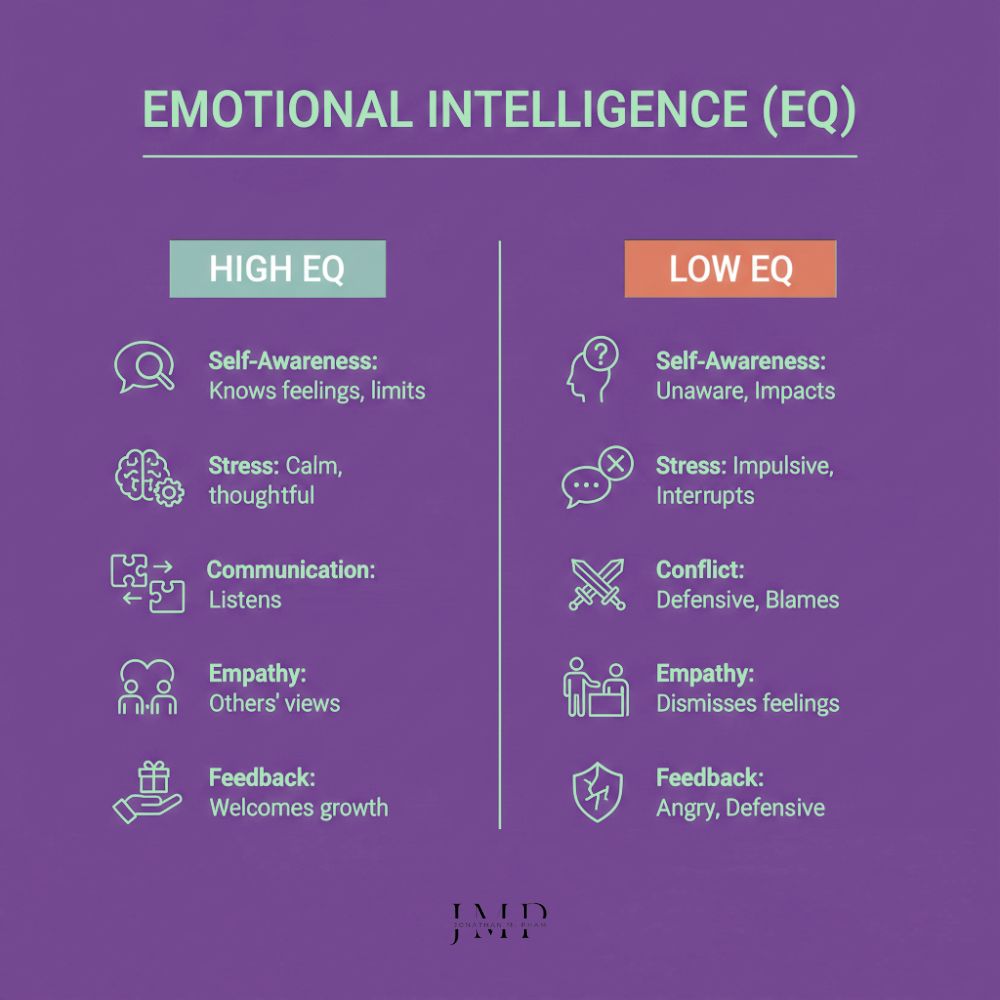
What does high EQ look like in daily life? It’s less about grand gestures and more about consistent, mindful actions. Here are some key characteristics:
| Trait | High Emotional Intelligence (EQ) | Low Emotional Intelligence (EQ) |
| Self-Awareness | Acknowledges one’s own feelings and weaknesses. | Unaware of one’s own emotions or how they affect others. |
| Reaction to Stress | Stays calm and thinks before acting. | Reacts impulsively; easily overwhelmed. |
| Communication | Listens to understand; expresses oneself clearly. | Interrupts others; has difficulty conveying feelings. |
| Conflict | Seeks win-win solutions and common ground. | Becomes defensive; makes excuses or blames others. |
| Empathy | Considers others’ perspectives. | Dismisses others’ feelings. |
| Receiving Feedback | Open to constructive criticism; sees it as a gift. | Gets angry or defensive when receiving feedback. |
While the concept of “emotional intelligence” may feel modern to some, its roots go back decades.

There is perhaps no psychological skill more fundamental than resisting impulse.
Daniel Goleman
So, why should you care about developing your EQ? Simple, because it has a profound impact on nearly every corner of life, from inner peace to outer success.
Emotional self-control – delaying gratification and stifling impulsiveness – underlies accomplishment of every sort.
Daniel Goleman
Research has shown that EQ is a better predictor of life satisfaction than IQ. People with higher emotional intelligence simply tend to lead happier, more resilient lives.
I learned this the hard way a few years ago. I was in a recurring argument with my sister that always ended in frustration. I’d get defensive, focusing only on proving my point, while she would shut down completely. I was so focused on the “logic” of my argument that I failed to see the hurt and insecurity behind her words.
That is, until one day, after another pointless fight, I realized I wasn’t listening at all. I was just reacting.
I started practicing what I was learning about EQ. The next time we talked, I made a conscious effort to just listen – to be attuned to what’s behind the words. And I acknowledged her feelings without judgment.
The change was immediate. The tension dissolved, and for the first time, we had a real conversation. It was a turning point not just for our relationship, but for my own self-discovery journey.
EQ is the foundation of healthy relationships, resilience in the face of setbacks, and the self-awareness needed for genuine personal growth.
Even if you’re not climbing a corporate ladder, EQ is still vital for a positive work experience. It’s a stronger predictor of success than technical skills alone. Why? Because it governs how we collaborate, handle stress, and communicate.
Every unaddressed conflict wastes about eight hours of company time in gossip and other unproductive activities.
Joseph Grenny, co-founder of VitalSmarts
Leadership is not domination, but the art of persuading people to work toward a common goal.
Daniel Goleman
You don’t need a title to be a leader. All of us lead in our families, friend groups, and communities. True leadership is about connection and inspiration.
Emotional intelligence is the key to leadership that inspires, empowers, and transforms.
JD Meier, leadership strategist
According to Daniel Goleman, emotional intelligence can be broken down into four key domains as follows:
The foundational competency, self-awareness involves the ability to understand one’s own emotions, triggers, and how they affect one’s thoughts and behavior. For example, it’s knowing you’re grumpy because you’re hungry, or that you feel anxious before big social events.
Once you’re aware of your inner states, the next step is managing them. This isn’t about suppressing feelings, but about responding to them in a healthy, constructive way.
Read more: Self-leadership – The Art of Leading from Within
This is where you turn your awareness outward. It’s the ability to be receptive to the emotions of others – and to grasp the dynamics within a group or relationship.
This involves leveraging the awareness of your own emotions and those of others to manage interactions successfully, cultivate long-lasting bonds, and inspire others.
Read more: Life Management – How to Design a Life You Love
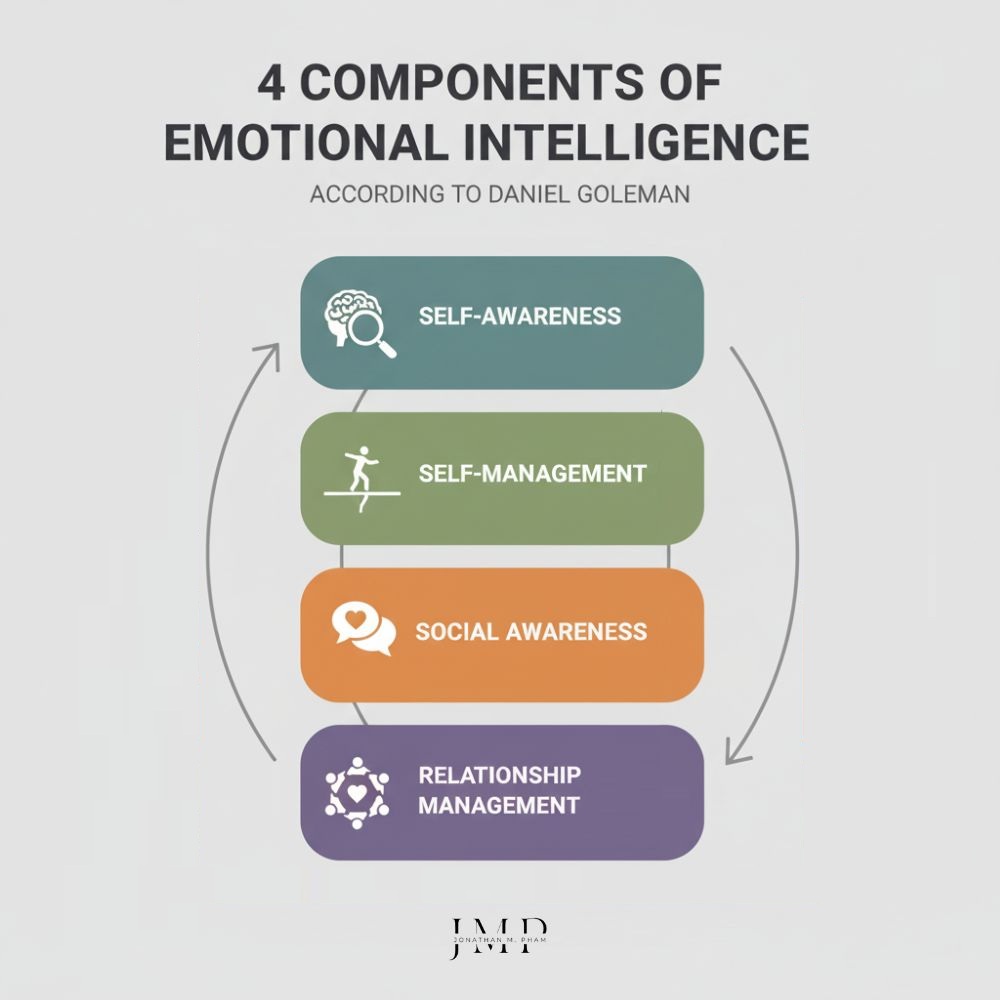
4 components of emotional intelligence (EQ)
The best news about EQ is that it’s not a fixed trait, but a skill that can be refined with intention and practice. Here’s how:
The first step is to set aside time for daily self-reflection – and journaling is one of the best tools for this. At the end of the day, try asking yourself questions like:
Similarly, practices such as meditation and mindfulness may also help. These exercises aren’t about emptying your mind, but about learning to watch your thoughts and feelings come and go without being swept away by them – so as to create that crucial pause between a trigger and your reaction.
Read more: 45 Daily Mindfulness Questions for Adults
We all have emotional blind spots – areas where our self-perception doesn’t match reality. The only way to be aware of them is to ask for help from people you trust – whether they are your friends, colleagues, managers, coaches, spiritual guides, or accountability partners.
Instead of a vague question like, “Do you think I’m a good listener?”, try something more specific; for example: “I’m working on being more present in conversations. Was there a time recently where I seemed distracted while you were talking?”
When the other person shares their input, your only job is to listen with an open heart. Thank them, and let their words sit with you without judgment or defensiveness.
Read more: Not Saying Thank You – Why Do Many of Us Fail to Express Gratitude?
The next time you’re talking with someone, try to listen with the sole purpose of getting into their world. Pay attention not just to what they say, but to the emotion in their voice, posture, and what is not being said.
When you reflect back with something like, “It sounds like you felt really unappreciated in that situation,” you validate their feelings and build a bridge of connection.
There is a simple technique for self-regulation called “affect labeling,” which simply means labeling feelings with words. When you label an emotion you are experiencing (for example, “I feel anger”), it somehow helps you manage that emotion.
Chade-Meng Tan, ‘Search Inside Yourself’
When you feel a strong emotion, try labeling it with precision. Instead of just “I feel bad,” are you feeling “disappointed,” “overwhelmed,” “insecure,” or “lonely”?
This practice, known as emotional granularity, is incredibly empowering. Psychologists have found that the simple act of naming a specific emotion can reduce its intensity and give rise to a greater sense of control. A precise diagnosis allows for a more effective response – you wouldn’t treat disappointment the same way you’d treat anxiety.
Instead of resorting to default coping mechanisms like scrolling on your phone or emotional eating when stressed, be intentional about building a toolkit of healthy outlets. Ask yourself this question: What truly calms and recharges you?
For some, it may be a brisk walk in nature.
For others, it may be getting lost in a creative hobby, listening to a specific playlist, or having a heartfelt talk with a friend.
These aren’t just distractions; they are proactive ways to manage your emotional state, helping you build resilience so you’re better prepared before stress hits its peak.
Read more: Learning to Love Yourself – 16 Handy Tips for Fostering Self-esteem Every Day
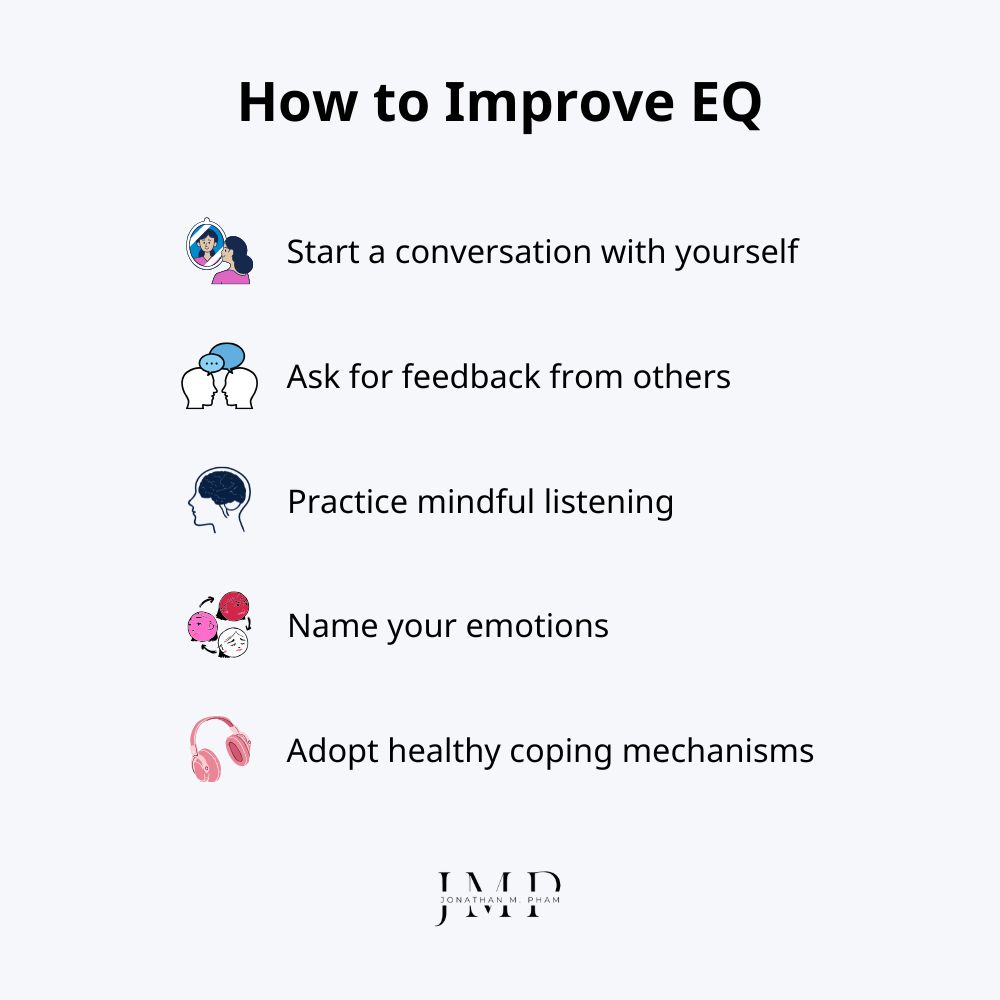
How to cultivate & improve EQ
This may seem surprising, but according to research by Travis Bradberry, only 36% of people can accurately identify their emotions as they happen. It leaves us with a question – if EQ is so beneficial, why doesn’t everyone have it?
In reality, the journey of improving one’s EQ is filled with a lot of hurdles. The biggest one might be what organizational psychologist Tasha Eurich calls the “self-awareness illusion.” Her research revealed a startling gap: while 95% of people believe they are self-aware, only 10-15% actually are.
What does that mean?
Many of us operate with a fundamental misunderstanding of ourselves – our triggers, motivations, and how we come across to others. This blind spot is the primary reason why developing EQ is so difficult; we can’t improve what we don’t realize needs work.
Beyond this core challenge, other common obstacles include:
It’s an unfortunate fact, but the thing is that these days, being busy is frequently praised over being present. We race from task to task, leaving no room for the quiet pauses required for emotional reflection.
In a world that values external productivity, taking time to check in with oneself may feel like a luxury, when in reality, it’s a necessity.
Read more: Work-life Balance – 14 Tips to Unplug & Recharge
Truly understanding your emotions means being courageous enough to confront the uncomfortable ones – jealousy, insecurity, shame, or sadness (which psychologist Carl Jung referred to as the “Shadow” – the parts of ourselves we instinctively hide). Many of us are taught from a young age to suppress these “negative” feelings; no wonder the act of exploring them feels daunting and vulnerable.
Read more: Healing Your Inner Child – 15 Steps to Unearthing the Happy, Healthy You Within
When it’s hysterical, it’s historical.
Marshall Goldsmith
Our automatic emotional reactions are, many times, pathways forged in childhood and reinforced over decades. If you learned early on that anger was best expressed through yelling – or that sadness should be hidden, changing that response requires immense conscious and consistent effort. It’s like trying to forge a new path through a dense forest when a well-worn road already exists.
Read more: Living in the Past – The Problem of Dwelling on What Was
In a society that tends to equate emotional expression with extroverted charisma, introverts (like me) are often misunderstood. While an introvert may process emotions internally and express them more subtly, this is sometimes mistaken for a lack of empathy or emotional skill.
The challenge for many introverts isn’t a lack of deep feeling, but finding authentic and comfortable ways to express that inner world outwardly.
Read more: 50 Introvert Hobbies for Self-Care and Connection

Unlike an IQ test, there isn’t a single score that defines one’s EQ. It’s more of a living, breathing skill set that fluctuates and grows. Measuring it is less about getting a definitive number and more about gaining insightful self-knowledge.
Here are a few practical ways to get a sense of where you stand.
As mentioned above, it’s important to make self-reflection a structured practice. At the end of each week, set aside 15 minutes to review your interactions through the lens of the four EQ components. Ask yourself questions such as:
Approach a trusted friend, partner, or colleague and say, “I’m trying to be more aware of how I handle stress. When we were dealing with that difficult project last month, how did my stress seem to affect you and the team?” This grounds the feedback in real-world events and paves the way for actionable information you can actually use.
There are a lot of professional tests designed to measure EQ, and they can provide a structured snapshot of your skills. It’s important to understand what they offer, though.
Some, like the MSCEIT, are ability-based, meaning they test your skill by having you solve emotionally-based problems.
Others, like the EQ-i 2.0, are self-report measures, which rely on your own perception of your abilities.
Neither gives a final, absolute score. Instead, view them as a mirror or a map – a tool to show you where your strengths lie and which areas might benefit from more attention on your self-discovery journey.
For some practical exercises to get you started, PositivePsychology.com does offer a Free Emotional Intelligence Exercises Pack that you may want to check out!
Want a quick self-check? This isn’t a scientific test, but it can definitely help you think. For each question, choose the answer that sounds most like you.
1. When you’re faced with a sudden, stressful situation, you tend to:
a) Feel overwhelmed and react impulsively.
b) Freeze up and aren’t sure what to do.
c) Take a deep breath to calm yourself before deciding on a course of action.
2. A friend cancels plans with you at the last minute. Your first thought is:
a) “How rude! They are so unreliable.”
b) “They must not want to see me. I must have done something wrong.”
c) “I hope everything’s okay with them. I’ll check in.”
3. When someone gives you constructive feedback, your initial reaction is to:
a) Feel defensive and start explaining why they’re wrong.
b) Feel hurt and take it as a personal attack.
c) Listen carefully, thank them for their perspective, and reflect on it later.
4. You’re in a group discussion, and someone is very quiet. You:
a) Don’t really notice or assume they have nothing to say.
b) Worry that they don’t like the ideas being discussed.
c) Make a point to gently ask for their opinion to ensure they feel included.
(Reflection: Mostly A’s suggest a need to work on self-management and empathy. Mostly B’s might point to areas for building self-confidence and a more positive outlook. Mostly C’s indicate a strong foundation in emotional intelligence.)
Read more: 35 Emotional Intelligence Questions to Ask Yourself for Mastery
Check out more quotes about emotional intelligence (EQ) here!
If your emotional abilities aren’t in hand… then no matter how smart you are, you are not going to get very far.
Daniel Goleman
Emotional intelligence is not the opposite of intelligence… it is the unique intersection of both.
David Caruso
To feel intensely is not a symptom of weakness, it is the trademark of the truly alive and compassionate.
Anthon St. Maarten
Fear doesn’t exist anywhere except in the mind.
Dale Carnegie
We are dangerous when we are not conscious of our emotions.
John O. Dozier
The foundational book that popularized EQ; explores self-awareness, empathy, and social skills.
Offers a step-by-step program to boost EQ with self-assessments and actionable strategies
Discusses daily habits that improve EQ in real-world scenarios.
Applies EQ to leadership, teamwork, and career success.
A quirky, practical guide to emotional regulation and self-awareness.
Introduces tools for establishing effective relationships through emotional communication.
Focuses on cultivating emotional resilience in children, with practices for educators and parents.

Emotional intelligence isn’t a destination one arrives at, but a lifelong journey of practice and continuous improvement. It’s about choosing curiosity over judgment, empathy over criticism, and reflection over reaction.
By nurturing your EQ, you’re giving yourself the gift of a richer inner life and more meaningful connections with those around you. So, start small. Pick one area to focus on this week – maybe it’s listening more deeply or just pausing before you speak.
Every small step is a victory on the path to a more well-arounded “you”!
Other resources you might be interested in:

A long time ago, in a provincial town far, far away… There was a wealthy, cynical landowner named Fyodor Pavlovitch Kara [...]

Let us visit a fictional place: The Village of the Valley. Once upon a time, those who lived there were divided into two [...]

Has this ever happened to you? Let’s say you are suffering from a frustrating health issue, or stuck in a chaotic life d [...]