



0808
Personal Philosophy: What is Your Truth & Stance for Living?
A long time ago, in a provincial town far, far away… There was a wealthy, cynical landowner named Fyodor Pavlovitch Kara [...]
Learn how to overcome the detrimental habit of making excuses and embrace accountability for personal professional success.
During each person’s journey towards personal and professional growth, one obstacle that often stands in the way is the habit of making excuses – whether it’s blaming external circumstances, avoiding responsibility, or justifying our shortcomings. By recognizing and addressing this destructive pattern, we may break free from the chains of excuse-making – while paving the way for personal empowerment and fulfillment.
Highlights
Making excuses is when we provide false justifications for our inability to perform a task or fulfill an obligation. An example is when you claim to be too occupied to assist your colleague with a project, while the underlying reason is simply a lack of motivation. Or, you may leave a social gathering early citing reasons such as a headache – while in reality, you are actually just feeling bored.
With the exception of instances when people aim to be polite or show respect (which, truthfully, are not as frequent as desired), excuses are primarily employed as a means to evade accountability or prevent personal embarrassment for our doings/ undoings. For instance, if you fail to complete your assigned work, you might resort to justifying yourself with something like:

Characteristics of people who make excuses
We have more ability than willpower, and it is often an excuse to ourselves that we imagine that things are impossible.
François de la Rochefoucauld
Have you ever pondered over the question: “Why do I keep making excuses?”
This weaseling tendency is deeply rooted in human behavior – and can be attributed to various underlying factors. Below are some of the most common reasons:
By recognizing these underlying motivations, we can gain a deeper understanding of the complex dynamics that drive our behavior in various aspects of life.

The mindset of people who make excuses
When it’s hysterical, it’s historical.
Marshall Goldsmith
Making excuses and clinging to the past share a common thread – they are both mechanisms that shield us from reality and hinder our ability to embrace change. When we make excuses, we strive to rationalize our actions or feelings by assigning blame to external factors/ circumstances.
Similarly, clinging to the past involves resistance to the present or future, as we desperately hold onto memories or emotions. These behaviors, although distinct, can impede our growth, learning, and progression.
Let us explore some of the underlying reasons behind both excuses and our attachment to the past:

Reasons to make excuses
He that is good for making excuses is seldom good for anything else.
Benjamin Franklin
Psychologists categorize excuse-making as a form of “self-handicapping,” which ultimately sabotages our performance and motivation. This bad habit diverts the attention away from our own flaws or mistakes – while at the same time attributing them to external factors.
Though some may perceive excuses as beneficial – allowing them to preserve their own self-esteem and alleviate stress – such justifications will prove detrimental if they hinder our ability to take responsibility, achieve our goals, or learn from our failures. As time passes by, the effects get accumulated, until there is no going back.
Dangers of making excuses for our bad behaviors:
The trouble with excuses is that they become inevitably difficult to believe after they’ve been used a couple of times.
Scott Spencer

People who make excuses never make progress
(This part – along with the 2 sections below – is compiled with inspiration from the bestseller ‘What got you here won’t get you there‘ by World #1 Executive coach, Dr. Marshall Goldsmith)
Making excuses is a bad habit commonly observed in the workplace, manifesting in two distinct categories: blunt and subtle excuses.
Blunt excuses resemble the classic “dog ate my homework” scenario. For instance, one might say, “Apologies for missing our lunch date. My assistant mistakenly marked the wrong day in my calendar.”
Essentially, such an excuse aims to shift blame away from oneself – by attributing it to someone else’s incompetence.
However, this approach rarely goes unnoticed; not to mention, it fails as an effective leadership strategy. Nobody would ever praise the leader for their exceptional excuse-making skills – nor their ability to turn things around with justifications.
The more subtle excuses emerge when we ascribe our shortcomings to fixed genetic traits that we believe cannot be altered. Such rationalizations revolve around ingrained attributes that we perceive as inherent flaws, creating a self-perception that hinders personal growth.
Undoubtedly, you have encountered these self-limiting excuses, perhaps even using them to describe yourself:
It is astonishing how frequently we encounter intelligent and accomplished individuals making purposefully self-deprecating remarks about themselves. It becomes a subtle art, as they unwittingly categorize themselves based on stereotypes – whether it’s impatience, a short fuse, or disorganization. They then employ these stereotypes to justify otherwise inexcusable behaviors.
The truth is that perpetuating these excuses does a disservice to personal and professional development. It limits our potential for growth – as well as hampers our ability to overcome challenges. By embracing a mindset that acknowledges our capacity for change and improvement, we can break free from the constraints of these excuses and strive for excellence.
Ninety-nine percent of the failures come from people who have the habit of making excuses.
George Washington Carver

The bad habit of making excuses
People with integrity do what they say they are going to do. Others have excuses.
Laura Schlessinger
In 2004, when Bill Clinton released his immensely popular memoir, he knew he had to address the infamous Monica Lewinsky scandal that marred his second term. Rather than resorting to excuses, he took personal responsibility and acknowledged it as a personal failure, an internal struggle he had succumbed to. In his memoir, he emphasized that regardless of any external influences or circumstances, once people reach the age of accountability, they must take ownership of their mistakes.
Clinton’s recognition of the distinction between explanation and excuse was not solely because his conduct was inexcusable. The truth is, there is simply no valid reason for making excuses.
When you catch yourself saying, “I apologize for being late, but the traffic was unbearable,” pause after the word “apologize” immediately. Blaming traffic is a feeble excuse that fails to justify keeping others waiting. The more prudent course of action would have been to start earlier.
What is the worst outcome? Arriving ahead of schedule and having to spend a few extra minutes in the lobby? Are you genuinely concerned about saying, “I’m sorry for being early, but I left too soon, and the traffic was not as terrible as anticipated”?
If the world operated on such principles, excuses would hold no sway.
Read more: Refusing to Apologize – How to Abandon This Insidious Habit

People who make excuses
As mentioned, personal stereotyping is a deep-rooted cause of our tendency to make excuses. Such stereotypes often trace their origins to long-standing narratives, frequently stemming from childhood. These stories, regardless of their factual basis, embed themselves in our minds and established a foundation of low expectations that inevitably become self-fulfilling prophecies. We unwittingly behave in ways that align with our negative beliefs, as if driven to prove them right.
Dr. Marshall Goldsmith once shared his own story about this phenomenon. From his earliest years, his mother would tell him that he was the smartest boy in Valley Station – and that he did not possess mechanical skills, probably because she was determined to ensure he didn’t end up pumping gas or changing tires at the service station.
Marshall, you are extremely smart. In fact, you are the smartest little boy in Valley Station!
or
Marshall, you have no mechanical skills, and you will never have any mechanical skills for the rest of your life.
The impact of this imprinting was profound. Goldsmith was never encouraged to engage with cars or tools, and as a teenager in the 1960s, he confesses that he believed a “universal joint” was a term connected to hippies’ smoking habits. Not only did his parents assume his lack of mechanical aptitude, but even his friends were aware of it.
At the age of 18, he took the U.S. Army’s Mechanical Aptitude Test and scored in the bottom second percentile nationwide – which further confirmed his self-limiting belief.
6 years later, however, while pursuing his Ph.D. at UCLA, Dr. Goldsmith found himself confronted with a defining moment. One of his professors prompted him to list his strengths and weaknesses.
On the positive side, he confidently listed “research,” “writing,” “analysis,” and “speaking”. Yet, on the negative side, he wrote, “I lack mechanical skills, and I always will.”
The professor then engaged in a conversation with him. Here’s how it went out:
“How are your mathematical skills?” he asked.
Goldsmith proudly replied that he had scored a perfect 800 on the SAT Math 1 achievement test.
The professor then asked, “Why is it that you can solve complex mathematical problems, but you can’t solve simple mechanical problems?”
Then he asked, “How is your eye-hand coordination?”
Goldsmith said that he was good at pinball and had helped pay his college expenses by shooting pool, so he guessed that it was fine.
The professor asked, “Why is it that you can shoot pool but you can’t hammer nails?”
It was at that moment that Dr. Goldsmith recognized that he was simply living out the expectations he had chosen to believe. That he was the one repeatedly affirming, “You can’t do this!”
The truth was that as long as he continued to feed that self-doubt, it would persist.
Mr. Goldsmith’s story is a testimonial to the dangerous effects of making excuses. The next time you find yourself uttering, “I’m just no good at…” pause and ask, “Why not?”
We often weasel away from confronting our chronic lateness because it has been a recurring theme throughout our lives, and those around us have allowed us to get away with it. The same holds true for other bothersome habits we may possess, such as passing judgment, making destructive feedback, or refusing to share information.
It is crucial to recognize that these are not inherent genetic flaws. We were not born with these traits, regardless of what we have been conditioned to believe.
Likewise, when you witness a coworker attempting to evade responsibility by saying, “I’m just no good at…,” challenge them with a simple question: “Why not?”
If we can break free from the cycle of self-excusing, we open ourselves up to tremendous growth and improvement in nearly every aspect of our lives. By embracing personal responsibility and dismissing the limitations we have imposed upon ourselves, we can achieve remarkable progress.
The only thing standing between you and your dream is the will to try and the belief that it is actually possible.
Joel Brown
Read more: Self-questioning – Why Should We Practice It on a Daily Basis?
If you really want to do it, you do it. There are no excuses.
Bruce Nauman
Transforming your mindset and embracing personal responsibility are essential steps to stop making excuses and start taking meaningful action. Here are some practical strategies you can employ to facilitate such a change – and take charge of your life:
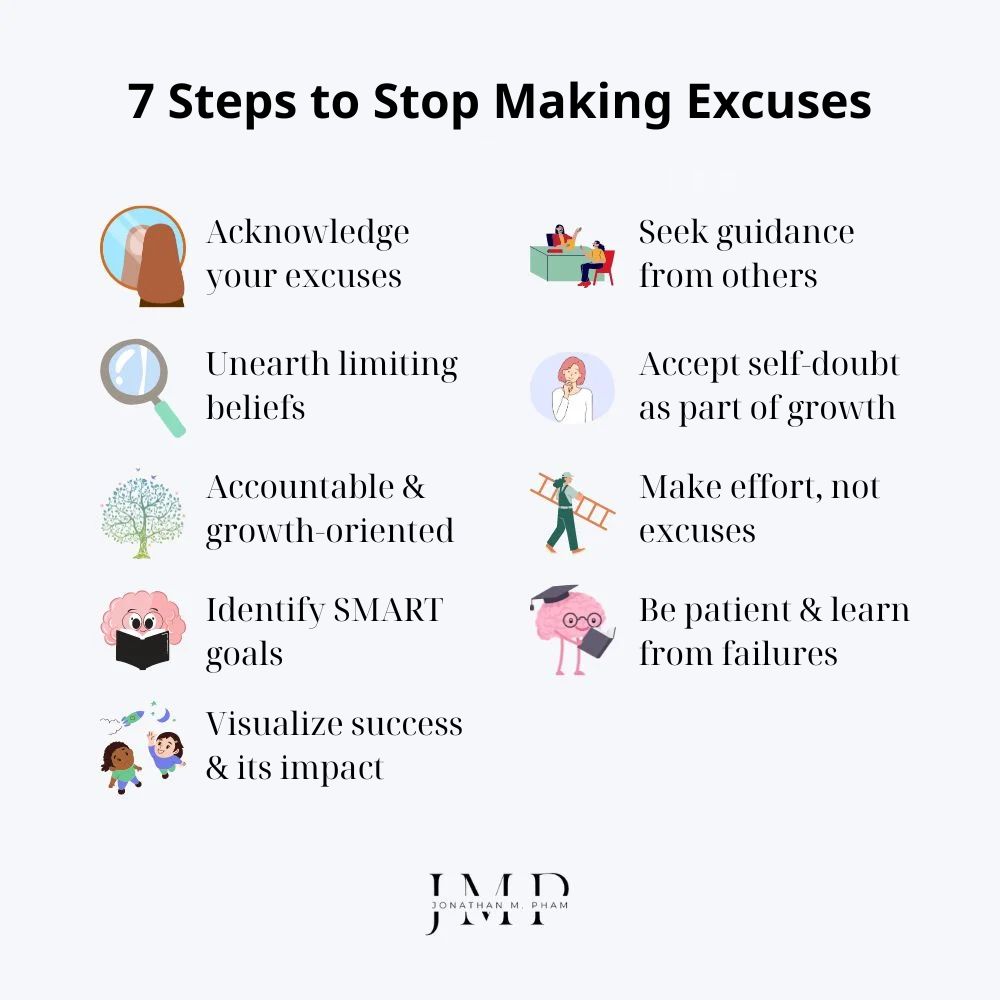
The initial step in overcoming any detrimental habit is to identify it. Take the time to compile a list of the excuses you frequently make and reflect on the underlying reasons behind them.
Once you have identified common scenarios when you tend to weasel away from responsibilities, it’s time to scrutinize the validity of your actions. Question whether these excuses hold true or if they are merely self-imposed barriers. Assess whether they are serving any constructive purpose in your life.
The next thing to do is to dig deeper to uncover the limiting beliefs that are hindering your progress towards your goals. Challenge these beliefs and replace them with empowering thoughts that bolster your personal growth and pave the way for success.
Our mindset plays a crucial role in shaping our actions. In order to start abandoning the habit of making excuses, you need to first believe in your capabilities and adopt a positive outlook. View obstacles as opportunities for growth and focus on solutions rather than dwelling on limitations. Shift your perspective from what you can’t do to what you can do and how you can overcome challenges.
Take ownership of your life and the choices you make. Refrain from placing blame on others or external circumstances for your failures or shortcomings. Instead, acknowledge your mistakes, learn from them, and use them as stepping stones toward improvement.
Establish specific, measurable, achievable, relevant, and time-bound goals. Clear and realistic objectives provide you with direction and motivation to stay on track.
Whenever faced with the temptation to make excuses, remind yourself of your goals and the reasons why you aspire to achieve them. Keep your objectives at the forefront of your mind, serving as a constant source of motivation.
Consider breaking down your goals into smaller, actionable tasks. This approach ensures that you do not feel discouraged by the complexity or difficulty of your objectives. Additionally, it also allows for progress tracking and celebrating achievements along the way.
Envision yourself successfully accomplishing your goals and immerse yourself in the positive emotions associated with that achievement. Visualizing your success boosts confidence and ignites the motivation needed to take action.
Identify those (ideally in your network) who have achieved what you aspire to accomplish or have overcome similar challenges. Learn from their experiences and strategies, applying them to your own situation. If possible, seek their advice or support.
Having a coach/ mentor or an accountability partner is extremely conducive to speeding up your professional journey – as they will help provide the necessary support and hold you accountable for your own actions.
Self-doubt is a natural part of the growth process. Rather than allowing it to paralyze you, embrace it as motivation to improve and prove your own reservations wrong.
Action is the antidote to excuses. Avoid mere talk and initiate meaningful steps toward your goals. Progress is only possible through consistent action.
Along the way, make sure to acknowledge and reward yourself when possible. Celebrating your successes reinforces your motivation and helps maintain your focus.
You have to understand that breaking the habit of making excuses takes time and effort. Do not fear failure; it is an inevitable part of growth. Learn from your mistakes, adjust your approach, and keep moving forward.
Remember, perseverance is key. Do not be disheartened if you stumble on your path. With determination and continued effort, you will ultimately succeed in overcoming excuses and achieving your goals.

On the other side, when faced with a colleague or friend who consistently resorts to making excuses, it’s important that you approach the situation with care and effectiveness. Here are some valuable tips for navigating these conversations:

It is better to offer no excuse than a bad one.
George Washington
Never make excuses. Your friends don’t need them and your foes won’t believe them.
John Wooden
We have forty million reasons for failure, but not a single excuse.
Rudyard Kipling
A man can fail many times, but he isn’t a failure until he begins to blame somebody else.
John Burroughs
Difficulty is the excuse history never accepts.
Edward R. Murrow
It is wise to direct your anger towards problems – not people, to focus your energies on answers – not excuses.
William Arthur Ward
Hold yourself responsible for a higher standard than anyone else expects of you. Never excuse yourself.
Henry Ward Beecher
It is wrong and immoral to seek to escape the consequences of one’s acts.
Mahatma Gandhi
The difference between a successful person and others is not a lack of strength, not a lack of knowledge, but rather a lack of will.
Vince Lombardi
Don’t excuse yourself by saying, ‘Look, we didn’t know.’
Proverbs 24:12
These books offer different perspectives on the topic of making excuses and how to overcome this habit. They provide practical advice and strategies that you can leverage to start living an owned and fulfilling life.

Making excuses is a common but detrimental habit that limits our progress and hinders our ability to achieve our goals. By cultivating self-awareness, challenging our assumptions, and taking proactive steps toward change, we can break free from this destructive cycle.
True success is achieved only when we dare to take responsibility for our actions, confront challenges head-on, and refuse to let excuses define our journey. The choice is ours to make.
You may be interested in:

A long time ago, in a provincial town far, far away… There was a wealthy, cynical landowner named Fyodor Pavlovitch Kara [...]

Let us visit a fictional place: The Village of the Valley. Once upon a time, those who lived there were divided into two [...]

Has this ever happened to you? Let’s say you are suffering from a frustrating health issue, or stuck in a chaotic life d [...]