


0808
Personal Philosophy: What is Your Truth & Stance for Living?
A long time ago, in a provincial town far, far away… There was a wealthy, cynical landowner named Fyodor Pavlovitch Kara [...]
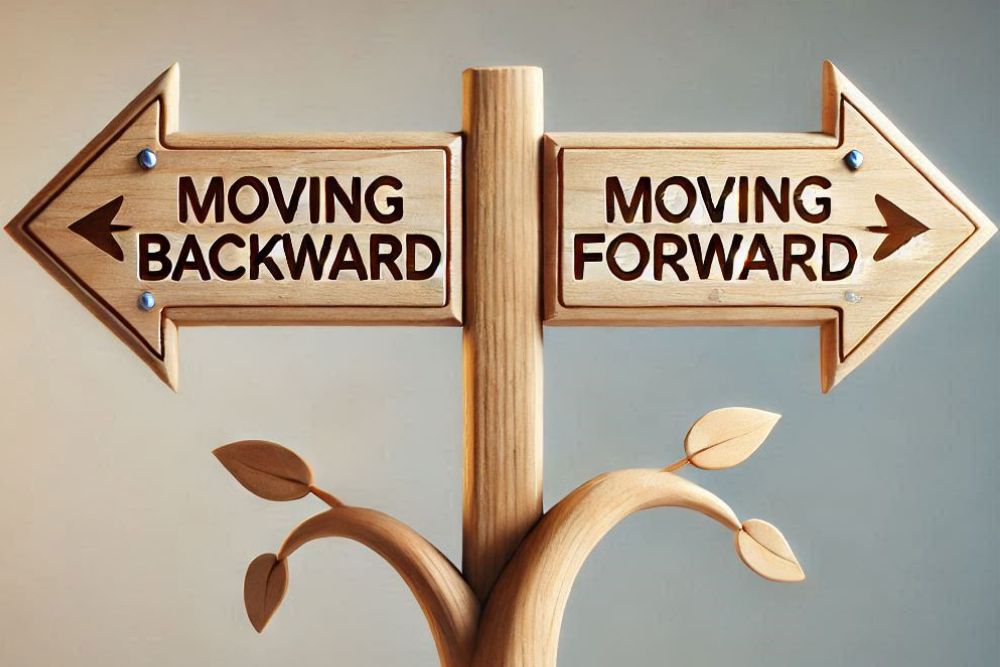
Unlike feedback, feedforward shifts the attention from the past to future possibilities – making it the superior option for behavior change.
Giving and receiving feedback has long been recognized as essential for individual and collective success. Traditionally, communication (especially in a team setting) primarily took the form of “downward feedback,” originating from top-level management. Recently, with the rise of the 360-degree assessment model came a rise in prominence of the “bottom-up” (or upward feedback) practice.
Nevertheless, whether top-down or bottom-up, the conventional feedback approach suffers from a fundamental limitation: an excessive focus on past events and historical assessments – which often causes us to overlook opportunities in the future. This has given rise to the development of a new paradigm called “feedforward.”
Highlights
The concept of “feedforward” was originally introduced by Dr. Marshall Goldsmith – renowned executive coach and leadership development expert. In the traditional feedback process, people typically receive evaluations from their superiors – who will assess their current capabilities and highlight both past accomplishments and areas that require improvement.
In contrast, the feedforward approach replaces the conventional positive-negative assessment with a set of proposed solutions. In other words, it places a primary emphasis on future growth – rather than dwelling on the past.
For instance, instead of reiterating customer service issues (feedback), the management provides guidance to their direct reports on how to handle complaints more professionally in the future (feedforward).

Feedback in the form of grades is the ultimate restraint: The grade can’t be changed, the lesson can’t be relearned, and numbers and letters don’t spell out a way forward.
Joe Hirsch
Traditional feedback often places a strong emphasis on past events. As a result, it suffers from 3 major drawbacks:
When people receive negative input concerning aspects beyond their control/ ability to change, it triggers the release of cortisol – the stress hormone – in the brain. This physiological response activates the perception of threat, causing them to experience a heightened level of anxiety and adopt a defensive stance.
As noted by Hirsch, when that happens, key cognitive functions responsible for decision-making and logical reasoning may enter a state of paralysis, impeding thoughtful and prudent action,
Traditional feedback predominantly revolves around scrutinizing past performance – often at the expense of future development strategies. When adhering strictly to a set of agreed standards – without taking into consideration personal differences, we veer ourselves away from the primary purpose of feedback: to foster positive, long-term growth.
Being confronted with mistakes beyond one’s capacity to rectify often results in a sense of powerlessness. Rather than being motivated to improve themselves, people may be prone to believe that similar issues will recur in the future. Such a negative self-perception is among the reasons why we fail to keep up with our aspirations for personal growth.
Indeed, numerous studies have demonstrated that feedback, despite its perceived effectiveness, frequently falls short of expectations. For instance, a poll by Gallup found that only 26% of employees perceive feedback from their superiors as conducive to enhancing their productivity.
| Feedback | Feedforward |
| Affirms what people already know | Promotes talent growth |
| Pointing out problems | Thinking about solutions |
| Vague | Specific |
| To judge | To help |
| Focus on measurement | Focus on the plan for change |
| Top down | Dynamic |

Feedforward vs Feedback
Source: Cult of Pedagogy
Over the years, Dr. Marshall Goldsmith has observed more than 30,000 leaders engaging in a captivating experiential exercise – in which participants are required to assume two different roles:
This exercise typically takes 10-15 minutes, during which an average participant may engage in approximately 6-7 dialogue sessions. First, they have to complete the 5 steps listed below.
When everyone is finished, it’s time to proceed as follows:
Upon concluding the exercise, participants are invited to select a single word encapsulating how they feel regarding the overall experience.
Most of the time, the majority of responses are positive – including words such as “excellent,” “inspiring,” and “beneficial.”
Read more: 20 Bad Habits in Life that Prevent Long-term Success
According to Dr. Goldsmith, feedforward is ultimately the superior option compared to conventional feedback – due to the following reasons:
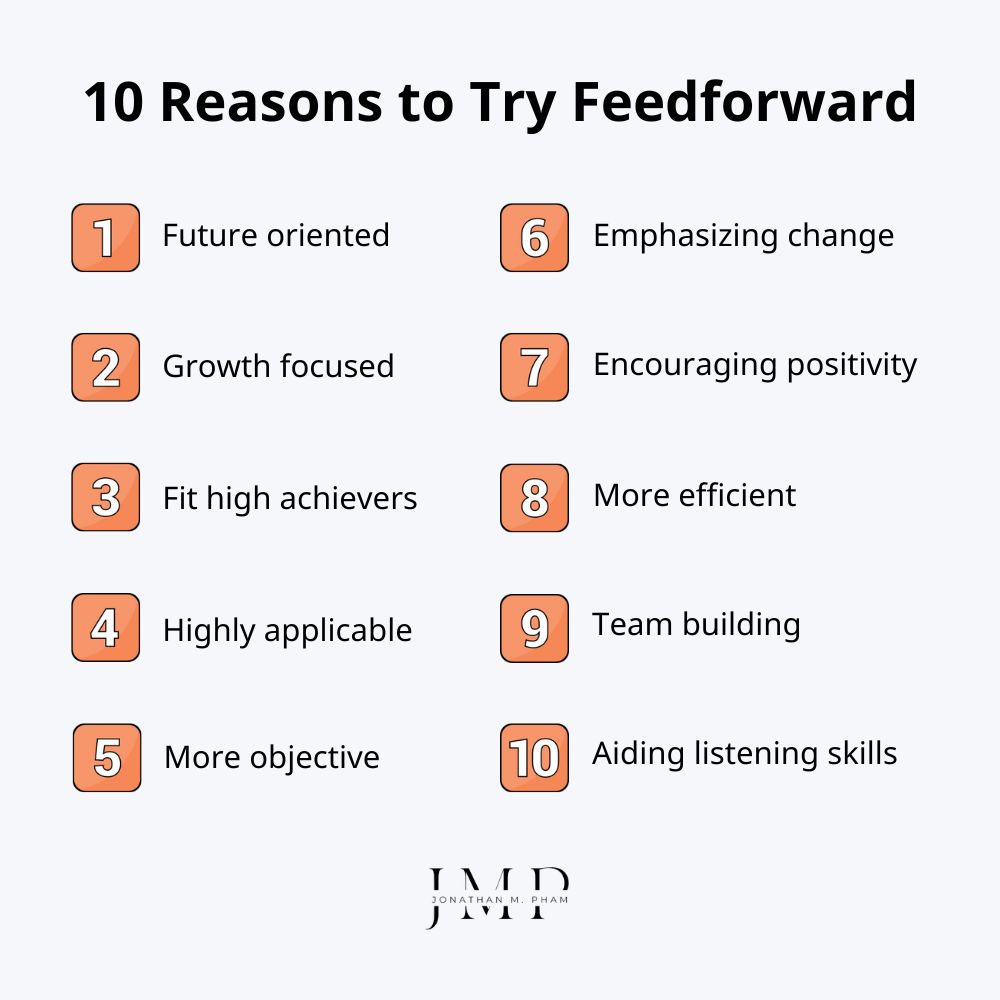
The past is the past; nothing about it can be changed. While we can learn a lot from it, there’s no point in dwelling too much on what has already happened. That’s where feedforward comes in – it shifts our attention toward the future, where possibilities await, thereby enabling us to adopt a more positive outlook.
The practice of providing feedforward is highly relevant in fields such as athletic training. For instance, high-speed racers are consistently instructed to:
Focus on the road, not the wall.
Similarly, basketball players are coached to mentally trace the trajectory of the ball and visualize the perfect shot. Encouraging people to contemplate opportunities – rather than challenges – fosters self-assurance, positivity, and preparedness for achieving success.
Feedforward prioritizes facilitating people’s personal growth over assessing mistakes – making it a much more impactful approach to guide others toward the “right” path.
As previously mentioned, feedback that excessively pinpoints errors triggers defensiveness and causes both parties to suffer from negative emotional reactions (hence diminishing overall effectiveness). No matter how constructive an input is, the result is the same. As such, one should always strive to discuss solutions that can be implemented right away.
What’s great about feedforward is that the whole focus is on helping each other – NOT judging each other.
Marshall Goldsmith
Successful people are known for their strong sense of self – they are generally more receptive to ideas that align with their goals, rather than those that drive them away from such aspirations. Feedforward, as a constructive approach, resonates really well with these individuals.
We all have the tendency to embrace ideas that align with our self-perception – while dismissing anything that contradicts it. Consequently, feedforward stands out as a particularly fitting method of communication when it comes to giving and exchanging input.
Read more: The Excessive Need to Be Me – When the Ego Takes Over
Unlike traditional feedback, feedforward does not require one to have previous experiences with the individual being assessed. Therefore, one doesn’t need to consult with people who are in their close network and can instead seek input from diverse sources – which enables them to benefit from potentially unexpected insights.
Here is an example. Let’s say you would like to improve your listening skills. In that case, virtually any leader is capable of providing guidance based on their own experiences – without the need for them to get to know you first.
Just like coaching, feedforward does not require us to have a deep knowledge of the person – or that we need to be better/ superior to them.
Theoretically, feedback should only center on accomplishments rather than the individual themselves. That said, it is often not the case in the real world, where people frequently hand out highly sensitive comments to others.
Our sense of personal identity is closely correlated with our own achievements – this is particularly true among those who have achieved a certain level of success in life. Thus, it is very challenging for one to share entirely objective input with such people.
That is where feedforward comes in – its focus is exclusively on future-oriented discussions, completely free from subjective commentaries. As such, communication is typically very objective, and the risk of one’s comments being perceived as a personal attack is extremely low.

One compelling benefit of feedforward lies in its emphasis on the potential for positive change – rather than revisiting past failures. This forward-looking perspective is key to empowering people to unlock their capabilities and strive for improvement.
Negative feedback often precipitates a descent into a quagmire of pessimistic thinking – such as: “That’s all I can do.” In contrast, feedforward stems from the assumption that everyone possesses the capacity for positive transformation.
Let’s say you’ve just delivered a presentation that didn’t quite meet the expectations in front of the board of directors. Rather than criticizing your performance, the manager opts to provide input on how to enhance the structural coherence of your future presentations.
Can you see the differences in terms of impact?
Even though the problem is still there, the manager has made it easier for you to internalize his messages – by talking about things in a positive light. Now you have the motivation to move forward and improve yourself, rather than feeling uncomfortable with your mistake!
Imagine you are presenting in a meeting like this:
“Here are four ideas for the future. I encourage everyone to approach them with the utmost positivity. If you find two of them aligning with your vision, please focus on those two and disregard the rest.”
In doing so, you essentially eliminate the need for time-consuming idea evaluation. Without the need to judge others, the meeting atmosphere suddenly becomes much more positive for everyone involved.
That is what happens when we practice feedforward. Not only encouraging a forward-thinking approach, it also helps eliminate the time-consuming process of assessing ideas – thereby fostering a positive environment for idea exchange.
Feedforward does not position us as an “expert” who is here to judge – rather, we are a “companion” who is trying to help others. As a result, people are much more inclined to engage in open conversations – which are essential to facilitating the development of more harmonious and efficient teams.
Practicing feedforward makes us become better listeners – it shifts the focus from reacting to receiving. Instead of trying to formulate a well-reasoned response in mind while others are still speaking, we now focus on absorbing and learning from their sharing.
Read more: Not Listening – The Silent Killer of Relationships and Success
Read more: Not Saying Thank You – Why We Fail to Express Gratitude
Check out a full list of feedback quotes here!
Given the complexities of interpersonal relationships these days, it is crucial that one adopts a future-oriented mindset rather than being obsessed with what has happened. In light of this truth, we need to adopt the practice of feedforward when it comes to input exchange – and shift the focus from past shortcomings to future possibilities.
Other resources you may be interested in:

A long time ago, in a provincial town far, far away… There was a wealthy, cynical landowner named Fyodor Pavlovitch Kara [...]

Let us visit a fictional place: The Village of the Valley. Once upon a time, those who lived there were divided into two [...]

Has this ever happened to you? Let’s say you are suffering from a frustrating health issue, or stuck in a chaotic life d [...]