




0808
Personal Philosophy: What is Your Truth & Stance for Living?
A long time ago, in a provincial town far, far away… There was a wealthy, cynical landowner named Fyodor Pavlovitch Kara [...]
Discover the art of asking for help – the first step to visualizing positive changes & living an earned life filled with fulfillment!
Self-sufficiency is often celebrated as a virtue in our current world – no wonder why many of us have developed a blindly independent mindset and refused to seek assistance from others. As simple as it is, asking for help is the first step to visualizing positive changes and living an earned life filled with fulfillment.
Highlights
Asking for help is a way of expressing your needs and seeking assistance from those who are capable of providing you with the necessary support/ guidance. A fundamental yet quite often overlooked aspect of interpersonal interactions, it is an act that transcends mere words or actions – for it embodies vulnerability, strength, and the essence of our interconnectedness as individuals.
At its core, asking for help means admitting our own limitations – that we cannot always do everything alone, that life often presents us with challenges beyond one single person’s capacities to handle, and that you are willing to reach out to others for support. Such humility is the foundation upon which personal growth may take place.

Asking for assistance
The best advice I can give to anyone going through a rough patch is to never be afraid to ask for help.
Demi Lovato
Asking for help is quite often interpreted as a sign of weakness; while it is, in fact, a manifestation of inner strength. It takes courage to lower the guard we often put up to protect our self-pride. In doing so, we reveal our authenticity – an inherent form of strength. Being vulnerable enables us to connect with others on a deeper level, as it demonstrates our shared humanity and imperfection.
By reaching out to others, you are essentially saying that you trust them enough to let them into your world, to share your concerns, and to rely on their expertise or support. This trust serves as the basis for meaningful connections in life. Additionally, it enables us to appreciate and embrace the value of cultivating gratitude in life.
We cultivate love when we allow our most vulnerable and powerful selves to be deeply seen and known, and when we honor the spiritual connection that grows from that offering with trust, respect, kindness, and affection.
Brene Brown
In requesting assistance, we expose ourselves to new ideas and insights. Whether it’s seeking professional advice, guidance from a coach/ mentor, or a comforting word from a friend, asking for help widens our perspective and reveals solutions we might never have considered on our own.
At the same time, the act also provides us with the opportunity to refine our own self-esteem and become a more confident person.
For me, being vulnerable is asking for help from other people whatever it may be.
Mason Jennings

The art of asking for help
Why do we struggle asking for help?
This might surprise you, but even I often find myself falling victim to the very thing I’m advocating for. There has always been a part of me that wants to be the ultimate problem-solver, the one who can handle anything thrown their way. This often translates to me spending hours wrestling with a task I don’t fully understand, rather than taking five minutes to explain the situation to a colleague.
It’s a strange mix of not wanting to bother anyone and a deep-seated desire to prove my independence. In fact, one of my previous managers used to joke that my “independent contractor” mentality wasn’t helping teamwork.
Perhaps there’s a kernel of truth in that.
For instance, I remember one time spending an entire day trying to decipher the coding of a client’s website, even though I am not a coder myself (though I do have some technical expertise). Finally, out of sheer frustration, I reached out to a tech-savvy friend. The solution he offered was embarrassingly simple, and it took him just two minutes to explain.
It was a classic case of me stubbornly trying to go it alone – when a quick question could have saved me hours of wasted effort!

Psychology of asking for help
For many of us (including me), reaching out for assistance proves to be quite a daunting task, often due to the psychological barriers that stand in the way:
This is particularly true within the current society/ workplace – in which self-reliance and independence are frequently exaggerated as traits of successful people. The prevalence of people passing judgment makes us reluctant to seek advice, even when it’s evident that doing so would be beneficial. In fact, research has found that this fear of being vulnerable can be observed in kids as young as 7.
People tend to overestimate how likely their direct request for help would be rejected by others.
Xuan Zhao, Social psychologist from Stanford University
Some of us may be troubled by past negative experiences, in which our pleas for help were replied to with silence, humiliation, or even betrayal. As a result, we refuse to extend our hand to others, even in situations when the stake is high. In such cases, it’s crucial to acknowledge that past rejections do not define our worth or our growth potential.
According to a study published in the Psychological Science journal, 2000 participants were involved in 6 experiments conducted to learn more about people’s tendency to ask for help. The result: those requesting help consistently underestimated the willingness of both friends and strangers to provide assistance, as well as the positive emotions experienced by those who lent a hand to them. This misalignment in expectations is defined as an explanation of why we are deterred from seeking support.
Despite our tendency to worry that people won’t help, studies have shown they’re more willing than we think! Helping others makes them feel good, and asking for support can actually strengthen connections.
Don’t let your inner critic stop you – people appreciate being asked for advice and won’t judge you for requiring assistance!
Asking for help requires us to acknowledge our own limitations – that we don’t have the answers to every problem. Such an act of vulnerability is uncomfortable and anxiety-inducing for many, especially those in leadership positions and those who have reached a certain degree of success in life.
Successful people tend to have a very high sense of infallibility, which makes it extremely challenging for them to perform an act of vulnerability like requesting assistance. Doing so would mean surrendering their control – and facing the risk of being perceived as less competent in the eyes of others.
You should acknowledge that judgment for asking for help comes from within, not from others.
Daniel Galletta
We all need help and it’s okay.
Dr. Marshall Goldsmith
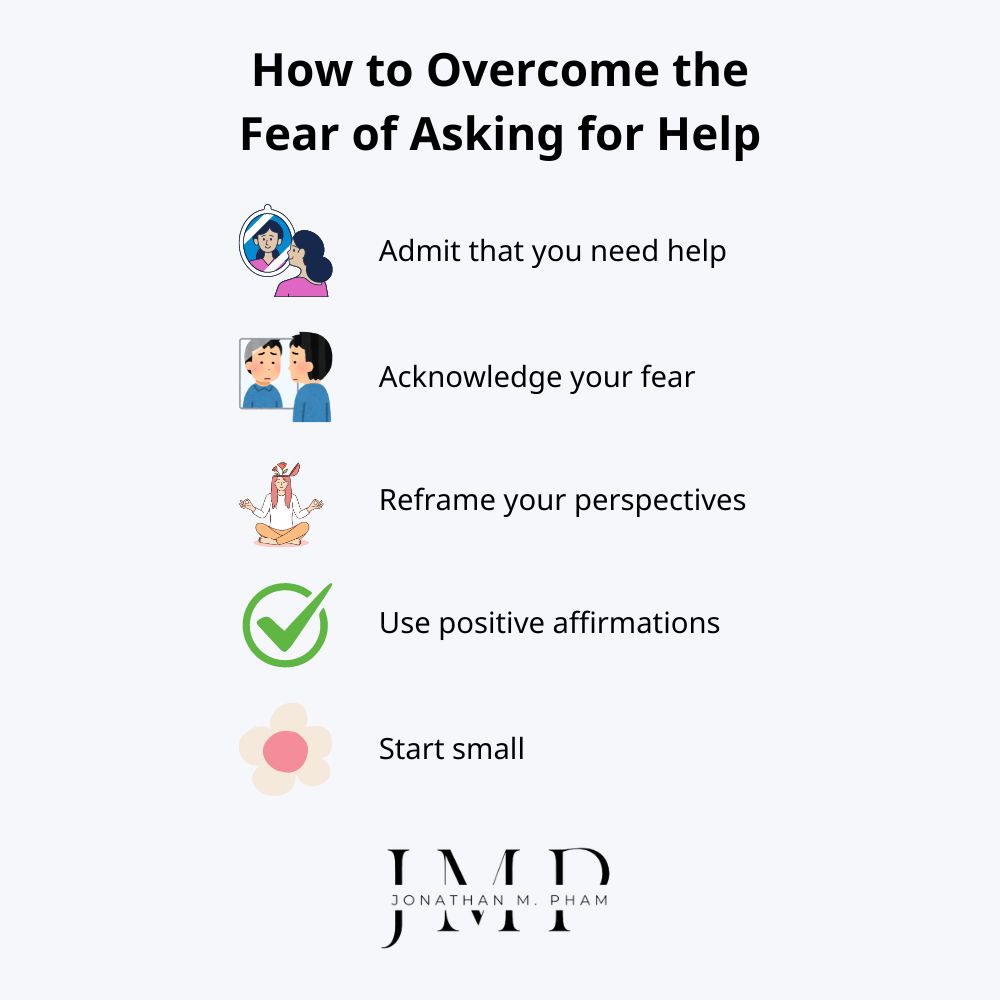
The first and foremost condition to overcome the fear of asking for help is to realize that everyone – regardless of their capabilities or achievements – inevitably requires assistance at various points in life. Such realization is a fundamental step to shifting your mindset from deeming the act as a weakness to understanding it as a universal aspect of human existence.
Embracing the fact that we all need help fosters the courage to seek assistance when needed. In fact, even highly successful people are not exempt from this sobering truth. For instance, the co-founder of Apple, Steve Jobs, was known for his perfectionism and strong vision. However, he also knew the value of collaboration. As a result, he surrounded himself with talented people and wasn’t afraid to ask for their expertise to achieve his ambitious goals.
Read more: Understanding Yourself – Roadmap to a More Authentic YOU
Once the first step is done, it’s time to look into the reason behind your refusal to seek assistance and then come up with strategies for overcoming it.
Here is an exercise to help you out. Every day, look through these questions and ask yourself:
This daily practice of self-questioning will provide the chance to retrospectively identify your own barriers, laying the necessary foundation for change.
Read more: 200 Self-reflection Questions – Toolkit for Life Pilgrims
Once you have identified your fear, it’s time to challenge its validity. For instance, if you are afraid of being seen as incompetent, remind yourself that everyone makes mistakes, and asking for assistance demonstrates humility and a willingness to learn.
In addition, it is recommended that you shift the focus from the negative aspects of reaching out for support (e.g. being rejected/ deemed as incompetent) to the positive ones. Think about the relief of getting things done, the potential to learn something new, or even the chance to cultivate stronger relationships!
If you still find yourself struggling to muster the courage to reach out to others, consider making use of positive affirmations. For example:
Repeat the above phrases to yourself constantly, and you will gradually build up the confidence necessary when it comes to asking for help.
Read more: Learning to Love Yourself – 16 Handy Tips for Fostering Self-esteem Every Day
If the idea of seeking assistance on a significant project or task feels overwhelming, let’s take it slow. Start by breaking down the task into manageable parts, and ask for help with a specific aspect or question. Make sure each part has a clear goal and is achievable within a reasonable timeframe.
For example, let’s say you’re working on a presentation for a new marketing campaign, but feeling lost on how to best present the data. Instead of seeking support with the whole presentation, it’s better to make a more manageable request like:
“I’m working on the data visualization section of the marketing presentation, but I’m not sure what chart type would be most effective. Do you have any suggestions?”
As you gain confidence from successfully requesting help in these smaller instances, you will gradually become more comfortable doing the same thing later within more complex situations.
Asking for assistance
Recognizing the right moments to seek assistance is crucial to facilitating productivity, improving relationships, and nurturing personal growth. Here are some key situations when it’s advisable to reach out to others:
There’s no shame in admitting that you don’t have all the answers. When you encounter a problem or challenge that you can’t resolve on your own, seeking help is a wise choice to save time and frustration – while also promoting problem-solving and collaboration.
Life is overwhelming at times, whether it’s due to work, personal issues, or other commitments. Asking for help at such moments will provide you with the emotional support and practical assistance necessary to regain balance and manage your responsibilities effectively.
For example, imagine you’re dealing with a family emergency on top of a busy work schedule. In such situations, don’t hesitate to ask your loved ones for support. It could be anything from requesting help with childcare to simply having a friend lend a listening ear. By sharing the burden, you may free up some mental space and emotional energy to navigate challenging times.
A desire to expand your knowledge or develop new skills is a perfect reason to seek help. Whether you want to learn a new language, master a musical instrument, or delve into a complex topic, seeking guidance from experts or mentors can significantly accelerate your learning journey.
Sometimes, you may find yourself lacking the necessary resources, whether it’s time, money, tools, or materials, to complete a task or achieve a goal. Asking for help can help bridge these resource gaps and increase your chances of success.
For instance, let’s say you’re passionate about a personal project but lack the budget to bring it to life. This is where seeking support can be truly resourceful. You could explore crowdfunding options, look for grants or scholarships, or even barter skills or services to acquire the necessary materials. Don’t be afraid to get creative!
Certain tasks or projects are simply too large or complex for one person to handle effectively. In such instances, collaborating with others is essential to produce better outcomes and ensure a more efficient use of resources.
Requesting assistance is an excellent way to foster trust and build strong relationships with others. It shows that you respect their expertise and value their contributions, thereby leading to mutually beneficial partnerships and collaborations.
If you want to make a friend, let someone do you a favor.
Benjamin Franklin
Personal growth and self-improvement often require external support. Whether you are working on breaking a bad habit, improving your physical fitness, or addressing a personal challenge, asking for help from friends, family, or professionals is a crucial step toward positive change.
For example, maybe you’re determined to kick your bad habit of procrastination. While willpower is important, having a support system can make a world of difference. As such, consider asking a friend to become your accountability partner, checking in with you regularly and offering encouragement. You could also explore online support groups or apps designed to help people abandon harmful behaviors!
Strength comes from vulnerability. You have to ask the question to get the answer, even though asking the question means you didn’t know.
Majid Kazmi

Ask for support when you need it
Read more: Healing Your Inner Child – A 15-step Guide
Asking for help in the workplace
Struggling to ask for help? Here are some ways to approach it, depending on the situation:
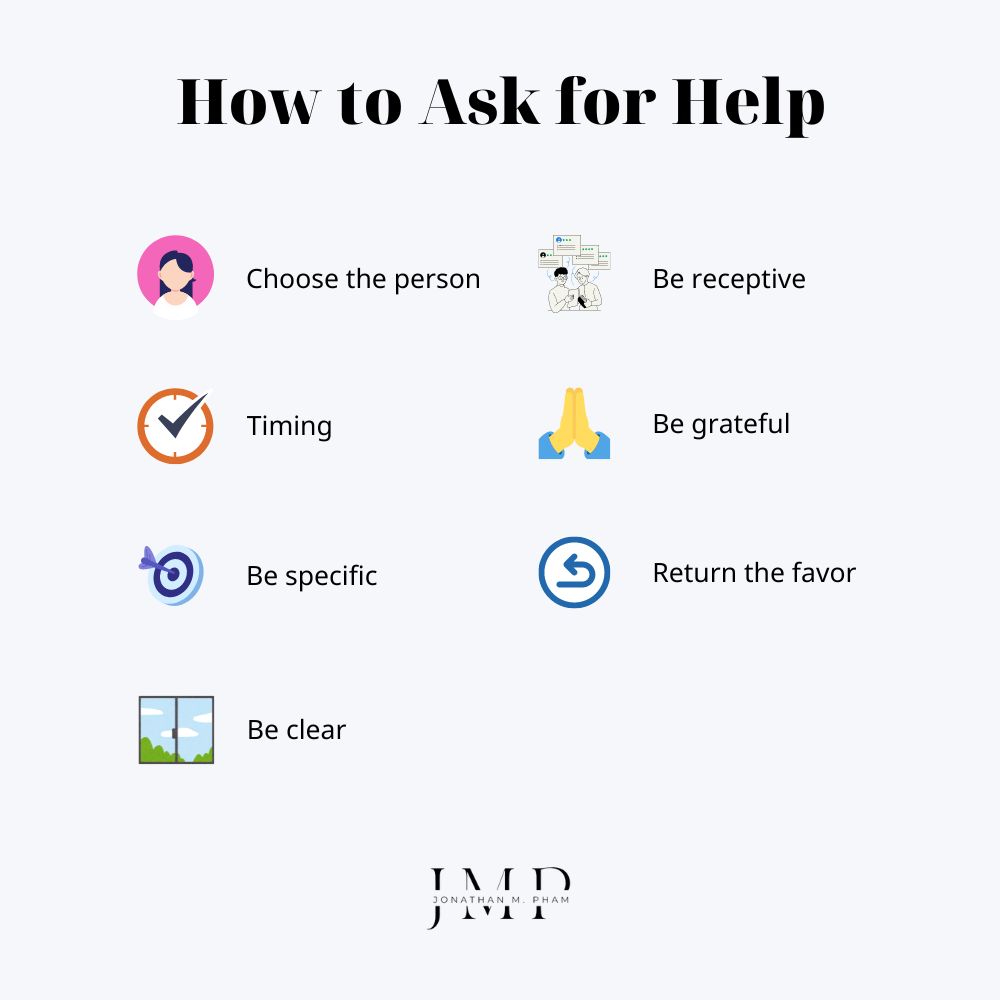
Consider who has the expertise to best assist you with your specific request. Do they have a track record of dealing with similar issues? Are they realistically able to help you right now?
Example:
Don’t be afraid to reach out for support as soon as you encounter a hurdle. A quick question can prevent a bigger issue down the line.
That being said, before approaching someone, make sure to gauge their workload and stress level. Are they rushing to meet a deadline or swamped with emails? If that’s the case, it might be better to wait for a calmer moment. If the issue requires more in-depth discussion, consider suggesting a specific time to meet that works for both of you.
Precision is crucial to successfully seeking assistance from others. Clearly articulate what you need help with, providing context and details. For example, instead of saying, “Can you help me with this report?” you could say, “I need assistance proofreading this report for grammar and formatting errors.”
The more specific you are, the easier it is for others to assist you.
In addition to being specific, make sure to communicate your expectations and the desired outcomes, so that it becomes easier for others to align their efforts with your objectives. For instance, instead of “I’m stuck on this problem”, try something like:
“I’m stuck trying to calculate the area of a triangle. I know the base is 5 cm and the height is 3 cm, but I can’t figure out the formula to get the area. Can you help me walk through it?”
Sometimes, providing a little information about the context may go a long way in landing you the assistance you require (e.g. you may explain what you’ve already tried or mention any deadlines associated with the task at hand).
Being coachable is a critical component of asking for help. Most of the time, people will come up with insights/ approaches that may be different from or completely contrary to your way. In such cases, make sure to be receptive to feedback and ready to embrace others’ perspectives.
If something is unclear or if you don’t understand the suggested approach, don’t be afraid to ask clarifying questions.
Asking for help with shame says: You have the power over me. Asking with condescension says: I have the power over you. But asking for help with gratitude says: We have the power to help each other.
Amanda Palmer
Always express gratitude for the help you receive. A simple “thank you” can go a long way in acknowledging the time and efforts one has dedicated to assist you. At the same time, you may also consider writing a thank-you note or email, especially for significant help.
Gratitude not only shows appreciation but also lays the foundation for positive and supportive relationships.
Read more: Not Saying Thank You – Why Do We Often Fall Into This Bad Habit?
Depending on the situation, you might be able to offer something in return for others’ assistance, such as your time, expertise on another topic, or a favor. Even if you cannot afford it, be mindful of future opportunities to help the person who assisted you.
Rules for asking for help

Asking for help activities for adults
Asking for help is a sign of strength, not weakness. But sometimes, despite our best efforts, the answer might be “no”. That’s perfectly okay and doesn’t mean that we should give up! Here’s how to navigate this situation productively.
First, take a deep breath and try to see things from the other person’s perspective. Perhaps they’re swamped or lack the specific expertise you need. Understanding their situation fosters empathy and helps you avoid taking it personally.
If appropriate, consider rephrasing your request. Be clear and specific about what you need. Did you overlook an alternative solution you could offer alongside the help you seek? If, after this, you still hear “no,” graciously accept it. There’s no point in dwelling on it!
Remember, a dead end with one person can be the starting point with another. This “no” might be the nudge you need to explore new resources or get creative in finding a solution. Don’t be discouraged by the first hurdle. Instead, keep asking until you find the right person to help you move forward!

Do not feel guilty asking for help
Asking for help isn’t a sign of weakness, it’s a sign of strength. It shows you have the courage to admit when you don’t know something, and to learn something new.
Barack Obama
When you judge yourself for needing help, you judge those you are helping. When you attach value to giving help, you attach value to needing help. The danger of tying your self-worth to being a helper is feeling shame when you have to ask for help. Offering help is courageous and compassionate, but so is asking for help.
Brené Brown
Nothing makes one feel so strong as a call for help.
Paul VI
Asking for other’s guidance helps you see what you may not be able to see. It’s always important to check your ego and ask for help.
Ken Blanchard
There is no better way to give someone the opportunity to feel good about themselves than to ask them to help you.
Heidi Grant
Ask for help. You need it more than you know.
Marshall Goldsmith
Help will always be given to those who ask for it.
J. K. Rowling
Ask, and you will receive; seek, and you will find.
Matthew 7:7
Asking for help is a profound act. It is a testament to one’s strength, an acknowledgment of one’s vulnerabilities, and a means of fostering connections with others. As we navigate the complexities of life, let us remember that reaching out for support is not just a practical choice, but a powerful step towards self-improvement and a life filled with fulfillment!
Other resources you might be interested in:

A long time ago, in a provincial town far, far away… There was a wealthy, cynical landowner named Fyodor Pavlovitch Kara [...]

Let us visit a fictional place: The Village of the Valley. Once upon a time, those who lived there were divided into two [...]

Has this ever happened to you? Let’s say you are suffering from a frustrating health issue, or stuck in a chaotic life d [...]